Monday, April 23, 2007

Are you an EXTREME Talker?

Want to lose credibilty really fast? Talk in extremes.

Here's an example. I was just reading a white paper on performance management. I was engaged and thinking "this is really good stuff." Then I came across this sentence:

"Training never provides managers with the practical tools they need to set clear objectives with their teams."

What's wrong with the word "never"?

Subconsciously, the word just begs to be refuted. As soon as I see or hear an "extreme" word like never (or always, or nobody), I immediately try to think of a contradiction. (Perhaps this is my contrarian nature...am I the only one who thinks this way?)

There are very few things in life that are absolute, so words like "never", "always" or "nobody" should be used cautiously and sparingly. When you do use them, be aware that other people may, like me, question your credibility and become distracted.

Here are some scenarios that demonstrate credibility-damaging extreme talking, and alternative statements that give speakers more credibility.


Scenario 1:

Salesperson says: "We've never had an unhappy customer."
Customer thinks:
"Oh really...I don't believe you. NEVER?"

Alternative:

Salesperson says: "Our customer surveys show that they're are happy with our work. We score a 9.5 out of a possible 10 average."


Scenario 2:

Manager says: "Remember that the customer is always right."
New customer service rep thinks: "Gimme a break!"

Alternative:

Manager says: "Even if we disagree with customers, we must still be
respectful and try to make them happy."


Scenario 3: (During a product development meeting)


Team member: "Nobody will ever use that technology!"
Rest of team:
"We can think of lots of people who WOULD!"

Alternative:

Team member: "I'm sure there will be some customers who would adopt this technology. My concern is that there won't be enough volume, and the price point won't be high enough, to justify our investment."

© 2006 The Loyalty Group. All Rights Reserved.

Thursday, April 12, 2007

How to Drive Your Clients Crazy

Dear Fellow Consultants,

How many times have you said, "My clients are driving me CRAZY!"? Well, now you can get them back - give them a taste of their own medicine - by driving them crazy. Read below to discover the secrets all good consultants know. These are our top four ways to bug the hell out of your clients.


  • Pepper your conversations with "consultantisms": A recent article in Consulting Times (page 10) cites a survey listing the most annoying phrases used by consultants. Topping the list were: going forward, leverage, core values, on the same page, paradigm (my PERSONAL unfavorite) and synnergy. Use these at every opportunity, even in your personal life.

  • Maximize complexification: Take a really simple concept and make it sound difficult and complex. Watch your clients nod their heads, as if they understand. They probably won't ask what you mean, so you're off the hook to explain yourself.

  • Dazzle em' with longer words and sentences: According to Language Monitor, there were approximately 988,968 words in the English language as of March 21, 2006. So why not use as many as possible? Instead of saying "before," why not say, "prior to"? Instead of saying "use," say "utilize". Why use the word "to" when you can say "in order to"? Instead of talking about change, why not talk about "shifting paradigms"? (This is a bonus because you're using one of the top annoying words!) When strung together, you can create one long sentence that will leave your clients scratching their heads. For example, Prior to the utilization of technology to manage shifting paradigms, aligning intangible organizational requirements with nebuluous customer-defined specifications in order to capitalize on opportunities had been challenging. (Say what?)

  • When questioned, go on the attack: After all, you are the expert. Your clients hired you because you're smart and you know more than them. Don't let them threaten your credibility by asking you questions or challenging your recommendations. If you back down, you'll be perceived as weak. Instead, show your superiority by going on the offensive. Make sure to point out how long you've been in the business and your past successes ("I've been doing this for a million years." "When I invented the Internet...") If that doesn't get them to back down, act indignant and suggest that "if they don't trust you, maybe we shouldn't work together." They should be crawling back in no time.

A personal disclaimer: We at The Loyalty Group, Los Angeles, pride ourselves on keeping things simple and straight-forward. This blog entry does not reflect our approach, philosophy or practices. We love and respect our clients!

© 2006 The Loyalty Group. All Rights Reserved.

Thursday, April 05, 2007

Is "Social Networking" Impacting Performance Management at Your Company? (Maybe It Should Be...)

Social networking (Facebook, MySpace, Twitter) is impacting your workplace, whether you realize it or not.

According to a GenY article in Workforce, Gen Y'rs (born between 1979 and 1994) will number 80 million - versus about 77 million Baby Boomers and 44 million Gen X'rs. In other words, as more Boomers retire, our corporations' cubicles and meeting rooms will be filled with young, tech-savvy workers, many of whom had MP3 players when they were six and had their own websites when they were seven. Social networking sites have become the new roller rinks of today (OK, I'm dating myself...but in my day, we "kids" went to the roller skating rink to meet, hang out and share gossip).

Mike Gotta tackled the issue of social networking's impact on organizations on his Collaborative Thinking blog this Tuesday. It's a well-laid-out discussion of the issues and challenges posed by social networking on organizations.

I agree with Gotta's assertion that "socially oriented systems will significantly reshape organizations over the next several years." And it is already reshaping how people are managed, trained and coached in business, whether we realize it or not.

On the one hand, business is squeezed by growing legal and compliance pressure. For example, in our consulting practice (www.theloyaltygroup.com) we teach performance management and coaching skills, and it's always been a struggle to get managers to record notes on employees' performance. It's harder than ever now, because managers (HR and Legal departments too) often are afraid to put anything in writing...as it may come back to haunt them later in a legal investigation. As a result, important notes from coaching and performance discussions don't get noted, which means the value of feedback to employees is diluted (for lack of written details).

At the same time, the new generation entering our workforce is accustomed to social networking sites and reality TV, where it's completely OK to bare your soul, disclose frank (and sometimes hurtful) opinions, and share intimate thoughts in writing.

Smart companies will need to help employees and managers balance the need for security, professionalism and privacy - with today's technology and social networking culture. To strike the appropriate balance, companies should focus on:

  • Training both employees and their managers on how to talk directly to people (actually hold face to face conversations) rather than put every detail in writing.
  • Creating a strategy for how to incorporate social networking, blogging, instant messaging and other emerging technology into their business practices - from managing human resource issues, to managing projects across departments, to communicating with customers.
  • Communicating clear guidelines about the difference between appropriate "business writing" in the organization and inappropriate "personal writing" that should be kept outside the work environment.
  • Teaching managers and employees how to select the appropriate method (face-to-face, phone, instant message, email, blogging) of communication in day-to-day performance management (coaching, giving feedback, sharing information or conducting reviews).

Companies that don't pay attention to these issues will struggle with miscommunications and unhappy employees that aren't getting the feedback and coaching they need - not to mention legal challenges.

© 2006 The Loyalty Group. All Rights Reserved.

Monday, March 19, 2007

Richard Branson Shows Boredom Can Be Good

Richard Branson, the king of Virgin, gets bored easily. According to a recent blog by Gary Bourgeault, Branson channels this "problem" into a positive by "getting himself into numerous businesses that he can spread himself around in." It hasn't held him back too much.

It makes me think, what other "weaknesses" or problems can leaders turn into positives?

A recent article by Mark Thompson confirms that the ability to overcome personal challenges - or turn your weaknesses into strengths - is critical to leadership and entrepreneureal success.

- Charles Schwab was dyslexic and almost flunked out of Stanford, having failed English twice. In business, he overcame this reading problem by speaking from the heart (nixing the need for reading and writing long memos and speeches).

- Cisco CEO John Chambers was also dyslexic, so he relies on memorized speeches and interacting personally with people as much as possible.

Branson's story hits home for me. Not many people know this about me, but I failed high school and got into college with a GED. I was bored and questioned everything. I thought something was wrong with me...until I found a way to channel my "weakness" into a positive. As a consultant, it's my job to question the status quo and help solve problems. I now get paid for what I got punished for in the past. Go figure!

What is your biggest personal struggle or challenge - and how can it work for you as a strength?

© 2006 The Loyalty Group. All Rights Reserved.

Sunday, March 18, 2007

Performance Reviews: Is Nobody "Average" Anymore?

An article in the Cleveland Plain-Dealer aptly titled, "A's and B's for Everyone", just goes to show how important it is to clearly define performance expectations, measurement methods and rating scales in performance management systems. It also shows what goes awry when you don't get clear.

The article quotes surveys in which Americans rate themselves on a variety of areas. Here's a sampling of results:

- 83% percent of Americans believe they are above-average workers.

- 74% percent of American adults believe they have above-average common sense.

- 58% percent of Americans believe they have above-average IQs.

- 94% percent of university professors say they are better at their job than their average colleague.

- 60% percent of men age 20 to 39 believe they are better than average in bed. (I threw this one in just for fun.)

Either lots of people are fooling themselves, or mostly above-average people respond to these surveys.

This just goes to show you how a simple word like "average" can be perceived differently by so many people. Of course, some things are easy to prove or disprove. For example, it's not hard to find out that an "average" American IQ is between 90 and 110, so you could say you're above average if you're over 110.

What about some of the other "average" measures? In work and life, these are harder to measure objectively. Take the term "above average common sense." What does that look like - and who decides what "average common sense looks like?" Obviously 74% of us can't be above average in common sense, but who among us thinks we're better than we are?

Take this as a lesson, managers and employees. When you're discussing performance expectations at the start of your performance management cycle, remember that:

- Vague words like "average" and "better" need to be defined. How are you going to measure "average"? Better than what? And who decides what "better" looks like?

- People often think they're better than they are. Both managers and employees should be accountable for providing specific data and behavioral examples to support ratings. It's not enough to say, "I think you're below average in X area." Support your rating by saying, "Here are some examples of why I'm rating you below (or above) average."

- Make it OK to be average. Angela Hayes (played by Mena Suvani) in American Beauty, says "I don't think there's anything worse than being ordinary." Unfortunately, lots of people feel this way - and corporate cultures often encourage this thinking. Not everyone can be above average or the best. And certainly not at everything. So make it OK for people to be average in some areas. How can an organization have candid discussions about leveraging strengths and professional development, if individuals feel pressured to inflate assessments of themselves?

TLG's Performance in Action solutions teach managers and employees how to clarify performance expectations and reach a "meeting of the minds" about what success looks like in jobs. Click here for more...


© 2006 The Loyalty Group. All Rights Reserved.

Saturday, March 17, 2007

How to Lose a Salesrep in Ten Days

Last night I watched the cute Kate Hudson, Matthew McConaughy film, How to Lose a Guy in Ten Days. It's not The Godfather or Citizen Kane, but it's light and mindless. In it, Kate Hudson is writing a fluff magazine article on things women do that push guys away. You'll have to see the movie yourself to see some of the chic-sins she commits (like moving personal belongings into his apartment after a first date). The funny part was (gasp) that we've ALL done some version of these stupid things in some relationship - we were just too close to the relationship to see it at the time.

So in the spirit of that movie, and for all of us who have done stupid things to push people away without realizing it, this blog is a10-day primer for sales managers. Read on to find out how to LOSE A SALESREP IN TEN DAYS!

Day 1:
Give the rep a sales goal that's way out of reach. Confide in the rep, "I know it's way too high, but it was handed down to me by someone at the top. I think they pull these numbers out of a hat...and we get stuck with them!"

Day 2:
Forget to ask about his kid who broke his leg on the playground yesterday.

Day 3:
When he gives you that 20-page Excel report you asked him for last month, say with a look of surprise, "Oh, you were still working on that? We dropped that project a few weeks ago. Hope you didn't spend too much time on it!"

Day 4:
Schedule a performance review meeting with him. Miss it. Then email later saying you're sorry - and that you got called into an important meeting.

Day 5:
Give him feedback and tips for how he can improve his sales performance. You haven't been in the field with him for months.

Day 6:
Call in the evening during his family dinner to ask why a big deal didn't close that day.

Day 7:
When he tells you proudly that he just closed a big account he's been working on for months, tell him, "It's about TIME."

Day 8:
When he tells you proudly that he just closed a 20k deal, ask him, "Why only 20?"

Day 9:
Ride along in the field with him (finally...you've been meaning to). Jump in on all of his calls and close deals for him, because you miss the thrill of the sale (and you're really good at closing)!

Day 10:
The rep just closed a few big sales and is well on his way to meeting goal. Congratulate him and in the next breath, say, "Since you're doing so well this month and the rest of the team is down, we're going to up your goal. I know you can do it because you're so good!"

Salespeople are guilty of committing "sins" too. If you want to discover some of the more common and deadly ones, see a great article by Steve Martin in ManageSmarter.

© 2006 The Loyalty Group. All Rights Reserved.

Tuesday, March 13, 2007

Sell to Who You Hire...and Who You Don't

I just read a great BusinessWeek article that reminds companies that their recruitment and selection processes are marketing tools. More companies should remember this.

You can enhance or erode your company's brand by the image you convey at each step of the recruitment and selection processes. Think about it. Every prospective candidate is a customer. You're evaluating them, and they're forming impressions about your company. Ask yourself (and others), "What does our process say about our company?"

Here's something we at The Loyalty Group did to build our brand with prospective job candidates. One of the things we value is giving back to the community. We want to work with people and companies who care about others and our society. To send this message, in our recruitment advertisements, we advertised as a benefit that we donate $500 at the end of each year to each employee's charity of choice. Of course, we must approve each charitable cause and won't allow anything political, religious or highly controversial. The point is - it's imporant to our company - and we wanted to hire people who valued "giving" and social responsiblity as a benefit.

It's amazing how many job candidates told us how excited they were to interview with us, specifically because of that benefit. We heard over and over again that it "said a lot about our company." Even those who weren't hired by us left the process knowing what our company stands for.

Think about your employment brand. What is your hiring process saying about your company?

Wednesday, March 07, 2007

Delta's New Customer Service?

It looks like the threat of a hostile bid from US Air has scared some customer service into Delta. Last week I flew Delta from Los Angeles, to Charlotte, to Altanta, then back home. Thursday night, trying to get to Altanta, I got stuck in the Charlotte airport for about eight hours (at least I wasn't sitting on a plane for hours like those poor JetBlue passengers). My first flight at 4:30 was canceled due to mechanical problems, then weather delays in Atlanta kept inching back our takeoff time.

What made the whole thing bearable was the Delta employees customer service.

  • At the gate, agents gave us regular, candid updates on where our inbound plane was and what the expected delay should be. No horsing around, no game playing, and with a sympathetic smile. It's hard to get mad at a gate agent who appears genuinely sympathetic and is patient enough to listen to everyone's complaints.
  • On the plane, the pilot came on the speaker and apologized sincerely for the delays, and acknowledged that we'd all been sitting in the airport for hours.
  • Before we landed, flight attendents walked through the aisles with customer feedback surveys. They actually encouraged us to fill them out. One attendant said, "I know you've been delayed and that you've had a rough night. We want to know how we handled it. Please give us some feedback."

I hope that this type of customer service commitment doesn't wear off after the sting of an acquisition threat fades!

Libby Trial Reveals "Inner Workings Gone Bad"

How would you describe the "inner workings" of your organization or team?

Commenting on the Scooter Libby trial and guilty verdict, a USA Today reporter observes:

"...the trial offered a rare glimpse into the inner workings of the White House.
It showed Cheney's eagerness to discredit a war critic, the Bush administration's policies on talking to reporters and its strategies for dealing with a crisis."

I take the term "inner workings" to mean the unoffical ways that things get done in organizations.

In healthy companies and teams, these inner workings are positive forces. For example, FastCompany.com ran an article on "working the grapevine" that argues that company grapevines, or informal communication networks, can be used positively to communicate messages through companies. And we all know "go-to" people in our companies; those seasoned experts who don't have position power, but whom you can always count on for advice or support. Informal mentoring relationships is yet another example of an unoffical but healthy method of achieving goals in organizations.

In unhealthy organizations, inner workings are devious and self-serving. The grapevine is used to spread malicious information and make others look bad. Communication is indirect. Rather than speak candidly about difficult subjects, people allow rumors and backstabbing to flourish. People jockey for position by developing cliques and favoring those who share their views or are "good soldiers".

What are your company's "inner workings?" If reporters were covering the inner workings of your company or team, what would they say? Are they healthy?

Thursday, March 01, 2007

Six Steps to Build Accountability Today!

All of us have been in these situations before:

- Everyone talks about ideas in a weekly meeting…and by the next week it’s apparent that nothing has happened.

- Something goes wrong on a project… and there is a chain of emails about who was to blame and what they should have done.

- A manager identifies a major need in his division…yet no one really wants to step up and do anything about it.

These scenarios are all symptoms of a culture that lacks accountability. Managers often try to force accountability by instituting new metrics, policies and inspections; yet these actions are like applying a BAND-AID® to a broken bone. Tools like these don’t work if people aren’t bought in to the idea of accountability and are not willing to be accountable.

Here are ways you can build a culture of accountability in your organization:


Hire for Accountability. Accountability can’t be taught; you have to hire for it. The next time you’re interviewing a job candidate, ask:

– “Tell me about a time when you stepped up and took ownership of a project that wasn’t really your ‘job.” (Listen to distinguish whether they took the initiative themselves or if they were asked to take on this project by someone else.)

– “Tell me about a time when you dropped the ball on a project.” (Do they own up to their mistakes? What did they do to fix it or make things better?)

– “Give me an example of a time when you were responsible for something that you didn’t have complete control over.” (What checks and balances did the person put in place on the front end to help ensure success, even when they didn’t have complete control over outcomes? Listen for signs of "victim mentality". Do they blame someone or something else for their inability to succeed?)

Address the “why’s” in advance. Its human nature to want to know "why" (think of children..."Why is the sky blue?”) . When assigning goals or new projects, make sure you explain the big picture (the why) to your team. It’s easy for a leader to simply lay out all of the to-do’s that they had thought about before a team meeting and simply ask others to take on tasks. Engage your employees by having an initial discussion about the big picture or overall strategy of your department. Give some background and talk about your vision to help set the stage. This helps employees understand the “whys” behind certain tasks.

Let others help with the details. Most people don’t like to be told what to do. Employees are much more likely to eagerly work on an issue and think of creative solutions when they feel as though they had a hand in shaping the project themselves. As a leader, ask more questions and listen to others’ ideas before contributing your thoughts.

Turn “we” statements into “I” statements. The next time you are in a meeting, listen for “we” statements. They sound like this: “We should be…” “We could…” “We need to be…” When a “we” statement comes up, pause and ask who specifically will take ownership of that task, define the results as a team and talk about realistic timelines. Write these out on a whiteboard, flip chart or record them in follow up minutes to be sent out immediately after the meeting. The goal should be to turn a list of verbal ideas into written tasks that have a defined owner, desired results and attainable deadline.

Avoid “should” conversations. When something goes wrong on a project, teams often spend a lot of time talking about who was responsible and what “should” have been done. This often leads to a chain of who “should” have done xyz first…and is often an attempt to try and shift the blame (and the negative attention) to someone else. In the middle of a crisis, avoid the past and focus on what can be done about the problem now. Think back to the original desired results and discuss who can take on what steps to achieve those goals. After the project is completed, schedule a team debrief so that everyone can learn best practices and what to avoid next time.

Don’t expect a year-end review to make people be accountable. A performance review, in and of itself, can’t make people take accountability. If you are working in an environment that currently lacks accountability, first think about what you can do to model accountability to those you lead throughout the year, not just at year-end.

Building a culture of accountability means realizing that all the mission statements, standards, expectations and directives in the world won’t make a difference unless individuals choose to make a commitment to them. By taking steps to make your team want to be accountable, rather then forcing them, you will be well on your way to a culture of accountability in the workplace

Imagine the power of everyone in your organization working smarter and focusing on a common vision…Check out TLG's Performance in Action solutions to learn more.

© 2006 The Loyalty Group. All Rights Reserved.

Accountability Run Amuck

Can an organization be too focused on accountability? Too much of a good thing is always bad. Below are some examples of accountability run amuck and its unintended negative consequences. See if your organization suffers any of these symptoms.

The “Ask for Forgiveness Later Syndrome”

Are there people in your organization who seem to think that saying “I’m sorry” or “I’m responsible” on the back end makes everything better?

When talking about accountability in your culture, make it clear that saying “I’m sorry” doesn’t give you carte blanche to behave however you want. Let everyone know that accountability starts on the front end, before you act. Accountability means taking responsibility for your words and actions, not just owning up to them after the fact.

The “I Gotcha” Syndrome

When things go wrong, do people blame and finger-point? Do managers try to catch employees doing things wrong, instead of doing things right?


While it is important for individuals to own their mistakes, too much focus on placing blame can create a “police state”. This is a distrusting, punitive environment in which more time is spent asking “Who did it?” versus actually fixing the problem. Remember, don’t let accountability interfere with getting good work done.

The “Track Everything” Syndrome

Has your organization gone “metrics happy”? Do people spend so much time tracking and measuring that they can’t get their work done?

These organizations are so concerned with being accountable and measuring everything that they lose focus. People in the organization forget to ask “Why are we tracking this?” As a result, everything gets tracked, even things that just aren’t that important.

Figure out what is most important to track and measure, and focus on those. Eliminate reports, tracking systems and accountabilities that aren’t critical to business success, like Home Depot's new CEO, Frank Blake, is trying to do. Who knows…when your employees start spending less time tracking and more time thinking, you might discover a whole new level of innovation in your business!

© 2006 The Loyalty Group. All Rights Reserved.

Friday, February 16, 2007

It’s Ok to Say “I Quit” Before Hearing “You’re Fired”!

I, like millions of other viewers, have been watching Donald Trump’s hit show The Apprentice – LA religiously for a few weeks now…but I’m not so sure about the process anymore. The show allows the Trump Organization, to take 19 candidates through a vigorous selection process and choose the best candidate for the role of Donald Trump’s newest “Apprentice.” Candidates technically have the opportunity to pull themselves out of the process but never did, in the past.

In this season, already one candidate, Michelle, has pulled herself out stating that she wasn’t comfortable with the selection process…essentially saying “I quit” before hearing “You’re Fired!”. The Trumps were incensed at her decision - calling her a “loser” and a “quitter” for pulling herself out…but I disagree.

A selection process goes both ways. It’s obvious that the company is evaluating a candidate the entire time…but a candidate should also be evaluating the company since the process is a representation of what it’s like to actually work there. Michelle had her reasons for resigning from the process and I think both she and the Trump Organization are better off in the long run. She recognized that this is not the right environment for her and spoke up about it – thus saving time and effort for everyone.

While I’m sure that episode had high ratings because of the heated discussion following Michelle’s decision, I applaud her for making that choice.

When you’re getting ready to look for your own “Apprentice”, remember these tips:

  • Do make it ok for candidates to drop out of the selection process if they don’t fit. You never know who they know…and what they might say about your business practices. Thank them for their time and wish them luck in finding something that better fits their needs. Remember, a candidate does not have to be an employee to be a fan of your company.
  • Do paint an accurate picture of the open position. Be sure to talk about the good, and the not-so-good, aspects of the job to ensure that the candidate really is a good fit. If your environment is cut-throat and Trump-like, let candidates know. If it’s a more caring, developmental environment, let that show through. The “right” people will be attracted. Everyone has different needs and likes; your job is to find a match, not to simply fill the position.
  • Don’t revise your job description based on your personal favorite candidate. It’s easy to want to downplay certain aspects of the job if the candidate you have the best chemistry with has weaknesses in certain key areas. Legally, you need to present the same material to all candidates and evaluate each one in the same areas. Don’t say that a finance job doesn’t really need a lot of number crunching if you meet a gregarious candidate (with no financial background) – in fact, why not refer him to a different department that better fits his strengths…saving time and money for everyone.

For more information on TLG’s Selection in Acton programs, click here. This program is designed for anyone who participates in your recruitment and selection process, including hiring managers, recruiters, HR staff or team leaders…and it makes it ok for someone to say “I quit” before costing your company time and money to say “You’re Fired” to someone down the road.

© 2006 The Loyalty Group. All Rights Reserved.

Tuesday, February 13, 2007

Soft Skills Training in MBA Programs

Yesterday's WSJ Online had an article describing how top tier business schools like Dartmouth and MIT are now focusing on the soft skills of managing, by "...copying and adapting popular corporate techniques such as coaching, personality assessments and peer feedback. The article says the schools are responding to increasing interest from employers who are looking for better inpersonal skills in freshly minted MBAs.

I remember when I was pursuing my Executive MBA at the University of Miami's business school several years ago, I had a few academically-obsessed professors who frequently "poo pooed" the work of consultants. (Overall I HIGHLY recommend UM's Executive MBA program and most of the professors were amazing.) One Leadership professor in particular grudgingly shared some of Ken Blanchard's work, to "just let us know what's out there," because we'd probably be exposed to it when we got into the corporate world. She clung to her heavily-research based theory and leadership models, which in her opinion (and which she was not shy about sharing) was much more ligitimate than the practical but "light" stuff that corporate consultants taught.

It's about time that business schools started recognizing the need for balance between teaching strategy, finance and analysis (the "hard" stuff), and the interpersonal skills and emotional intelligence (the "soft" stuff) required to lead effectively in today's business environment.

What's the implication for business? You can capitalize on this trend by doing the following:

  • When hiring new business school graduates, ask them what they learned about the "interpersonal-side" of managing in their MBA program. The WSJ article says that many programs now require students to take leadership assessments and create development plans for themselves. Find out what insight graduates gleaned from their assessments and development plans, and what actions they have been taking to hone their skills.

  • Don't assume that even with soft-skills built into the curriculum, new MBAs are ready-made for leadership responsibility...particularly the challenge of managing people of diverse backgrounds and styles. Nothing is a substitute for the first-hand experience of leading people in a corporate setting. Give them support, such as mentoring, continuous leadership development training and coaching, to help them deal with the day-to-day challenges of applying soft-skills theory to the real world.

  • Talk to your local college about incorporating practical, soft-skills training into their MBA and undergraduate business programs. By doing this, you're helping to create your own pool of better-prepared, new leaders in your own back yard.

  • Keep your seasoned managers' soft-skills sharp with ongoing development. New business school graduates with stronger interpersonal skills raises the bar on all leaders in the organization. Make sure your vets are getting the same tools and resources your new managers are getting. It's easy to assume that veteran managers have "been there, done that" when it comes to training in topics like Coaching, Performance Management and Giving Feedback. But seasoned vets get sloppy on the soft-skills without continuous development, feedback and refreshers (I include myself in that category...even I can get sloppy and I teach this stuff!).

For more information about succession management and the importance of soft skills for future leaders, see the following link to our e-newsletter:

http://www.theloyaltygroup.com/tt.Vol1.issue7.pdf


Tuesday, February 06, 2007

Don't be Sorry. Be Accountable Before You Act.

Accountability is a hot topic today. When we deliver performance management and coaching workshops, the discussion always gravitates to the topic of accountability. In an era of Enron, Anderson and Sarbane-Oxley, clients are looking for ways to make people more accountable for their words and actions.

We often think that accountability means "owning up to your mistakes" and saying you're sorry. But that definition is back-ended. It implies that you've done something wrong and that, on the back end, you make amends.

Think Gavin Newsom (San Fran Mayor).
Think Mel Gibson and Michael Richards.
Think Mark Foley.
Think Patrick Kennedy.
I could go on.

All messed up, then apologized and entered rehab or therapy. I know it takes courage to apologize and admit mistakes. And it truly takes courage to seek help for a real problem. This is an important part of accountability.

The most important part of accountability, however, is the front-end. What about being accountable before the fact? How about thinking about consequences before acting? I'm afraid that part of the accountability message is being lost.

What does this have to do with corporate learning or training? Think about how difficult it is to get people in organizations to be accountable. And when we do talk about being accountable, we tend to talk about the back-end, taking responsiblity for outcomes and admitting mistakes. That's important. But let's not forget to make the front-end just as important. Be accountable for your actions before committing them. Think a little before doing.

As leaders and facilitators, we should broaden the discussion of accountablity and remember than an apology on the back end doesn't always erase past behaviors.

Monday, January 22, 2007

Managers as "Coaches and Conductors"

Today's Wall Street Journal Boss Talk article interviews Ken Favaro, co-chairman of Marakon Associates. He discusses the challenge, or "tension", leaders face in balancing conflicting business goals. One set of conflicting goals is the need to build individual business unit autonomy versus the need to strengthen the company as a whole. Too much focus on individual autonomy, Favaro says, creates silos. Too much centralization can inhibit innovation and specialization.

To achive the right balance, Favaro says that CEOs must be both "coaches and conductors." Good coaches know the strengths and development needs of individuals, and capitalize on them. Good conductors know how to bring a team together, to work as a whole. In other words, strong leaders must be able to focus on the big picture (the entire business enterprise) as well as tap into individual needs.

I agree with Favaro and even go a step further. I believe that in today's flat, technology-driven organizations, managers at all levels (not just the C-level), must be coaches and conductors. Imagine an operations manager who can only focus as a coach, at the individual level. She may get the best out of her own team, but she's unlikely to build strong cross-functional partnerships. She may make decisions that help her team, but conflict with the greater organizational goals.

On the flip side, think of a sales manager who is a strong conductor, but is weak as a coach. He may be good at influencing up and make strategic decisions that are in the company's long-term interest. Yet he may be out of touch with the individuals on his team and their needs. He may avoid performance problems and stay in the office attending meetings, rather than be in the field with his reps.

Being a manager at any level is always a balancing act. The right amount of coaching and conducting helps ensure that individuals feel empowered and automous - while the good of the whole is being served.

Friday, January 19, 2007

Majority of Employees Don't Seek Boss' Advice. Why Worry?

A recent article in Chief Learning Officer's online magazine has the headline, "Majority of Employees Don't Seek Advice from Boss." Is this news?

The article cites research from CO2 Partners, whose President, Gary Cohen, states that “someone’s immediate report would be the logical starting place for advice..."

Really? I'm not at all surprised that only about 10% of survey respondents ask their supervisors for advice on workplace issues. Even when employee-manager relationships are at their best, it is still a direct-reporting relationship. There are some issues that are best discussed with a peer or mentor, particularly if the issue is one involving the supervisor. Peer-coaching makes an organization strong and encourages networking. It discourages employees from becoming too dependent on their supervisors for advice and answers.

Employees seeking advice from others (rather than their supervisors) only becomes a problem when issues are being side-stepped and conversations with the boss are being avoided. Asking peers or mentors for advice should never replace candid, regular performance discussions with supervisors.

What do you think?

Thursday, December 28, 2006

How to Survive Long Sales Cycles (The Four "Ps")

Like investing, selling is not a profession for the faint of heart. Both professions require a strong stomach and the ability to endure the ups and downs of long business cycles.

If you're an organization that deals with long selling cycles (typically selling big-ticket items or working with “major accounts”), you need a plan to thrive in both good times and bad.

I tell clients that there are four “Ps” for surviving long sales cycles and business fluctuations. They are: Planning, Pacing and Patience and Protection.

Planning
Many sales managers and sales people think short term. “What is coming in this week?” “What can I do to close this deal now?” However, the sales cycle for a large-ticket sale or corporate account can take months. In fact, I’ve worked on prospects that have taken years to develop. (I recall that it took me three years to get in the door of a major cruise line. They later turned out to be our biggest client.) To deal with a long sales or prospecting cycle, salespeople must take a longer-term view and anticipate the steps required to close a big sale. Ask customers planning questions directly, such as “Tell me about your decision-making process.” “What steps are involved in this decision?” “How urgent is this?” and “What are your timeframes?” Customers appreciate your asking (they don’t want you hounding them every other day if their sales cycle is long), and it helps you plan and schedule your follow-up.

Pacing
Working a long-term sale is like dancing with a partner. You and your partner (customer) must be in step at all times. It can be really tempting, when a salesperson has a number to achieve or when a sales division isn't making budget, to move faster than your customer. Out of desperation, you push your customer faster than they’re ready to move. The result is that you look desperate and pushy – and you likely lose the sale. I suggest living by your Outlook calendar. I schedule every customer contact during a sales process, months in advance. If a prospective customer says, “We’ll be ready to talk on August 15th” and it’s only March, I’ll put a reminder on my calendar for August 15th. On that day, I call back the prospect and remind them that they asked me to call that day…and even recap our previous call. I’ve found that customers are very impressed – they feel confident that if they give you their business, you’ll be diligent in your follow-up and deliver as promised. (You’d be surprised how many salespeople don’t follow-up during a long sales cycle. If you’re the person who doesn’t give up and is reliable, you’ll stand out.)

Patience
This goes hand-in-hand with Pacing. I’ve found that the best salespeople have immense patience. This is a personal trait that really can’t be taught. If you’re an impatient person, you shouldn’t be selling to customers with long sales cycles. You’re probably better suited for quick, short-term sales (such as selling stereo systems to consumers or selling office supplies) which give you immediate gratification.

Protection
Salespeople by nature are optimists. They don’t like to think about the possibility that a sale won’t close right away. So often they put all of their eggs into one basket – that “big sale” that’s going to make the year a success. This “waiting game” can wreak havoc on a salesperson's paycheck. And if enough salespeople are overly optimistic in their projections, the entire sales organization's budget projections are thrown off.

Often, salespeople are derailed when sales don't close as quickly as anticipated. In our consulting business, we call this the “hurry up and wait” syndrome. Customers initially want your proposal “yesterday” – they can’t wait to get started on a project. The need is “urgent.” Yet once the proposal is submitted to the customer, it loses priority or gets stuck in their internal decision-making process. The “urgent” need suddenly loses urgency. If you’re a salesperson and were banking on getting those dollars in the next month or two, you’d better be prepared. As a salesperson, always ask yourself, “What if this sale doesn’t close in the expected time frames?” “What if this big sale falls apart?” Make sure that you always have other sales activity happening as you’re following up on the big potential sale. This is your insurance policy for your business. If the long-term sale doesn’t pan out, or takes longer than expected, will you be able to survive?

©2006 The Loyalty Group. All Rights Reserved. www.TheLoyaltyGroup.com

Thursday, October 26, 2006

Find the Fear (If You Want to Sell Your Idea or Gain Support)

I thought of this Blog topic after reading an article in last Wednesday's Wall Street Journal (Why Your Lizard Brain Makes You a Bad Investor - and How to Battle Back), in which writer Jonathan Clements discusses the psychology of financial investing. His article makes the point that humans instinctively (dating back to caveman days) have a strong aversion to loss. And this fear of loss tends to be much more powerful than the desire to gain.

He quotes economics Professor Robert Frank of Cornell University, who notes that "animals will fight viciously to protect territory that they hold, but they won't fight nearly as hard to extend their territory." Most humans have this same protective instinct, which is why we tend to be more motivated by fear than desire.

Why should business people care? Think about those times you tried to sell an idea, make a proposal or get someone's help and you got a "no." Chances are there is some fear behind the response. Think about the following examples:

- Your boss dumped a bucket of cold water on your last budget request. (He was worried that if his boss called him on the expenditure, he wouldn't be able to defend it, making him look bad.)

- Your process improvement idea was rejected by other departments, despite the fact that it would save the company thousands of dollars. (They like their current processes, they created them, and only they understand them. Now you want to take that all away.)

- You hit a brick wall when you asked someone from your IT Department to show you how to fix your own computer problem. (They felt threatened. If they show you how to fix your own problems, you won't need them.)

Granted, not every decision is fear-based. But you can have greater influence over others if you tune into their worries and fears.

Below are some pointers for getting more "yes" responses to your ideas and proposals by finding people's hidden fears - and alleviating them...

Before presenting your idea or proposal:

  • Stay objective - No matter how good your idea is or how much time and money it will save, don't assume that just because you're excited about your idea, others will be.

  • Play devil's advocate with yourself and someone else - Before presenting your idea, test it. List all of the possible arguments against it...and go beyond the obvious. For example, if you're asking for a raise, think beyond the actual dollars. Even if there is budget for your salary increase, your boss may be afraid that if he gives you the raise and word gets out, others will ask for more money as well. Check yourself by asking an objective third party - preferably someone who knows the person to whom you're presenting the idea - to play devil's advocate with you. That person will likely think of arguments against your idea that you've missed.

  • Figure out how to "Tip the Value Scale" - Imagine that inside everyone's head is a little scale - the "Value Scale." Humans use this value scale to make decisions. The scale helps the brain weigh the benefits (gains) they'll receive from saying "yes" to a decision, versus the losses (fears) they'll face if they say "yes". Since the loss/fear side of the Value Scale can be a more powerful motivator than the benefit/gain side, your job as the proposal-presenter is to get inside the other person's head and tip that scale, so that the gain outweighs the fear. You've got to figure out, "What is it going to take to alleviate that person's fear of my proposal?" and "How do I tip the 'value scale', so that in the other person's head, the gains from my proposal outweigh the fears about it?"

  • Think about other influencers or decision-makers - A note of caution. Make sure that you're presenting your proposal or idea to the right person. Ask yourself, "Is this person truly the decision maker, or will he/she have to check with others for approval?" If others are likely to influence or be involved with the decision, you must assess each person individually. Everyone has different concerns and fears. Make sure that you've thought through each person's value scale and prepare to address potential fears. For example, when you're asking the person in your IT Department to help you, think about who else might be impacted if he says "yes". Not only may the IT person be threatened by your desire to learn how to fix your own computer problem - but he may also need to ask his manager for an extension on a project deadline because he'll be spending more time with you (it would be quicker for him if he just fixed your problem and went back to his project). In other words, his manager's fear may be that the project work won't get done because the IT person is wasting time teaching you how to fix a problem. To get the IT person to help you, you may need to help him think about how to ask his boss for the project deadline extension.

When presenting your idea or proposal:

  • Ask first - Don't start the conversation by launching into an explanation of your idea, or trying to sell the benefits. It's important to get the individual talking, so you can confirm whether your assessment of the person's fears and desires was accurate. For example, if you've anticipated that the IT person may resist your request to teach your team how to do basic troubleshooting, you might ask questions such as: "How much time have you spent fixing this problem over and over again for our department?" "What other projects are you working on, when you're not trouble-shooting for us?" "If you didn't have to fix these recurring problems, what could you be doing with your time?" "If our team were willing to invest the time on our end...how would you feel about teaching us some of the trouble-shooting basics - so you could focus on the more complex, business-critical work?" What's good about these questions is that they're addressing the person's potential underlying worry, that he won't be valued, in a non-threatening way. You're helping him see that by teaching your team some basic trouble-shooting, he'll actually increase his value to the organization by focusing on more complex, business-critical work.

  • Don't be cagey - Most people can smell a manipulation job a mile away. It's ok to acknowledge the fact that you have an idea or proposal right up front. You might say, "I've been toying with an idea, but first I'd like to ask you a few questions to see if it's even viable." Then start asking your questions. If the person says, "Can't you just tell me your idea and I'll tell you if I like it or not?" it's all right to say, "I could, but I don't want to waste your time trying to sell you on an idea that won't work. If you give me a minute to ask a few questions, I can probably save both of us some time." Very few people will resist that approach, because most people fear having their time wasted, or having a bad idea pushed on them. In most people (because we're such a busy society), these fears will outweigh their desire to hear your idea quickly or skip the questions.

  • Acknowledge and encourage challenges - No matter how much analysis you did in advance, you'll occasionally be caught off guard by a challenge you weren't prepared for as you present your idea. Welcome these challenges! In fact, thank the person for bringing up these issues. Once their concerns are on the table, you have the chance to address them. As long as concerns are unspoken, you'll be in the dark about why your ideas are being rejected.

  • Tell a story with your proposal - One of the biggest mistakes people make when presenting ideas or proposals is forgetting to put them in context. In other words, forgetting to tell the story of why your idea's benefit (value) outweighs the cost (fear). If you've done your work in advance by assessing the other person's fears and desires, and asked questions to get the person talking about costs and benefits, you have what you need to tell a strong story. A story sounds something like this, when presenting your idea:
    • "Here's the idea..."
    • "Here's how it's going to address your needs and here's the assessment I've done."
    • "I recognize that there are some issues, such as X and Y. Here's how we can address those issues."
    • "What additional questions do you have - or what other information do you need?"
If there are no other questions, just ask for the approval to proceed. For example, ask
    • "How should we move forward on this?" or just recommend a next step.

Keep in mind, it's not about using fear to manipulate others. Rather, it's about working to understand what people worry about (what keeps them up at night)...and figuring out ways to alleviate those worries with your ideas. In other words, you get what you want when you're a problem-solver (aka: fear-remover). The best part is, you're giving the other person what they want - making the problem/fear go away.

Are you a salesperson who wants to learn how to be a problem-solver by uncovering customers' concerns and needs? Click here for more information on TLG's Sales in Action programs.

©2006 The Loyalty Group. All Rights Reserved. www.TheLoyaltyGroup.com


Wednesday, October 04, 2006

Cost of a Bad Sales Hire in Your Organization

What’s the impact of making a hasty hiring decision? Think about the cost of a bad sales hire in your organization by completing the table below. You will need to calculate costs using your best estimate. Consult with others in your organization for help as needed. For example, human resources may have numbers on costs for recruiting, hiring and training a new salesperson.

Assume that the ineffective salesperson remains in the territory for three months.

While the poor sales performer is in the job for three months:


1. Lost sales revenue in territory (Calculate what the territory should be producing versus what a poor performer actually produces.)

$

2. Value of manager time, dealing with poor performer’s issues.

$

3. Cost of recruiting and hiring the poor performer.

$

4. Cost of training and coaching the poor salesperson.

$

5. Cost of low morale on team, caused by poor hire (think about burnout, turnover, and negative attitudes).

$

6. Value of human resource’s time facilitating the termination.

$

7. Other

$


When the poor performer leaves the organization:


8. Revenue drops in other territories while salespeople are covering the open territory.

$

9. Time and dollars spent repairing damaged customer relationships or making good on promises made by the poor salesperson.

$

10. Dissatisfied customers who left for a competitor (lost accounts).

$

11. Other

$


Total estimated cost of a bad sales hire:
©2006 The Loyalty Group. All Rights Reserved. www.TheLoyaltyGroup.com

$

Friday, September 29, 2006

Fill Your Funnel with Stronger Sales Candidates

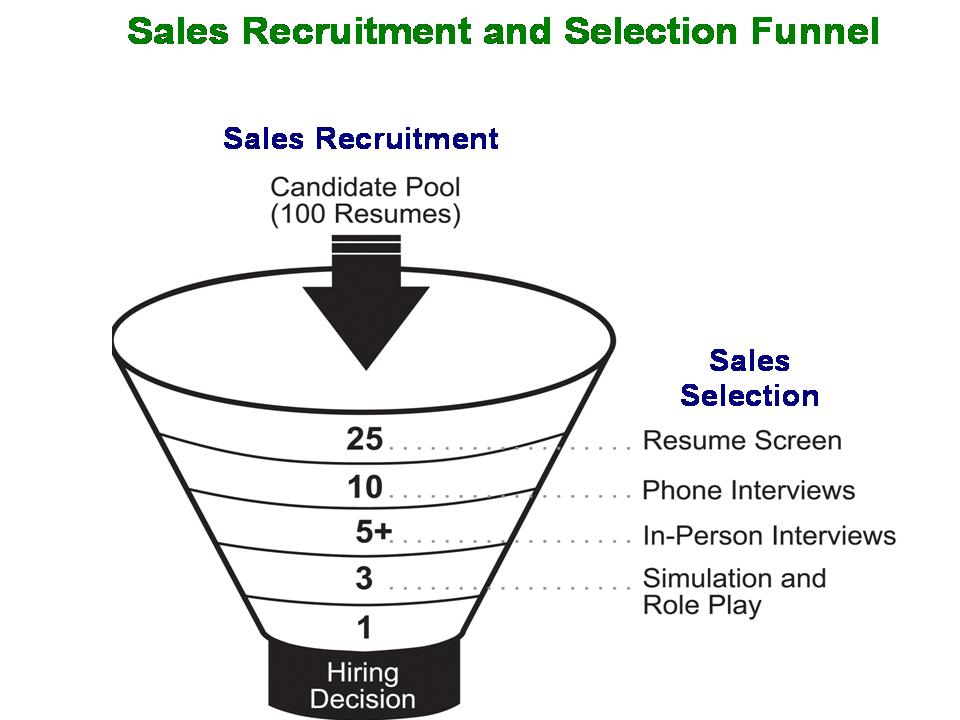
Sales managers often ask salespeople what they have in the “sales prospecting funnel”. The funnel is a prospecting tool used to predict how much new business a salesperson will bring in over the next few months. The idea is that salespeople who “fill their funnels” with a high volume of quality sales leads typically end up with a high volume of viable prospects…which if pursued, turn into a high volume of new business.

The funnel concept also applies to recruiting and selecting sales candidates for open positions:
  • The more sales talent your company consistently attracts;
  • The bigger the pool of qualified applicants for each open sales position;
  • The more strong candidates make it through the selection process;
  • Yielding a better quality sales hire.


The recruitment and selection funnel works on a “garbage in – garbage out” principle.

If your sales recruitment process (filling the funnel) and your sales selection process (screening and filtering through candidates) aren’t in sync, you’ll be disappointed when it comes time to make the hiring decision. You may be stuck with no good options and have to repost the job...or you may hire a "warm body" out of desperation to fill the position.

Check out Issue 6 of our company's e-newsletter, thinktwice™ Today, for tips and advice on keeping your sales selection funnel full of top quality candidates - and ensuring that you're making the best hiring decisions.

©2006 The Loyalty Group. All Rights Reserved. www.TheLoyaltyGroup.com

Friday, September 22, 2006

What Makes a "Champion" Business Leader?

What separates good leaders from great leaders? And does the business world have truly great leaders - those legendary, "championship" leaders who are the Tiger Woods and Michael Jordans of their professions?

In today's issue of USA Today, an article by Erik Brady shows that elite athletes share common threads. (Article: Soul of a Champion) In this first of a series of articles profiling "champions", Brady focuses on the sports world. I couldn't help but wonder - what makes a "champion" leader in today's business world? Do the world's legendary athletes and the world's legendary leaders share common traits?

The article quotes Patrick Cohn, a sports psychologist and president of Peak Performance Sports in Orlando Florida. He lists four "mental and emotional characteristics common to champion athletes."
  • Competitiveness (I'd add the word "healthy" to competitiveness)
  • Confidence
  • Composure (under pressure)
  • Focus
It can be argued that these traits - or competencies - also distinguish good leaders from those who are exceptional. Who in modern business fits this profile? The first person who comes to mind is Jack Welch. In modern politics, I think of Arnold Schwartzenegger (who also happens to have been a very successful businessman and athlete). Martha Stewart may not have been popular with everyone who worked with her, but she certainly built a business empire with confidence and competitiveness. And after her arrest and imprisonment for securities violations - kept her composure and stayed focused as she ran her empire from jail.

If we had to define these four traits in terms of behaviors that "champion leaders" demonstrate, it might look something like this:

Competitiveness: Willing to do whatever it takes - without compromising ethics or sacrificing others - to achieve success. Taking smart risks and bouncing back quickly from failure. Constantly surveying the competitive landscape, knowing where you stand relative to the competition and anticipating competitors' next moves.

Confidence: Self-motivated and driven internally. Standing by decisions, yet comfortable admitting mistakes and failures. Unafraid to make unpopular choices and disagree. Standing up for beliefs. Staying the course even when faced with obstacles.

Composure: Staying cool under pressure. Controlling behavior and actions when faced with stress. Able to function effectively - or even perform better - in tense situations.

Focus: Always keeping sight of the goal and taking purposeful action to achieve that goal. Able to rally others around a common goal. Eliminating roadblocks, obstacles and distractions that get in the way of success. Knowing when to stay the course - and when to change direction.

How do your company's leaders stack up against these traits?

©2006 The Loyalty Group. All Rights Reserved. www.TheLoyaltyGroup.com

Wednesday, August 30, 2006

Marketing to Your Internal Customers

Marketing to Your Internal Customers for Effective Organizational Communication
Each year, companies spend millions of dollars on communicating the benefits of their products to an end user…but what about when they communicate to their internal customers—their employees? It is crucial to communicate effectively internally as well as externally. If you get the message across well to your employees, in turn, it sets the standard of how they communicate with consumers. Here are some tips on how you can use your company’s marketing and branding skills to achieve effective communication within your organization:
  • Use simple messages: “Taste Great, Less Filling”, “We Try Harder.” According to a 2005 survey of the Most Influential Taglines, these are among the top 10. Having a short, succinct message helps employees remember the message. If you are communicating a culture change for example, try coming up with a short title or tagline about it so that it becomes easy to understand. Longer messages tend to get lost in the crowd.
  • Repeat those messages: By repeating the message over and over in different circumstances, you reassure the audience that this is not just a fleeting “Flavor of the Month” change. Talk about the message consistently after the usual Annual Company Town Hall Meeting to help your employees live the message on a daily basis.
  • Use consistent language: Give credibility to your message by defining and using consistent vocabulary. Starbucks, for example, uses the term “tall” to mean the smallest serving available—and even though it’s counterintuitive, it’s caught on everywhere because they are persistent about their vocabulary. Using consistent language helps eliminate confusion as more and more people repeat the message throughout the organization.
  • Build champions: Who doesn’t want to “Be Like Mike?” To give credibility to a company-wide change or announcement, find people who are respected and well liked to champion your idea. Even though major communication begins at the top level, it helps to have “local leaders” also pitching the message.
  • Use visuals: Remember that different people communicate differently. Some understand better visually and some need to hear messages. Companies like BMV and Atari talk advantage of this and have created widely recognizable logos to represent their communication. While you don’t have to come up with a logo for every announcement you make, remember that visually showing how everything fits together or depicting a timeline is usually more effective then a wordy description.

If you ask five people on the street about Nike’s latest marketing, most likely you’ll hear “Just Do It” from everyone. What will you hear if you asked five of your employees about your latest organizational message?

©2006 The Loyalty Group. All Rights Reserved. www.TheLoyaltyGroup.com

Monday, August 07, 2006

Interview Etiquette for Companies


The WSJ recently had an article about how all the little things you do as a job candidate - from the minute you pull up to the building - leave a lasting impression. It gives funny examples of how everything gets noticed by prospective employers, from what you read in the lobby to how clean your car is.

As I was reading this article, I realized that this is a two-way street. While employers scrutinize everything candidates do, remember that candidates also scrutinize everything employers do. What kind of an image is your company projecting to job candidates?

I thought back to some of my experiences as a job candidate. One particularly disorganized company knew I was coming in but had nothing prepared…including the fact that the suite number to their offices was wrong in their directions to me! After finally finding the right office space, I was shuffled between a few interviewers who looked like they didn’t want to be there. Consequently, I decided I didn’t want to be there either.

In another company, a hiring manager kept sneaking peeks at his Blackberry while I was answering questions— and once his secretary popped in unannounced to let him know his wife was on the line and needed to ask him something! Although I had turned off my mobile phone and cleared my mind of all distractions for this opportunity, he clearly didn’t value my time enough to do the same.

Here are some tips on what you can do to leave a lasting positive impression on the candidates who interview YOU:

  1. Treat the candidate like you would a client. Would you keep a potential client waiting around for an hour? Do you make an announcement that a big sales prospect is coming in and everyone should be on their best behavior? Whether they are hired or not, remember that all candidates are walking billboards for how your company treated them during the selection process. You never know who they might know!
  1. Orchestrate every minute of the interview. Do you know where candidates will be at all times? Who is taking them to the next interview appointment? Is anyone meeting them downstairs to get them through security? Make sure you coordinate with other selection managers in advance so that you are not wasting anyone’s time by “winging it.”
  1. Pay Attention to the candidate. Are you subtly glancing at your Blackberry or your open email inbox on the computer screen? Have you asked for all calls to be held unless it’s an emergency? Treat the interview seriously to show how serious you are about finding the right person for this job.


Finding the right job means “finding the right fit”— and that definitely goes for both candidates and employers. What other tips or ideas do you have to help hiring managers make a positive impression on all job candidates?

©2006 The Loyalty Group. All Rights Reserved. www.TheLoyaltyGroup.com

Wednesday, August 02, 2006

Explaining Competencies in Simple Language

Some people "get" competencies and behaviors right away and love them. If you're charged with implementing competencies in an organization full of these people, lucky you. Your job is easy. In most organizations, however, there's a contingent of people who don't "get" - or don't want to get - the whole idea of using competencies. They may see them as too soft or subjective, they may be too numbers-driven to focus on people, or they may just not be accustomed to thinking about behavior, motivations and feelings.

This blog entry is dedicated to keeping your explanation of competencies and behaviors as simple as possible. It's easy to over-explain, use consultant/HR jargon or just overcomplicate the whole idea of competencies and behaviors. That's when you start to see people checking their watches and cell phones.

I thought it would be helpful to share some of the visuals, analogies and tips we use for explaining the whole concept of competencies and behaviors. We find it helps to start by analyzing your audience - who they are, what they care about and what they relate to. Then put competencies and behaviors into their language, using analogies and examples that they can get their arms around. This makes competencies simpler, more practical and easier for them to implement.

The Competency Yardstick

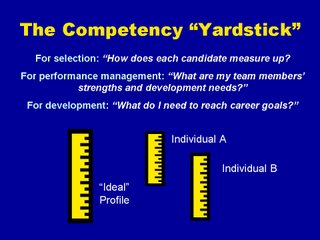
We use the "yardstick" or "ruler" analogy to show managers and employees that competencies are merely units of measure. A competency profile is a yardstick that sets a standard for what "ideal behavior" looks like. In other words, the competency yardstick shows what the "ideal performer" would look like in terms of how they behave.

It can be used to:

  • Take an individual measurement ("What are my current strengths and development needs?"),
  • Compare different measurements ("How do I stack up against my peers, using the competency profile as a guide?"),
  • Measure growth ("How do I compare to my past measurements? Where have I grown?")

No one is expected to be perfect. The competency yardstick is a model, against which people can assess themselves and others...the goal being to get as close to perfect as possible, and keep getting better over time.

The slide below shows how the competency yardstick can be used in a number of business applications, such as selecting the right people, career planning and development, and managing performance. It's a good discussion starter. I use this slide in all types of meetings and trainings, to reinforce the importance of competencies.


What are Competencies?

"Competency" is a tough word to define, particularly because experts and academics disagree on definitions. Ask 100 consultants what competencies are, and you'll likely get 100 different definitions. Ours is below. We like it because it's simple and most people can relate to it.

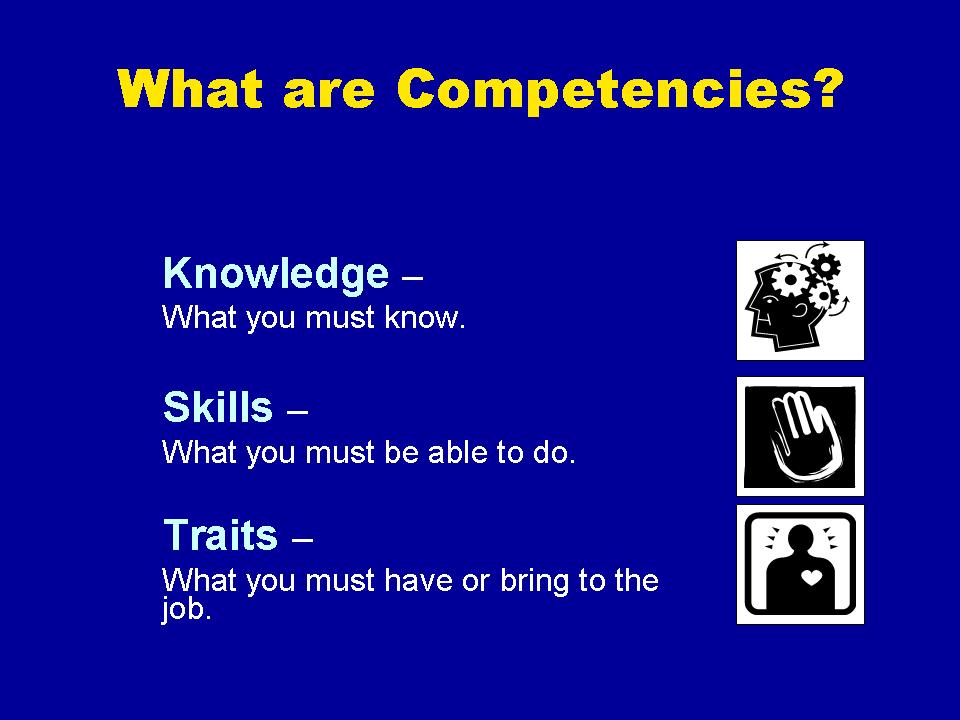
Competencies are the things people need to know (knowledge), to do (skills) and have (traits), to be successful in a role. They are defined by behaviors that describe what that competency would look like if someone were using it effectively.

Here's a frequently asked question. "Why do we have to be so specific about putting behaviors and actions into the right competency category, and why be so specific in defining behaviors? Aren't we splitting hairs?" Valid question. It may seem like wordsmithing and being nit-picky. Here's the explanation I give. Labeling the "soft stuff" - behaviors that we observe - and defining them clearly allows us to talk about them. It gives us a common language, so that when we say that we want to improve our Coaching skill (for example)...we all know that we're talking about the same thing. If our competencies, definitions and behaviors are fuzzy or open to interpretation, we'll have misunderstandings and disagreements down the road when we talk about strengths, development needs, performance reviews and who we should hire.

Another frequently asked question:
"Why group competencies into knowledge, skills and traits/motivations?"

We break them down into knowledge, skills and traits/motivations because the first two - knowledge and skills - are trainable. Personal traits and motivations are deeply engrained in people. In business, sending people to a training class to improve their personality rarely works. Grouping competencies helps us, as managers, understand what's within our control to change and what isn't.


How Companies Use Competencies

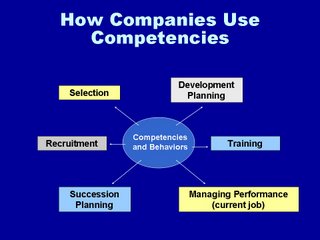
We use this visual with all audiences. It's helpful to show over and over again in meetings and training, to remind people of how all "people-systems" are linked in best-practice companies. It can be used as a very simple diagnostic tool, by asking the group: "Where are our systems aligned and where are there gaps?" Or, "Do we hire for the right competencies, then train people to those competencies?" This is also a good visual to use when making the business case to senior leadership for integrated "people-systems". When all of these systems are aligned, and based on competencies that are critical to future business success, the company works efficiently. There is less wasted effort, hiring is more on-target and everyone is working toward common goals.


Analogies
For some people, often those who are numbers or technically oriented, competencies and behaviors are too "squishy". They may have trouble relating to them, or see more value in focusing on numbers and hard data (more tangible ideas). That's where analogies help. Below are some analogies I've used with different audiences to help them understand how to use competencies and behaviors - and see their value.

Just a note...my intent here isn't to stereotype anyone. I acknowledge that every individual is different and unique.

Taking with Engineers or Scientists

Engineers and scientists are trained to look for precise measurements. They like to analyze. Scientists and engineers learn by observing patterns and trends. So they should enjoy working with competencies and behaviors when presented this way. Competencies and behaviors are units of measure that help us take something very intangible - how people behave - and make it more tangible and measurable.

Talking with IT/Systems Groups

A key function of IT or Systems staff is to problem solve and diagnose. They're driven to figure out what's going on and make systems run better.

That's why competencies and behaviors should appeal to IT-types. People are like systems...we're all programmed differently. Competencies and behaviors give us a common language and "platform" from which to assess our behavior, just like programmers, IT analysts, and others need a common language and tools to assess why information systems work and why they don't work.

Talking with Sales Groups

Numbers rule in sales. Salespeople make their money, get recognition and are judged by the numbers they produce. Why care about competencies and behaviors? We like to give examples to show why competencies and behaviors very directly impact sales numbers. "What if you're not making your numbers?" Typical sales manager will say "go sell more" or "make more calls" or "be more aggressive". But how? What does that mean? It's not actionable...doesn't tell the salesperson what they should be doing differently tomorrow when they get in their car. And it doesn't really diagnose what the root problem is. What if the salesperson isn't asking enough questions? What if the salesperson isn't listening to customers? "Go sell more" or "make more calls" won't help. Competencies and behaviors give sales managers and reps tools to diagnose what is working...and what isn't. They help improve the numbers.

Tell me your tips for simplifying competencies and behaviors for people in your organization!

©2006 The Loyalty Group. All Rights Reserved. www.TheLoyaltyGroup.com