Showing posts with label Candidates. Show all posts

Friday, May 04, 2007

Help Wanted: Failures

Resume

Job Objective: To obtain a position where I can leverage my significant failures.

Key Accomplishments:

  • Lost a major account to the competition because I got too comfortable and assumed that the customer was happy, when they weren't.

  • Hired the wrong person for a leadership position and as a result, employee engagement dropped 2% over the prior year.

  • Risked $1.5 million on a new product launch that failed.

Fastcompany.com recently had a fascinating two-part interview with Sir James Dyson, founder of Dyson, the maker of the best selling vacuum cleaners in the U.S. by revenues. (Article part 1, part 2 ). Dyson describes himself as an inventor, who created 5127 prototypes of his vacuum over 15 years before getting it right.

Dyson says, "I've always thought that schoolchildren should be marked by the number of failures they've had. The child who tries strange things and experiences lots of failures to get there is probably more creative."

What a refreshing perspective on failure!

Another Fastcompany.com article by Richard Watson , CEO of Global Innovation Network, talks about Celebrating Failure. In the article, Watson says "Most companies -- indeed, most people -- fail more often than they succeed. It is the proverbial elephant-in-the-boardroom. And yet by being scared of failure, we are missing a great opportunity. The point about failure is not that it happens but what we do when it happens. "

Both Dyson and Watson are talking about failure in the context of invention and innovation. They argue that creativity relies on failure - and learning from those mistakes. I'll go a step further. It's not just inventors and product development specialists that need to embrace failure. Everyone in today's organization has the right, and the need, to fail. Sometimes miserably.

Unfortunately, our society encourages hiding failure. When we fail in a job, career coaches often teach us how to put a positive spin on it...or bury it all together. When politicians or corporate executives make big mistakes, their first reaction is often "I didn't know about it", "I wasn't involved" or "Someone (or something) else was to blame."

I am not afraid to say that I have failed, sometimes miserably. But one thing I can say with confidence is that I learn from my mistakes. Rarely do I make the same mistake twice. And I always use what I learn from the failure to propel me forward in other directions. Sometimes it does take two steps back to take three steps forward.

In job interviews, one of the questions I teach managers to ask is, "Tell me about a big mistake or failure you've had recently that had significant consequences." The responses you get are fascinating. Often candidates claim that they can't recall any examples (the Alberto Gonzalez defense)...or that they haven't made any big mistakes with significant consequences. These candidates are either: a) Fibbing b) Guilty of having a very bad memory (unlikely) or c) Very risk-adverse individuals who always do exactly what they're told to stay safe...and never any more.

In any case, the "I haven't had major failures" answer raises huge red flags about a candidate. I'll take the candidate that smiles and coolly tells me in great detail about a major misstep or failure...and what he/she did about it. The person that turned the situation around and landed on his/her feet, smelling like a rose, is the candidate that interests me most. This is usually the same candidate who has a track record of stellar accomplishments and success throughout his/her career.

Of course, failure has to be balanced with good judgment, forward movement and ultimately success. Here are some of my ground rules for failing successfully, with grace and brains.

  • Fail quickly and cheaply if you can.
  • Know the risks. When you fail, you shouldn't be blindsided by the consequences.
  • Cut and run when you need to (don't hang on too long...which goes with the first bullet).
  • Don't be bitter. If you lose a promotion because you failed, accept it and move on.
  • Take time to think after failure. Failing to learn from failure is the only REAL failure.

What's the failure you're proudest of...and why? What good came from it?

© 2007. Phyllis Roteman, The Loyalty Group. All Rights Reserved.

Friday, September 29, 2006

Fill Your Funnel with Stronger Sales Candidates

Sales managers often ask salespeople what they have in the “sales prospecting funnel”. The funnel is a prospecting tool used to predict how much new business a salesperson will bring in over the next few months. The idea is that salespeople who “fill their funnels” with a high volume of quality sales leads typically end up with a high volume of viable prospects…which if pursued, turn into a high volume of new business.

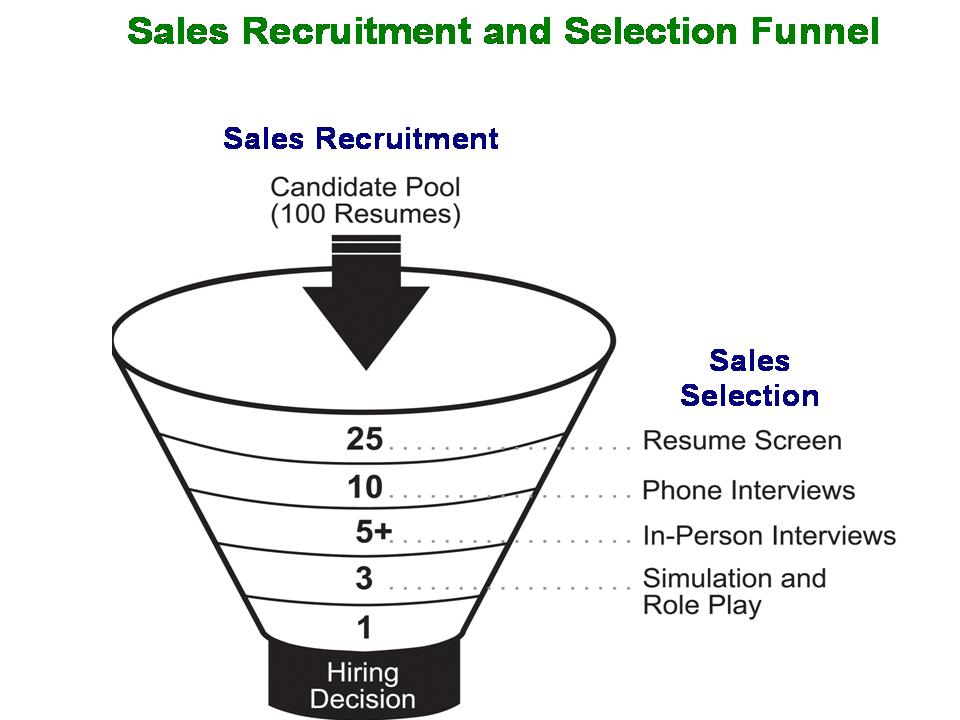
The funnel concept also applies to recruiting and selecting sales candidates for open positions:
  • The more sales talent your company consistently attracts;
  • The bigger the pool of qualified applicants for each open sales position;
  • The more strong candidates make it through the selection process;
  • Yielding a better quality sales hire.


The recruitment and selection funnel works on a “garbage in – garbage out” principle.

If your sales recruitment process (filling the funnel) and your sales selection process (screening and filtering through candidates) aren’t in sync, you’ll be disappointed when it comes time to make the hiring decision. You may be stuck with no good options and have to repost the job...or you may hire a "warm body" out of desperation to fill the position.

Check out Issue 6 of our company's e-newsletter, thinktwice™ Today, for tips and advice on keeping your sales selection funnel full of top quality candidates - and ensuring that you're making the best hiring decisions.

©2006 The Loyalty Group. All Rights Reserved. www.TheLoyaltyGroup.com

Monday, August 07, 2006

Interview Etiquette for Companies


The WSJ recently had an article about how all the little things you do as a job candidate - from the minute you pull up to the building - leave a lasting impression. It gives funny examples of how everything gets noticed by prospective employers, from what you read in the lobby to how clean your car is.

As I was reading this article, I realized that this is a two-way street. While employers scrutinize everything candidates do, remember that candidates also scrutinize everything employers do. What kind of an image is your company projecting to job candidates?

I thought back to some of my experiences as a job candidate. One particularly disorganized company knew I was coming in but had nothing prepared…including the fact that the suite number to their offices was wrong in their directions to me! After finally finding the right office space, I was shuffled between a few interviewers who looked like they didn’t want to be there. Consequently, I decided I didn’t want to be there either.

In another company, a hiring manager kept sneaking peeks at his Blackberry while I was answering questions— and once his secretary popped in unannounced to let him know his wife was on the line and needed to ask him something! Although I had turned off my mobile phone and cleared my mind of all distractions for this opportunity, he clearly didn’t value my time enough to do the same.

Here are some tips on what you can do to leave a lasting positive impression on the candidates who interview YOU:

  1. Treat the candidate like you would a client. Would you keep a potential client waiting around for an hour? Do you make an announcement that a big sales prospect is coming in and everyone should be on their best behavior? Whether they are hired or not, remember that all candidates are walking billboards for how your company treated them during the selection process. You never know who they might know!
  1. Orchestrate every minute of the interview. Do you know where candidates will be at all times? Who is taking them to the next interview appointment? Is anyone meeting them downstairs to get them through security? Make sure you coordinate with other selection managers in advance so that you are not wasting anyone’s time by “winging it.”
  1. Pay Attention to the candidate. Are you subtly glancing at your Blackberry or your open email inbox on the computer screen? Have you asked for all calls to be held unless it’s an emergency? Treat the interview seriously to show how serious you are about finding the right person for this job.


Finding the right job means “finding the right fit”— and that definitely goes for both candidates and employers. What other tips or ideas do you have to help hiring managers make a positive impression on all job candidates?

©2006 The Loyalty Group. All Rights Reserved. www.TheLoyaltyGroup.com