Showing posts with label Hiring. Show all posts

Monday, May 28, 2007

So You Want to Hire a Guru?

In the old roadrunner cartoons, Wile E. Coyote had a business card. It said:

Wile E. Coyote, Genius

Now I can't say that I've been handed a business card with a "Genius" title on it. But I have come across a lot of self-proclaimed "Gurus" lately.

I'm a member of the professional networking site, LinkedIn . Just for fun, I ran a search of my network (contacts and my contacts' contacts) to see how many people call themselves gurus. I found 53. Outside of my network, there were hundreds more.


Gurus galore.

There were your run-of-the-mill gurus. Marketing gurus. Sales gurus.

And there were some highly specialized gurus. I found a "70s music guru", lots of "recruitment gurus" and a "dp api guru" who worked for a major software company.

It seems that many companies want to hire gurus as consultants, usually with a heavy price tag...to motivate the troops or work some kind of magic in the organization. Gurus are often seen as a quick fix. They are expected to fly in like bees, speak at a conference or talk to an executive team, pollinate their people with magic dust, then jettison out.

So what makes someone a guru? Here's a definition from Answers.com:

"An advisor or teacher. The term, which comes from Hinduism, refers to a spiritual teacher. 'Gu' means darkness, and 'ru' means light; thus a guru turns ignorance into enlightenment.

In the west, the term has been interpreted quite often as simply an expert in a field, whether that person helps you learn or understand anything or not."

So let's say your company is looking to hire a guru - a high-powered consultant, speaker or advisor. How do you know you're really getting a guru (someone who can turn ignorance into enlightenment)...and not some self-proclaimed genius who decided to quit corporate life and hang out a "guru" shingle?

Here are some tips for hiring a guru for your business:

  • Beware of people who call themselves gurus. As my husband says, "Any self-respecting guru would be embarassed about being called a guru." (Can you imagine great people like Martin Luther King, Albert Einstein or Vince Lombardi calling themselves gurus?)

  • Peel back the layers. When you think you've found your guru, ask lots of questions to make sure there's substance beneath the surface. Many consultants and "experts" talk a good game (like salespeople), but lack the smarts or common sense to deliver results. Don't be afraid to ask tough questions to make sure you've found the right person.

  • Set realistic expectations. If you're expecting to hire a guru to work miracles in your organization, you're setting yourself up for disappointment (and wasted money). Be clear about why you want to bring in a guru. Is it to motivate the troops for a day? Do you want behavior or cultural change in your organization? Or do you just want a smart person to come in and talk tough to your leadership team? Before engaging your guru, ask yourself, "Is this really what we need...and will it really solve our problems?" Or are we just looking for a quick fix?
© 2007. Phyllis Roteman, The Loyalty Group. All Rights Reserved.

Tuesday, March 13, 2007

Sell to Who You Hire...and Who You Don't

I just read a great BusinessWeek article that reminds companies that their recruitment and selection processes are marketing tools. More companies should remember this.

You can enhance or erode your company's brand by the image you convey at each step of the recruitment and selection processes. Think about it. Every prospective candidate is a customer. You're evaluating them, and they're forming impressions about your company. Ask yourself (and others), "What does our process say about our company?"

Here's something we at The Loyalty Group did to build our brand with prospective job candidates. One of the things we value is giving back to the community. We want to work with people and companies who care about others and our society. To send this message, in our recruitment advertisements, we advertised as a benefit that we donate $500 at the end of each year to each employee's charity of choice. Of course, we must approve each charitable cause and won't allow anything political, religious or highly controversial. The point is - it's imporant to our company - and we wanted to hire people who valued "giving" and social responsiblity as a benefit.

It's amazing how many job candidates told us how excited they were to interview with us, specifically because of that benefit. We heard over and over again that it "said a lot about our company." Even those who weren't hired by us left the process knowing what our company stands for.

Think about your employment brand. What is your hiring process saying about your company?

Friday, February 16, 2007

It’s Ok to Say “I Quit” Before Hearing “You’re Fired”!

I, like millions of other viewers, have been watching Donald Trump’s hit show The Apprentice – LA religiously for a few weeks now…but I’m not so sure about the process anymore. The show allows the Trump Organization, to take 19 candidates through a vigorous selection process and choose the best candidate for the role of Donald Trump’s newest “Apprentice.” Candidates technically have the opportunity to pull themselves out of the process but never did, in the past.

In this season, already one candidate, Michelle, has pulled herself out stating that she wasn’t comfortable with the selection process…essentially saying “I quit” before hearing “You’re Fired!”. The Trumps were incensed at her decision - calling her a “loser” and a “quitter” for pulling herself out…but I disagree.

A selection process goes both ways. It’s obvious that the company is evaluating a candidate the entire time…but a candidate should also be evaluating the company since the process is a representation of what it’s like to actually work there. Michelle had her reasons for resigning from the process and I think both she and the Trump Organization are better off in the long run. She recognized that this is not the right environment for her and spoke up about it – thus saving time and effort for everyone.

While I’m sure that episode had high ratings because of the heated discussion following Michelle’s decision, I applaud her for making that choice.

When you’re getting ready to look for your own “Apprentice”, remember these tips:

  • Do make it ok for candidates to drop out of the selection process if they don’t fit. You never know who they know…and what they might say about your business practices. Thank them for their time and wish them luck in finding something that better fits their needs. Remember, a candidate does not have to be an employee to be a fan of your company.
  • Do paint an accurate picture of the open position. Be sure to talk about the good, and the not-so-good, aspects of the job to ensure that the candidate really is a good fit. If your environment is cut-throat and Trump-like, let candidates know. If it’s a more caring, developmental environment, let that show through. The “right” people will be attracted. Everyone has different needs and likes; your job is to find a match, not to simply fill the position.
  • Don’t revise your job description based on your personal favorite candidate. It’s easy to want to downplay certain aspects of the job if the candidate you have the best chemistry with has weaknesses in certain key areas. Legally, you need to present the same material to all candidates and evaluate each one in the same areas. Don’t say that a finance job doesn’t really need a lot of number crunching if you meet a gregarious candidate (with no financial background) – in fact, why not refer him to a different department that better fits his strengths…saving time and money for everyone.

For more information on TLG’s Selection in Acton programs, click here. This program is designed for anyone who participates in your recruitment and selection process, including hiring managers, recruiters, HR staff or team leaders…and it makes it ok for someone to say “I quit” before costing your company time and money to say “You’re Fired” to someone down the road.

© 2006 The Loyalty Group. All Rights Reserved.

Wednesday, October 04, 2006

Cost of a Bad Sales Hire in Your Organization

What’s the impact of making a hasty hiring decision? Think about the cost of a bad sales hire in your organization by completing the table below. You will need to calculate costs using your best estimate. Consult with others in your organization for help as needed. For example, human resources may have numbers on costs for recruiting, hiring and training a new salesperson.

Assume that the ineffective salesperson remains in the territory for three months.

While the poor sales performer is in the job for three months:


1. Lost sales revenue in territory (Calculate what the territory should be producing versus what a poor performer actually produces.)

$

2. Value of manager time, dealing with poor performer’s issues.

$

3. Cost of recruiting and hiring the poor performer.

$

4. Cost of training and coaching the poor salesperson.

$

5. Cost of low morale on team, caused by poor hire (think about burnout, turnover, and negative attitudes).

$

6. Value of human resource’s time facilitating the termination.

$

7. Other

$


When the poor performer leaves the organization:


8. Revenue drops in other territories while salespeople are covering the open territory.

$

9. Time and dollars spent repairing damaged customer relationships or making good on promises made by the poor salesperson.

$

10. Dissatisfied customers who left for a competitor (lost accounts).

$

11. Other

$


Total estimated cost of a bad sales hire:
©2006 The Loyalty Group. All Rights Reserved. www.TheLoyaltyGroup.com

$

Friday, September 29, 2006

Fill Your Funnel with Stronger Sales Candidates

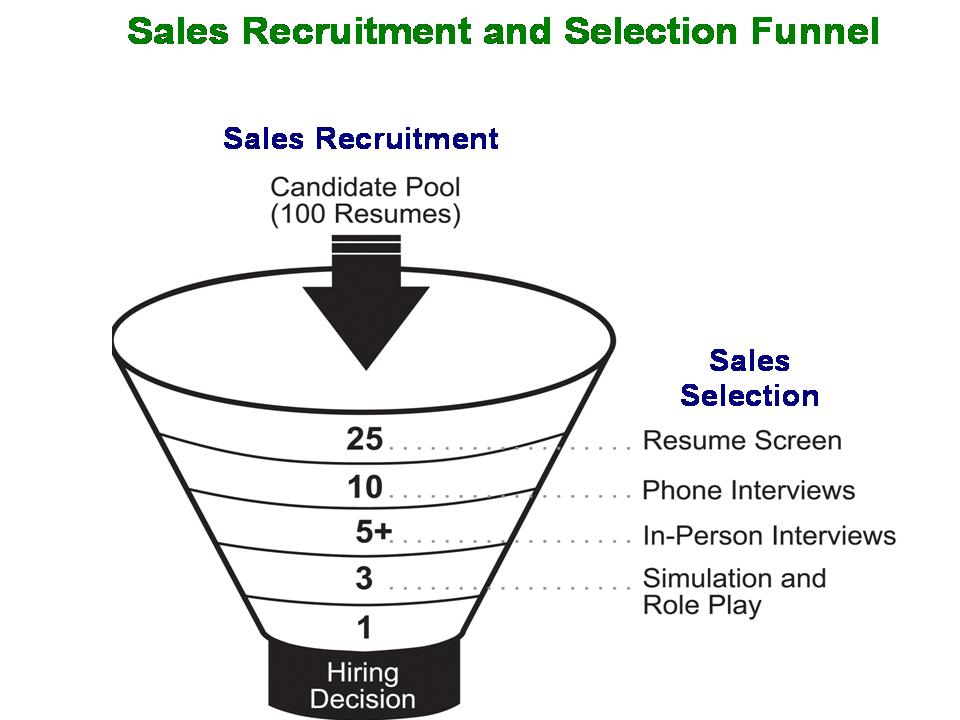
Sales managers often ask salespeople what they have in the “sales prospecting funnel”. The funnel is a prospecting tool used to predict how much new business a salesperson will bring in over the next few months. The idea is that salespeople who “fill their funnels” with a high volume of quality sales leads typically end up with a high volume of viable prospects…which if pursued, turn into a high volume of new business.

The funnel concept also applies to recruiting and selecting sales candidates for open positions:
  • The more sales talent your company consistently attracts;
  • The bigger the pool of qualified applicants for each open sales position;
  • The more strong candidates make it through the selection process;
  • Yielding a better quality sales hire.


The recruitment and selection funnel works on a “garbage in – garbage out” principle.

If your sales recruitment process (filling the funnel) and your sales selection process (screening and filtering through candidates) aren’t in sync, you’ll be disappointed when it comes time to make the hiring decision. You may be stuck with no good options and have to repost the job...or you may hire a "warm body" out of desperation to fill the position.

Check out Issue 6 of our company's e-newsletter, thinktwice™ Today, for tips and advice on keeping your sales selection funnel full of top quality candidates - and ensuring that you're making the best hiring decisions.

©2006 The Loyalty Group. All Rights Reserved. www.TheLoyaltyGroup.com

Tuesday, June 13, 2006

How to Select Job Candidates with Integrity (Pay Attention to Clues)

In the film Meet the Parents, Robert DeNiro's character is a parent/ex-CIA agent who is known as a "human lie detector." Although he had a real polygraph machine in his basement, he didn't need it. He could just tell when people were lying by talking to them. He would have made a great interviewer.

It seems to be getting harder to find job candidates who have strong integrity. Candidates who are "integrity-challenged" don't necessarily have criminal records, shifty eyes or sweaty palms. They may be normal-looking (even highly skilled) employees who hide mistakes or blame others, take credit for other people's work, violate copyrights intentionally or sabotage others when upset.

In our company's Selection in Action training, managers often ask us, "What can we do as hiring managers to select for integrity and weed out those who lack it?" The easy answer is...there is no easy answer.

The best we can do is set up an effective selection system that has validated, built-in assessments for integrity, including psychological testing, behavioral interviewing and simulations.

However, even the best selection system can suffer from human error. Think about it. Well-built cars don't have accidents. Drivers have accidents. The same goes for selection systems. Well-built selection systems rarely make mistakes. Hiring managers who use selection systems have accidents. The biggest "accident" a hiring manager can make in the selection process is ignoring the objective data that a strong selection process provides.

If your selection system is set up properly, candidates who lack integrity will give clues throughout the selection process. They won't come out and tell you that they lack integrity - they probably won't admit to lying, cheating or sabotaging others. Here are some examples of what you might see and hear during a selection process, that are clues to a candidate's questionable integrity:

- Denying that they've made mistakes in the past or that they've had failures. When candidates consistently make comments such as, "I haven't ever had a big failure or disappointment," or "I haven't had a conflict at work. I always get along with everybody," you know they're not telling the truth. If you hire them, don't expect them to own up to mistakes in the workplace.

- Showing up late for phone calls and interviews, rescheduling appointments, not following up as promised...and making excuses. No matter how much you love these candidates or how "perfect" they are for the job, don't ignore how they behave during the selection process. This is your best clue as to how they'll actually behave when you hire them.

- Telling stories about how they achieved a positive result, but cut corners or "fudged the truth" to get the result. As hiring managers, it's easy to be blinded by candidates' stories of making customers happy, saving the company money or making a sale. Don't ignore how they got those results. For example, a sales candidate who closed a million dollar contract at her last job may make a sales hiring manager salivate. But don't forget to ask how the candidate got that million dollar sale. Did she have to overpromise deliverables to get the sale? Did the sale actually cost the company money because the margins weren't high enough? Did she exaggerate her company's capabilities, or sweeten the deal with unauthorized "freebies", to close the sale? Dig deep and pay attention to the whole story.

Of course, none of this is a guarantee that you'll hire the perfect candidate with impeccable integrity. Like motivations or personal values, integrity isn't something you can see easily. But you can become more like DeNiro's "human lie detector" by engaging your integrity radar and paying attention to the clues candidates drop during the selection process. Chances are, candidates who are lacking integrity will subtly reveal themselves if you pay attention to the signs.

And remember, most people are good. Assume that people have integrity until they show you otherwise. Try to be smart and objective when hiring...without being cynical or prejudging.

©2006 The Loyalty Group. All Rights Reserved. www.TheLoyaltyGroup.com