Since posting my last blog entry, someone close to me emailed, wondering why I -- a successful sales consultant who's trying to market her business -- would publish such basic sales mistakes for the world (and prospective clients) to see. What about my reputation?
First, I'm honest enough to admit that I've made some pretty stupid mistakes along the way. Every expert and professional has. Anyone who claims they haven't is lying, arrogant or lacking self-awareness. Remember Michael Jordan's baseball career? Al Gore saying that he created the internet (or something like that)? Oprah flaunting her weight loss to her fans, then later admitting that she'd had liposuction? Famous people cursing when they thought the microphone was off? Oops!
Second, if you can't laugh at and move on from your mistakes, you'll either beat yourself up over them (NOT productive) or you'll never learn from them.
That said -- I don't make a lot of mistakes. But when I do, I remember them and don't make them again. Phyllis
Showing posts with label Sales. Show all posts
Showing posts with label Sales. Show all posts
Thursday, January 08, 2009


Stupid Sales Blunders
 Note to self: Don't do that again.
Falling on your face is a great educator.
In that vein, I'm going to confess two of the most embarrassing things I've said and done in my 20+ year sales career. Funny how they're little things -- that make a big impact.
Want to Chat?
The first year I started my business, I did a lot of "warm calling". I'd research companies I wanted to target, then make the call. I'd get up and start calling at 7 am, hoping to catch decision makers at their desks.
One woman I'd been trying to reach for months was the Director of Training for a major auto dealership on the east coast. One early morning, to my surprise, she answered her own phone. Caught off guard, I introduced myself and said, "I was hoping we could chat about your business and see if there might be a fit with what we offer." Flatly, the woman replied, "I don't have time to chat."
Note to self:
Most of the time, you only get one shot at an opportunity. Don't blow it by winging it. Always be ready and focused, even at 7 am.
Relaying Two Much on Spill Check
You know where this is going, right?
Big proposal. Fortune 100 prospect. Big typo.
Yes, we misspelled the client company's name throughout the proposal.
I don't want to give the company name, but let's say that it includes a word that's commonly misspelled -- like principal and principle. Alas, the client wasn't very forgiving and (surprise!) we didn't get the business.
Note to self:
Details can win or lose business. We put a lot of work into that proposal - and it was good. Don't ever let something like a (big) spelling error kill you.
If you think you've got me beat with a really silly sales blunder, please share!
Copyright 2008. Phyllis Roteman. The Loyalty Group. Sherman Oaks, CA.
Thursday, May 29, 2008
Riverboarding on the Zambezi River...and Change

I know...white water rafting analogies (like sports analogies) are a bit overused in leadership and teamwork training. But I've got my own new twist and it's a personal example: river-boarding (body surfing) down the Class 2 to 4 rapids of the Zambezi River in Africa.
This is something I did during a pre-midlife crisis in my early 30s. Picture this...ten of us in wetsuits with crash helmets and flippers, on our bellies fighting the rapids on little body boards strapped to our wrists. (I have no idea why I did this.)
At one turn, we were warned about sunbathing crocodiles watching us from the rocks above the water. At another turn, we were warned to "keep to the left" because of dangerous sharp rocks and an undertow to the right. Did I mention that I'm an awful swimmer?
It was a great learning experience. I was attempting something that others had done before (I knew it was humanly possible). Yet I was terrified, lacking the proper skill, and unsure of what was in store. I was with a group of strangers and being led by guides I'd just met...but was trusting with my life.
Sound familiar? Isn't this how many employees and managers feel during times of change?
Here's an example. A client of ours acquired several former competitors in a short period of time. As you can imagine, this was a huge shake-up for the sales organization. Territories were restructured, salesforces were combined and the organization was flattened. Some managers went back into sales - and some managers found themselves leading groups of strangers who used to be their competitors. The acquisitions added product lines, giving the new company a bigger industry footprint and more opportunities. But it significantly changed the sales process, from a simple sale of a few products to a much more strategic, complex sale of integrated solutions.
Suddenly, leaders and salespeople who'd been successful in the "old" environment found themselves on unfamiliar ground. Many skills that were rewarded and made them successful in the past were less relevant. Potential obstacles lurked like crocodiles around each corner as the organization struggled through the transition stage of change. Everyone plowed ahead, as we did on the rapids, while worrying about what might be around the corner or if success would ever come.
My next blog posting will deal with the practical elements of managing change, based on a great article I just read from Knowledge.Wharton on why business strategies fail. Not surprisingly, the reason is often poor execution. It was this article that got me thinking about my riverboarding trip and the importance of balancing strategy and execution during turbulent times.
This is something I did during a pre-midlife crisis in my early 30s. Picture this...ten of us in wetsuits with crash helmets and flippers, on our bellies fighting the rapids on little body boards strapped to our wrists. (I have no idea why I did this.)
At one turn, we were warned about sunbathing crocodiles watching us from the rocks above the water. At another turn, we were warned to "keep to the left" because of dangerous sharp rocks and an undertow to the right. Did I mention that I'm an awful swimmer?
It was a great learning experience. I was attempting something that others had done before (I knew it was humanly possible). Yet I was terrified, lacking the proper skill, and unsure of what was in store. I was with a group of strangers and being led by guides I'd just met...but was trusting with my life.
Sound familiar? Isn't this how many employees and managers feel during times of change?
Here's an example. A client of ours acquired several former competitors in a short period of time. As you can imagine, this was a huge shake-up for the sales organization. Territories were restructured, salesforces were combined and the organization was flattened. Some managers went back into sales - and some managers found themselves leading groups of strangers who used to be their competitors. The acquisitions added product lines, giving the new company a bigger industry footprint and more opportunities. But it significantly changed the sales process, from a simple sale of a few products to a much more strategic, complex sale of integrated solutions.
Suddenly, leaders and salespeople who'd been successful in the "old" environment found themselves on unfamiliar ground. Many skills that were rewarded and made them successful in the past were less relevant. Potential obstacles lurked like crocodiles around each corner as the organization struggled through the transition stage of change. Everyone plowed ahead, as we did on the rapids, while worrying about what might be around the corner or if success would ever come.
My next blog posting will deal with the practical elements of managing change, based on a great article I just read from Knowledge.Wharton on why business strategies fail. Not surprisingly, the reason is often poor execution. It was this article that got me thinking about my riverboarding trip and the importance of balancing strategy and execution during turbulent times.
Copyright 2008. Phyllis Roteman. The Loyalty Group. Sherman Oaks, CA.
Wednesday, March 26, 2008
Drop Price, Drop Credibility! A post-script...
Haha.
Since my last post (about how our postage meter vendor dropped our price when we threatened to cancel)...the saga continues.
Our initial rate was $20.00/month.
My assistant called to cancel and was offered $12.95/month.
She said she'd call them back, and checked with me. I said no thanks.
I posted my blog (rant).
Needless to say, when my assistant called them back to reject the $12.95/month, they offered her $7.95/month!
Do you think if we hold out long enough they'll pay us to keep the meter?
Since my last post (about how our postage meter vendor dropped our price when we threatened to cancel)...the saga continues.
Our initial rate was $20.00/month.
My assistant called to cancel and was offered $12.95/month.
She said she'd call them back, and checked with me. I said no thanks.
I posted my blog (rant).
Needless to say, when my assistant called them back to reject the $12.95/month, they offered her $7.95/month!
Do you think if we hold out long enough they'll pay us to keep the meter?
Drop Price, Drop Credibility!

We have a postage meter in our small office. We ordered it from the vendor when we were doing bulk mailings a few years ago. Since then, our snail mail usage has trickled off, so we decided to run the meter down to zero, then send it back. Why pay $20.00 a month for a small convenience that we really don't need?
Today my assistant, Jenn, contacted the company to ask how to send the meter back. She tells me that they offered to lower our monthly fee to $12.95 if we keep the meter. Hmmm...now that I want to cancel, they can drop their monthly rate by $7.00?
Basically, that translates into $7.00 a month too much that I've been paying for almost two years. Rather than jump at the reduced rate, I'm a little ticked off. Granted, $7.00 a month is nothing. It's the principle. I feel like I've been ripped off, paying $20.00 per month for a service that is only worth $12.95.
And they've lost credibility with me. If they can arbitrarily give us the service for $12.95 a month, how do I know someone else isn't getting exactly the same thing for $9.00 a month?!!!
Lesson for all businesses: Don't drop rates without justifying the price reduction. It erodes your credibility, makes you look desperate and devalues what you're selling.
Friday, October 05, 2007
Is Your "Inner Child" Sabotaging Your Sales Career?
 As my loyal readers can see, lately I have both babies and selling on my mind. Who knew the two would converge so well into blog topics?
Last week I posted about the personal traits that top salespeople share with babies, including curiosity, openness and flexibility.
In this post, I look at the not-so-cute side of being a sales baby. This post covers a baby-like trait that will stunt your sales growth and prevent you from reaching your potential - impulsiveness.
Take a Quiz: Are You an Impulsive Salesperson?
In his book Emotional Intelligence, Daniel Goleman writes that "...perhaps there is no psychological skill more fundamental than resisting impulse." He cites as an example the famous "marshmallow test", in which psychologist Walter Mischel at Stanford studied impulse control in four-year-olds. If you aren't familiar with the study, here's a quick summary from clipmarks.com:
"Mischel put marshmallows in front of a room full of 4-year-olds. He told them they could have one marshmallow now, but if they could wait several minutes, they could have two. Some children eagerly grabbed a marshmallow and ate it. Others waited, some having to cover their eyes in order not to see the tempting treat and one child even licked the table around the marshmallow. Mischel followed the group and found that, 14 years later, the "grabbers" suffered low self-esteem and were viewed by others as stubborn, prone to envy and easily frustrated. The "waiters" were better copers, more socially competent and self-assertive, trustworthy, dependable and more academically successful."
Ask yourself, are you a "grabber" as a professional salesperson? Granted, there are times to jump when opportunity knocks. You can't be successful in sales if you can't aggressively pounce at the right time. The key phrase here is at the right time. Impulsive ("grabbing") sales behavior will sabotage your sales career if you have trouble controlling the impulse to pounce.
Take this quiz and see whether your inner child's impulsivity and lack of patience may be sabotaging your sales results.
- Do you feel compelled to swoop in for the close the moment you hear a customer need?
- When you hear a customer objection, do you quickly try to squash it with a comeback, argument or product benefit?
- Do you try to "pitch" your products and services when you see an opening, because you might not get another chance?
- Are you impatient while other people are talking? Can you hardly wait to say what you want to say - or interrupt often?
- Do you easily drop price or make concessions to close a sale, rather than take the time to build value and sell the higher price?
- Can you walk away from "bad business" - or do you find yourself saying "yes" to everything?
- Have you received feedback that you talk too much?
- Do you have difficulty allowing silence on a sales call? Do you jump in to break the uncomfortable silence?
There is good news, even if you answered "yes" to one or more of these questions. You may not be able to control the feeling of impulsiveness. However, most behavioral psychologists agree that you can control whether or not you act on those impulses. As with making any major behavioral change, the first step is to be aware of your current behavior. Pay attention to situations in which you feel yourself wanting to interrupt a customer, toss a sales pitch without understanding a need, or shut down a customer objection with an argument. Catching yourself in the act of impulsiveness is the first step toward learning patience and good sales timing. It's also a big step toward accelerating your sales success!
© 2007. Phyllis Roteman, The Loyalty Group, Inc. Sherman Oaks, CA.
Wednesday, September 12, 2007
Are you a Sales Baby? (Maybe That's Good!)
 Do you want to become a better salesperson? Go to the training seminars, read motivational books...then spend a little time with a baby.
Below are four baby characteristics that all great salespeople share. If you're in sales, see how you measure up against the baby.
Curiosity
Babies look at everything with fresh eyes. Unlike most adults, they don't make assumptions or think they know it all. They're fascinated by the world around them and how things work.
Why it matters in sales: Curious salespeople ask good questions - and as a result, uncover information that other less curious salespeople miss. For example, a curious salesperson who hears a customer problem, such as, "Our online sales are down" will naturally ask, "Why are they down?" The less curious salesperson won't bother to ask why. He hears a problem and immediately jumps in with a sales pitch. ("I've got a great product that'll help you increase your online sales!"). The less curious salesperson appears pushy and the customer backs off.
Unjaded
Babies are non-judgmental. They lack the cynicism of jaded adults who, based on bad experience, often take a negative outlook on life.
Why it matters in sales: Cynicism and negativity are sales killers. That's why so often new salespeople, fresh out of new hire training, start out like gang-busters. They're enthusiastic, excited about their new job, and (like babies) haven't yet been tainted by negativity. They're eager to apply what they've learned in training are excited to make money. They have a winning sales attitude...until some crusty sales manager or veteran salesrep pulls that newbie aside and says, "Forget what you learned in sales training. This is the real world. Let me tell you how things really work." Over time, the new rep gets infected with cynicism and adopts a jaded outlook. Negative attitudes like, "Customers are cheap" or "My quota is too high" become excuses that kill sales performance.
Flexible
Most babies can stick their feet in their mouths. How many adults can do that?
Why it matters in sales: OK, to be a great salesperson, you don't need physical flexibility (although being able to stand on your head or shove your fist in your mouth may come in handy when entertaining clients). Personal flexibility, however, is always critical in a consultative sales process. When your sales approach isn't working, can you bend and adapt? We've all gone into a sales call prepared with our proposal, questions or presentation...only to have the rug pulled out from under us by a change in client agenda. ("We're sorry...did we forget to tell you that the decision maker isn't able to join us today? And that we only have five minutes instead of an hour?" And that our specs have completely changed since we last talked?") Great salespeople are flexible enough to go with the flow and bend like a baby.
Resiliant
When babies fall down, they get right back up. They don't quit when they fail. If they did, none of us would ever walk - we'd be forever on our bellies.
Why it matters in sales: Most salespeople stop calling a prospect after three attempts or follow-up calls. (I've followed up with prospects for years before doing any business.) The really great salespeople bounce back quickly and don't use obstacles as excuses for giving up. Ask yourself, Do you give up quickly when you fall? Do you make excuses why you can't be successful? Do you blame outside forces - bad clients, bad products, your company, the weather, your internal partners - for your lack of success? Like a baby, when you bump into a wall, dust yourself up and keep going.In my next blog post, we'll look at the baby-like traits that all salespeople should avoid. All whiners and those who work with them in sales should read this!
© 2007. The Loyalty Group. All Rights Reserved.
Thursday, May 17, 2007
A Tale of Buyer's Remorse
 Scene 1:
 Our living room, the night before a sales appointment.
A few weeks ago my husband and I were in the market for new windows for our home. My husband got a referral for a window contractor and scheduled an appointment in our home at dinner time the next day. My husband told me:
- He was just getting an estimate.
- He expected the job to cost around $20,000.
- We really needed to get it done soon.
Fast forward to the end of this story...
We signed a contract for almost $30,000 that night...then cancelled the whole contract the next morning. What happened? It's a good lesson for salespeople on buyer's remorse - and what happens when you take shortcuts to close a sale quickly. Read on for the rest of the story...
Scene 2: The Set Up
Walking through the house, while Mom (me) is distracted
My husband greets the friendly salesman at the door. I'm distracted with our baby (and trying to finish some work email), so I suggest that the guys (my husband and the salesman) walk around the house and discuss the job.
I hear bits and pieces of their conversation. It sounds low-key and friendly. Occasionally my husband asks my opinion and I try my best to jump in (but my hands are literally full). He asks, "What kind of door would you prefer here?" "Should we replace the bedroom windows while we're at it?" The job was growing...but what the heck, we were just getting an estimate. Let's see what it'll cost, I thought.
Scene 3: The "Divide and Conquer" Tactic
The husband and wife try to talk in the kitchen...
When the house walk is done, my husband and the salesman sit at the dining room table to go over numbers. It comes out to over $30,000, more than $10,000 more than we'd anticipated spending. My husband and I try to talk in private in our kitchen, but the salesman can hear us. I ask my husband quietly, "Did you plan on spending that kind of money?" "I thought we were just getting an estimate." "Are you ready to sign now?" "Why don't we wait and think about this, or cut some stuff out. We don't really need all of this, do we?"
Sensing that his sale was in jeapordy, the salesman interrupted our private conversation and told my husband that "he needed to show him something in the other room." Separating the husband and the wife. One of the oldest tricks in the book!
Scene 4: The "Sign Today or Else" Threat
Back at the dining room table...
When my husband returns with the salesman, he tries to close us again by telling us what a great deal he's giving us. He says we're getting "free installation, which has a several hundred dollar value." He tells us it's because he's the company's sales trainer...and we're a referral (implying he's doing us a personal favor).
I say, "We'd like to think about it overnight. How about if we let you know tomorrow or on the weekend?"
The salesman says, "That's fine, but it'll cost you more. It's the end of our quarter tomorrow and we need to get this order in. And if I don't sign you today, I'll have to send a real commissioned salesman out tomorrow...and we'll have to tack on a commission. If you buy today, you're getting the job commission-free."
Scene 5: We Sign...But with an Escape
Haggling at the dining room table, while baby cries.
I ask if we can change our minds, if we sign today. The salesman says of course...and shows us the cancellation clause in the contract. We have three days to change our order or cancel.
So we sign, knowing that we're probably going to change the order anyway. (I know...dumb move. In hindsight, it's very clear that we should have just thrown him out the door. I don't know why we didn't.)
Scene 6: We Get Mad and Cancel
Later that evening, in the bedroom...
After dinner we're getting ready for bed and decide to put the issue to rest. We talk about what happened. As my husband and I recount the scenario, we get mad. And madder. Until we're so ticked off at the guy's sales tactics that we decide to cancel the whole job...even though the company was recommended highly and we really needed windows. We figured we could get them somewhere else. And we'd rather spend more to work with someone we trust and respect.
Epilogue
My husband and I felt good about our decision. More important, our relationship was in tact. And I took away a few lessons...
- Salespeople: Don't shortcut a sale. You might make a "deal," but it won't be a good one.
- Customers: If the sale doesn't feel right, trust your instinct. If you feel pushed, you probably are.
- Sales Organizations: Be careful about the messages you convey to your salesforce. If you pressure salespeople to close everything by the end of the quarter, you're likely to get "bad sales." They'll cost you in the long run. Reward good, solid sales that stick.
© 2007. Phyllis Roteman, The Loyalty Group. All Rights Reserved.
Thursday, May 03, 2007
Beware Workplace Bobble-heads (Part 1)
 We've all seen them.
They stare at you in meetings as you discuss ideas. They appear to be listening as you give them feedback. They say little. They nod their heads. (That's why I like to call them "workplace bobble-heads.")
Rarely will they disagree openly or challenge ideas. In fact, to the untrained human eye, they might even seem agreeable and pleasant. But beware. Behind that agreeable facade may lurk a hidden cynic, doubter, nay-sayer, or behind-the-scenes griper who would rather smile and nod than express him or herself to your face. Who are these bobble-heads...and what causes them to nod silently as if in agreement, even when they're not?
Customer Bobble-heads
If you're a salesperson, you've most likely met customer head bobbers. Here's the scenario. The salesperson is making an engaging presentation, with all the bells and whistles, saying all of the "right things"...and there's the customer, not saying a word but nodding (seemingly in agreement). But when the salesperson asks for the order, the customer (to the salesperson's surprise) says something like "I need to think about it" or "Thanks, can you leave me some information?"
What happened? The salesperson, who was falsely encouraged by the customer's quiet head-bobbing, assumed that the customer's silence meant the customer was ready to buy. She wasn't.
Employee Bobble-heads
This can frustrate the heck out of managers. Here's the scenario. A manager and employee are meeting to discuss a new project the employee is going to take on. The manager tells the employee all about the project in great detail (while the employee looks on and - you guessed it - nods his head as if he's listening). The manager then asks something like, "Do you have any questions for me?" And the employee shrugs and says, "I guess not."
Fast forward...it's three weeks later. The manager and employee meet for a project update. To the manager's surprise, the employee is floundering. The manager wonders why the head-bobber didn't speak up and ask questions in their initial meeting.
What happened? The manager assumed that the employee was bought into the assignment and understood it. (Fooled again by the head bob).
Manager Bobble-heads
Imagine a meeting with a group of managers. A senior executive (or someone in power) is talking. She's droning on and on - plugging through endless PowerPoint slides - and no one really knows what she's trying to say. Instead of speaking up to get clarification, the group just sits there and nods, as if in agreement...as if what they're hearing makes perfect sense. The meeting adjourns. In the hallway (after the exec leaves), the managers whisper to each other, "What do you think she meant?" and "I'm more confused than before the meeting!"
What happened? Because of fear of speaking up or looking dumb, the managers just kept their mouths shut and nodded. And no doubt, this body language from the manager group assured the senior exec that she was communicating loudly and clearly. She likely left the meeting thinking it was a success.
In my next blog (Part 2 of Beware Workplace Bobble-heads), I'll provide tips for how to communicate more effectively with head bobbers - and engage them in dialogue.
© 2007. Phyllis Roteman, The Loyalty Group. All Rights Reserved.
Tuesday, May 01, 2007
Salespeople...Think Before You Propose!

Is all business good business?
It's always difficult to say "no" to potential business. Let's face it, when times are lean and sales goals are aggressive, it's easy to get desperate and jump at every opportunity...even when it doesn't make strategic sense for your company. Smart sales leaders are strong enough to walk away when needed. But it takes discipline.
The next time you’re asked to create a big proposal or bid on a project, stop and think. Below are some questions you can ask yourself, to ensure that the business will be good business for your company.
1. Do we know that we can do a good job and deliver value?
Making the sale is just the beginning. You can damage your reputation, lose customer confidence and get bad press if you take on work or sell solutions that don’t get results. Make sure you can actually deliver what you’re promising.
2. What are the indirect costs of working with this customer? Do the potential revenues outweigh those costs?
Some customers cost more to do business with than others. Think about those hidden costs before pricing your proposal. For example, a demanding customer that requires lots of hand-holding will add to your cost of sale…and will also cost your company time and resources (dollars) after the sale. It adds up and erodes your margins.
3. What's the opportunity cost of responding? (In other words, what can't we do if we dedicate resources to getting this business?)
We’ve all seen it. Sales teams running around like chickens with their heads cut off, falling all over themselves trying to get a sales presentation ready for a big potential client. After 20 revisions and thousands of hours, it’s ready. But at what cost? Ask yourself, “What could we have done with that time?” How many other sales calls could have been made? How many other proposals could have been written? How much time could you have spent researching other prospects? It’s important to go after the “big fish.” Just make sure you’re aware of what you’re not doing when you make that time investment…and ask yourself whether it’s worth it.
4. Is this a strategic fit with our company’s goals and values?
The promise of money and growth can easily lure a company away from its core values and strategy, leading it to make business it later regrets. Take Google and its decision to sell a censored version of its search engine in the China market (the ultimate big fish customer). Less than two years later, Google co-founder Sergey Brin said he regretted the decision because “on a business level, that decision to censor… was a net negative.” Sacrificing your values and core strategies to make a buck rarely works well in the long run - in sales and in life.
It's always difficult to say "no" to potential business. Let's face it, when times are lean and sales goals are aggressive, it's easy to get desperate and jump at every opportunity...even when it doesn't make strategic sense for your company. Smart sales leaders are strong enough to walk away when needed. But it takes discipline.
The next time you’re asked to create a big proposal or bid on a project, stop and think. Below are some questions you can ask yourself, to ensure that the business will be good business for your company.
1. Do we know that we can do a good job and deliver value?
Making the sale is just the beginning. You can damage your reputation, lose customer confidence and get bad press if you take on work or sell solutions that don’t get results. Make sure you can actually deliver what you’re promising.
2. What are the indirect costs of working with this customer? Do the potential revenues outweigh those costs?
Some customers cost more to do business with than others. Think about those hidden costs before pricing your proposal. For example, a demanding customer that requires lots of hand-holding will add to your cost of sale…and will also cost your company time and resources (dollars) after the sale. It adds up and erodes your margins.
3. What's the opportunity cost of responding? (In other words, what can't we do if we dedicate resources to getting this business?)
We’ve all seen it. Sales teams running around like chickens with their heads cut off, falling all over themselves trying to get a sales presentation ready for a big potential client. After 20 revisions and thousands of hours, it’s ready. But at what cost? Ask yourself, “What could we have done with that time?” How many other sales calls could have been made? How many other proposals could have been written? How much time could you have spent researching other prospects? It’s important to go after the “big fish.” Just make sure you’re aware of what you’re not doing when you make that time investment…and ask yourself whether it’s worth it.
4. Is this a strategic fit with our company’s goals and values?
The promise of money and growth can easily lure a company away from its core values and strategy, leading it to make business it later regrets. Take Google and its decision to sell a censored version of its search engine in the China market (the ultimate big fish customer). Less than two years later, Google co-founder Sergey Brin said he regretted the decision because “on a business level, that decision to censor… was a net negative.” Sacrificing your values and core strategies to make a buck rarely works well in the long run - in sales and in life.
© 2007. The Loyalty Group. All Rights Reserved.
Thursday, April 26, 2007
Is it OK to Cry at Work?

Early in my career I had a colleague (let's call her Liza) who was a self-professed "crier". She was young, professional and competent. But when she became angry, frustrated or felt backed into a corner, the water-works would start. I remember one day Liza left our boss' office after receiving her performance review. I asked her how it went. She said, "We're just on a break. We stopped because I was crying. I'm humiliated."
No matter how hard Liza tried to choke back the tears, she couldn't. It made her feel weak and stupid - she didn't want to be crying - but she claimed that she just couldn't control it. I felt so bad for her. It was hard enough back then for a young female professional to get respect in the consulting world. Tears just made it near impossible.
I bring this story up because today's Wall Street Journal online edition has an article by Sue Shellenbarger headlined, Crying at Work Gains Acceptance. In it, Shellengbarger makes the case that the proliferation of Gen Y'ers in today's workplace is making it more acceptable to show emotions, including crying. The article says that the younger generation is generally more in touch with feelings than baby boomers - and that clashes between more stoic older bosses and more sensitive younger workers are ensuing in the workplace.
So will crying be "cool" at work? Will managers get promoted for their open sensitivity and ability to openly shed tears? Is crying really gaining acceptance at work?
I think this remains to be seen. A few things I question:
- Even if people (including those interviewed for the WSJ article) claim that they accept crying at work, I wonder what they actually feel about it. I'd like to think that I'm an open, accepting person and wouldn't judge someone who cried at work...but subconsciously, would I feel differently? Would I somehow see the person as weak? (I'm not sure, but I guess it would depend on the circumstances and why the person was crying.)
- I wonder how many of my clients would want their consultant to cry in front of them...or worse yet, in front of a group of their leaders. My bet is that while a client might feel sorry or embarassed for the consultant, they'd be a lot less confident in that individual - and may question their "emotional toughness" or tolerance for stress. Let's face it. There are some situations where crying is just bad for your image and can be damaging.
- When does crying become a real problem? Sure, most of us have felt like crying after we've received bad feedback or had a particularly horrible day. But if an employee cries at seemlingly inappropriate times (for example, he makes a typo or she spills her coffee) and it happens frequently, there might be an underlying issue.
- What can tears tell you? I recently had a client, a sales manager, tell me about a new hire who was a terrific salesperson. She was blowing away her numbers in the first few months on the job. Yet when the manager did her ride-alongs with the rep in the field, she found that the rep would cry before and after every customer call. When the manager asked the rep why she was crying, the rep said, "I'm terrified of making calls. I feel sick to my stomach before I make every call...and then I feel so relieved after the call, I feel sick again!" Needless to say, this rep's crying betrayed an underlying, serious issue - she hated her job even though she was great at it.
Crying at work may be gaining some acceptance...but I wouldn't yet say there's a crying revolution at work. Like any other expression of emotion (yelling, laughing loudly, cursing) - there's a right time and right place. And some very wrong times and places.
No matter how hard Liza tried to choke back the tears, she couldn't. It made her feel weak and stupid - she didn't want to be crying - but she claimed that she just couldn't control it. I felt so bad for her. It was hard enough back then for a young female professional to get respect in the consulting world. Tears just made it near impossible.
I bring this story up because today's Wall Street Journal online edition has an article by Sue Shellenbarger headlined, Crying at Work Gains Acceptance. In it, Shellengbarger makes the case that the proliferation of Gen Y'ers in today's workplace is making it more acceptable to show emotions, including crying. The article says that the younger generation is generally more in touch with feelings than baby boomers - and that clashes between more stoic older bosses and more sensitive younger workers are ensuing in the workplace.
So will crying be "cool" at work? Will managers get promoted for their open sensitivity and ability to openly shed tears? Is crying really gaining acceptance at work?
I think this remains to be seen. A few things I question:
- Even if people (including those interviewed for the WSJ article) claim that they accept crying at work, I wonder what they actually feel about it. I'd like to think that I'm an open, accepting person and wouldn't judge someone who cried at work...but subconsciously, would I feel differently? Would I somehow see the person as weak? (I'm not sure, but I guess it would depend on the circumstances and why the person was crying.)
- I wonder how many of my clients would want their consultant to cry in front of them...or worse yet, in front of a group of their leaders. My bet is that while a client might feel sorry or embarassed for the consultant, they'd be a lot less confident in that individual - and may question their "emotional toughness" or tolerance for stress. Let's face it. There are some situations where crying is just bad for your image and can be damaging.
- When does crying become a real problem? Sure, most of us have felt like crying after we've received bad feedback or had a particularly horrible day. But if an employee cries at seemlingly inappropriate times (for example, he makes a typo or she spills her coffee) and it happens frequently, there might be an underlying issue.
- What can tears tell you? I recently had a client, a sales manager, tell me about a new hire who was a terrific salesperson. She was blowing away her numbers in the first few months on the job. Yet when the manager did her ride-alongs with the rep in the field, she found that the rep would cry before and after every customer call. When the manager asked the rep why she was crying, the rep said, "I'm terrified of making calls. I feel sick to my stomach before I make every call...and then I feel so relieved after the call, I feel sick again!" Needless to say, this rep's crying betrayed an underlying, serious issue - she hated her job even though she was great at it.
Crying at work may be gaining some acceptance...but I wouldn't yet say there's a crying revolution at work. Like any other expression of emotion (yelling, laughing loudly, cursing) - there's a right time and right place. And some very wrong times and places.
© 2006 The Loyalty Group. All Rights Reserved.
Monday, April 23, 2007
Are you an EXTREME Talker?
Want to lose credibilty really fast? Talk in extremes.
Here's an example. I was just reading a white paper on performance management. I was engaged and thinking "this is really good stuff." Then I came across this sentence:
"Training never provides managers with the practical tools they need to set clear objectives with their teams."
What's wrong with the word "never"?
Subconsciously, the word just begs to be refuted. As soon as I see or hear an "extreme" word like never (or always, or nobody), I immediately try to think of a contradiction. (Perhaps this is my contrarian nature...am I the only one who thinks this way?)
There are very few things in life that are absolute, so words like "never", "always" or "nobody" should be used cautiously and sparingly. When you do use them, be aware that other people may, like me, question your credibility and become distracted.
Here are some scenarios that demonstrate credibility-damaging extreme talking, and alternative statements that give speakers more credibility.
Here's an example. I was just reading a white paper on performance management. I was engaged and thinking "this is really good stuff." Then I came across this sentence:
"Training never provides managers with the practical tools they need to set clear objectives with their teams."
What's wrong with the word "never"?
Subconsciously, the word just begs to be refuted. As soon as I see or hear an "extreme" word like never (or always, or nobody), I immediately try to think of a contradiction. (Perhaps this is my contrarian nature...am I the only one who thinks this way?)
There are very few things in life that are absolute, so words like "never", "always" or "nobody" should be used cautiously and sparingly. When you do use them, be aware that other people may, like me, question your credibility and become distracted.
Here are some scenarios that demonstrate credibility-damaging extreme talking, and alternative statements that give speakers more credibility.
Scenario 1:
Salesperson says: "We've never had an unhappy customer."
Customer thinks: "Oh really...I don't believe you. NEVER?"
Alternative:
Salesperson says: "Our customer surveys show that they're are happy with our work. We score a 9.5 out of a possible 10 average."
Scenario 2:
Manager says: "Remember that the customer is always right."
New customer service rep thinks: "Gimme a break!"
Alternative:
Manager says: "Even if we disagree with customers, we must still be
respectful and try to make them happy."
Scenario 3: (During a product development meeting)
Team member: "Nobody will ever use that technology!"
Rest of team: "We can think of lots of people who WOULD!"Alternative:
Team member: "I'm sure there will be some customers who would adopt this technology. My concern is that there won't be enough volume, and the price point won't be high enough, to justify our investment."
© 2006 The Loyalty Group. All Rights Reserved.
Saturday, March 17, 2007
How to Lose a Salesrep in Ten Days
Last night I watched the cute Kate Hudson, Matthew McConaughy film, How to Lose a Guy in Ten Days. It's not The Godfather or Citizen Kane, but it's light and mindless. In it, Kate Hudson is writing a fluff magazine article on things women do that push guys away. You'll have to see the movie yourself to see some of the chic-sins she commits (like moving personal belongings into his apartment after a first date). The funny part was (gasp) that we've ALL done some version of these stupid things in some relationship - we were just too close to the relationship to see it at the time.
So in the spirit of that movie, and for all of us who have done stupid things to push people away without realizing it, this blog is a10-day primer for sales managers. Read on to find out how to LOSE A SALESREP IN TEN DAYS!
Day 1:
Give the rep a sales goal that's way out of reach. Confide in the rep, "I know it's way too high, but it was handed down to me by someone at the top. I think they pull these numbers out of a hat...and we get stuck with them!"
Day 2:
Forget to ask about his kid who broke his leg on the playground yesterday.
Day 3:
When he gives you that 20-page Excel report you asked him for last month, say with a look of surprise, "Oh, you were still working on that? We dropped that project a few weeks ago. Hope you didn't spend too much time on it!"
Day 4:
Schedule a performance review meeting with him. Miss it. Then email later saying you're sorry - and that you got called into an important meeting.
Day 5:
Give him feedback and tips for how he can improve his sales performance. You haven't been in the field with him for months.
Day 6:
Call in the evening during his family dinner to ask why a big deal didn't close that day.
Day 7:
When he tells you proudly that he just closed a big account he's been working on for months, tell him, "It's about TIME."
Day 8:
When he tells you proudly that he just closed a 20k deal, ask him, "Why only 20?"
Day 9:
Ride along in the field with him (finally...you've been meaning to). Jump in on all of his calls and close deals for him, because you miss the thrill of the sale (and you're really good at closing)!
Day 10:
The rep just closed a few big sales and is well on his way to meeting goal. Congratulate him and in the next breath, say, "Since you're doing so well this month and the rest of the team is down, we're going to up your goal. I know you can do it because you're so good!"
Salespeople are guilty of committing "sins" too. If you want to discover some of the more common and deadly ones, see a great article by Steve Martin in ManageSmarter.
© 2006 The Loyalty Group. All Rights Reserved.
So in the spirit of that movie, and for all of us who have done stupid things to push people away without realizing it, this blog is a10-day primer for sales managers. Read on to find out how to LOSE A SALESREP IN TEN DAYS!
Day 1:
Give the rep a sales goal that's way out of reach. Confide in the rep, "I know it's way too high, but it was handed down to me by someone at the top. I think they pull these numbers out of a hat...and we get stuck with them!"
Day 2:
Forget to ask about his kid who broke his leg on the playground yesterday.
Day 3:
When he gives you that 20-page Excel report you asked him for last month, say with a look of surprise, "Oh, you were still working on that? We dropped that project a few weeks ago. Hope you didn't spend too much time on it!"
Day 4:
Schedule a performance review meeting with him. Miss it. Then email later saying you're sorry - and that you got called into an important meeting.
Day 5:
Give him feedback and tips for how he can improve his sales performance. You haven't been in the field with him for months.
Day 6:
Call in the evening during his family dinner to ask why a big deal didn't close that day.
Day 7:
When he tells you proudly that he just closed a big account he's been working on for months, tell him, "It's about TIME."
Day 8:
When he tells you proudly that he just closed a 20k deal, ask him, "Why only 20?"
Day 9:
Ride along in the field with him (finally...you've been meaning to). Jump in on all of his calls and close deals for him, because you miss the thrill of the sale (and you're really good at closing)!
Day 10:
The rep just closed a few big sales and is well on his way to meeting goal. Congratulate him and in the next breath, say, "Since you're doing so well this month and the rest of the team is down, we're going to up your goal. I know you can do it because you're so good!"
Salespeople are guilty of committing "sins" too. If you want to discover some of the more common and deadly ones, see a great article by Steve Martin in ManageSmarter.
© 2006 The Loyalty Group. All Rights Reserved.
Thursday, December 28, 2006
How to Survive Long Sales Cycles (The Four "Ps")
Like investing, selling is not a profession for the faint of heart. Both professions require a strong stomach and the ability to endure the ups and downs of long business cycles.
If you're an organization that deals with long selling cycles (typically selling big-ticket items or working with “major accounts”), you need a plan to thrive in both good times and bad.
I tell clients that there are four “Ps” for surviving long sales cycles and business fluctuations. They are: Planning, Pacing and Patience and Protection.
Planning
Many sales managers and sales people think short term. “What is coming in this week?” “What can I do to close this deal now?” However, the sales cycle for a large-ticket sale or corporate account can take months. In fact, I’ve worked on prospects that have taken years to develop. (I recall that it took me three years to get in the door of a major cruise line. They later turned out to be our biggest client.) To deal with a long sales or prospecting cycle, salespeople must take a longer-term view and anticipate the steps required to close a big sale. Ask customers planning questions directly, such as “Tell me about your decision-making process.” “What steps are involved in this decision?” “How urgent is this?” and “What are your timeframes?” Customers appreciate your asking (they don’t want you hounding them every other day if their sales cycle is long), and it helps you plan and schedule your follow-up.
Pacing
Working a long-term sale is like dancing with a partner. You and your partner (customer) must be in step at all times. It can be really tempting, when a salesperson has a number to achieve or when a sales division isn't making budget, to move faster than your customer. Out of desperation, you push your customer faster than they’re ready to move. The result is that you look desperate and pushy – and you likely lose the sale. I suggest living by your Outlook calendar. I schedule every customer contact during a sales process, months in advance. If a prospective customer says, “We’ll be ready to talk on August 15th” and it’s only March, I’ll put a reminder on my calendar for August 15th. On that day, I call back the prospect and remind them that they asked me to call that day…and even recap our previous call. I’ve found that customers are very impressed – they feel confident that if they give you their business, you’ll be diligent in your follow-up and deliver as promised. (You’d be surprised how many salespeople don’t follow-up during a long sales cycle. If you’re the person who doesn’t give up and is reliable, you’ll stand out.)
Patience
This goes hand-in-hand with Pacing. I’ve found that the best salespeople have immense patience. This is a personal trait that really can’t be taught. If you’re an impatient person, you shouldn’t be selling to customers with long sales cycles. You’re probably better suited for quick, short-term sales (such as selling stereo systems to consumers or selling office supplies) which give you immediate gratification.
Protection
Salespeople by nature are optimists. They don’t like to think about the possibility that a sale won’t close right away. So often they put all of their eggs into one basket – that “big sale” that’s going to make the year a success. This “waiting game” can wreak havoc on a salesperson's paycheck. And if enough salespeople are overly optimistic in their projections, the entire sales organization's budget projections are thrown off.
Often, salespeople are derailed when sales don't close as quickly as anticipated. In our consulting business, we call this the “hurry up and wait” syndrome. Customers initially want your proposal “yesterday” – they can’t wait to get started on a project. The need is “urgent.” Yet once the proposal is submitted to the customer, it loses priority or gets stuck in their internal decision-making process. The “urgent” need suddenly loses urgency. If you’re a salesperson and were banking on getting those dollars in the next month or two, you’d better be prepared. As a salesperson, always ask yourself, “What if this sale doesn’t close in the expected time frames?” “What if this big sale falls apart?” Make sure that you always have other sales activity happening as you’re following up on the big potential sale. This is your insurance policy for your business. If the long-term sale doesn’t pan out, or takes longer than expected, will you be able to survive?
©2006 The Loyalty Group. All Rights Reserved. www.TheLoyaltyGroup.com
If you're an organization that deals with long selling cycles (typically selling big-ticket items or working with “major accounts”), you need a plan to thrive in both good times and bad.
I tell clients that there are four “Ps” for surviving long sales cycles and business fluctuations. They are: Planning, Pacing and Patience and Protection.
Planning
Many sales managers and sales people think short term. “What is coming in this week?” “What can I do to close this deal now?” However, the sales cycle for a large-ticket sale or corporate account can take months. In fact, I’ve worked on prospects that have taken years to develop. (I recall that it took me three years to get in the door of a major cruise line. They later turned out to be our biggest client.) To deal with a long sales or prospecting cycle, salespeople must take a longer-term view and anticipate the steps required to close a big sale. Ask customers planning questions directly, such as “Tell me about your decision-making process.” “What steps are involved in this decision?” “How urgent is this?” and “What are your timeframes?” Customers appreciate your asking (they don’t want you hounding them every other day if their sales cycle is long), and it helps you plan and schedule your follow-up.
Pacing
Working a long-term sale is like dancing with a partner. You and your partner (customer) must be in step at all times. It can be really tempting, when a salesperson has a number to achieve or when a sales division isn't making budget, to move faster than your customer. Out of desperation, you push your customer faster than they’re ready to move. The result is that you look desperate and pushy – and you likely lose the sale. I suggest living by your Outlook calendar. I schedule every customer contact during a sales process, months in advance. If a prospective customer says, “We’ll be ready to talk on August 15th” and it’s only March, I’ll put a reminder on my calendar for August 15th. On that day, I call back the prospect and remind them that they asked me to call that day…and even recap our previous call. I’ve found that customers are very impressed – they feel confident that if they give you their business, you’ll be diligent in your follow-up and deliver as promised. (You’d be surprised how many salespeople don’t follow-up during a long sales cycle. If you’re the person who doesn’t give up and is reliable, you’ll stand out.)
Patience
This goes hand-in-hand with Pacing. I’ve found that the best salespeople have immense patience. This is a personal trait that really can’t be taught. If you’re an impatient person, you shouldn’t be selling to customers with long sales cycles. You’re probably better suited for quick, short-term sales (such as selling stereo systems to consumers or selling office supplies) which give you immediate gratification.
Protection
Salespeople by nature are optimists. They don’t like to think about the possibility that a sale won’t close right away. So often they put all of their eggs into one basket – that “big sale” that’s going to make the year a success. This “waiting game” can wreak havoc on a salesperson's paycheck. And if enough salespeople are overly optimistic in their projections, the entire sales organization's budget projections are thrown off.
Often, salespeople are derailed when sales don't close as quickly as anticipated. In our consulting business, we call this the “hurry up and wait” syndrome. Customers initially want your proposal “yesterday” – they can’t wait to get started on a project. The need is “urgent.” Yet once the proposal is submitted to the customer, it loses priority or gets stuck in their internal decision-making process. The “urgent” need suddenly loses urgency. If you’re a salesperson and were banking on getting those dollars in the next month or two, you’d better be prepared. As a salesperson, always ask yourself, “What if this sale doesn’t close in the expected time frames?” “What if this big sale falls apart?” Make sure that you always have other sales activity happening as you’re following up on the big potential sale. This is your insurance policy for your business. If the long-term sale doesn’t pan out, or takes longer than expected, will you be able to survive?
©2006 The Loyalty Group. All Rights Reserved. www.TheLoyaltyGroup.com
Thursday, October 26, 2006
Find the Fear (If You Want to Sell Your Idea or Gain Support)
I thought of this Blog topic after reading an article in last Wednesday's Wall Street Journal (Why Your Lizard Brain Makes You a Bad Investor - and How to Battle Back), in which writer Jonathan Clements discusses the psychology of financial investing. His article makes the point that humans instinctively (dating back to caveman days) have a strong aversion to loss. And this fear of loss tends to be much more powerful than the desire to gain.
He quotes economics Professor Robert Frank of Cornell University, who notes that "animals will fight viciously to protect territory that they hold, but they won't fight nearly as hard to extend their territory." Most humans have this same protective instinct, which is why we tend to be more motivated by fear than desire.
Why should business people care? Think about those times you tried to sell an idea, make a proposal or get someone's help and you got a "no." Chances are there is some fear behind the response. Think about the following examples:
 - Your boss dumped a bucket of cold water on your last budget request. (He was worried that if his boss called him on the expenditure, he wouldn't be able to defend it, making him look bad.)
- Your process improvement idea was rejected by other departments, despite the fact that it would save the company thousands of dollars. (They like their current processes, they created them, and only they understand them. Now you want to take that all away.)
- You hit a brick wall when you asked someone from your IT Department to show you how to fix your own computer problem. (They felt threatened. If they show you how to fix your own problems, you won't need them.)
He quotes economics Professor Robert Frank of Cornell University, who notes that "animals will fight viciously to protect territory that they hold, but they won't fight nearly as hard to extend their territory." Most humans have this same protective instinct, which is why we tend to be more motivated by fear than desire.
Why should business people care? Think about those times you tried to sell an idea, make a proposal or get someone's help and you got a "no." Chances are there is some fear behind the response. Think about the following examples:
 - Your boss dumped a bucket of cold water on your last budget request. (He was worried that if his boss called him on the expenditure, he wouldn't be able to defend it, making him look bad.)
- Your process improvement idea was rejected by other departments, despite the fact that it would save the company thousands of dollars. (They like their current processes, they created them, and only they understand them. Now you want to take that all away.)
- You hit a brick wall when you asked someone from your IT Department to show you how to fix your own computer problem. (They felt threatened. If they show you how to fix your own problems, you won't need them.)
Granted, not every decision is fear-based. But you can have greater influence over others if you tune into their worries and fears.
Below are some pointers for getting more "yes" responses to your ideas and proposals by finding people's hidden fears - and alleviating them...
Before presenting your idea or proposal:
- Stay objective - No matter how good your idea is or how much time and money it will save, don't assume that just because you're excited about your idea, others will be.
- Play devil's advocate with yourself and someone else - Before presenting your idea, test it. List all of the possible arguments against it...and go beyond the obvious. For example, if you're asking for a raise, think beyond the actual dollars. Even if there is budget for your salary increase, your boss may be afraid that if he gives you the raise and word gets out, others will ask for more money as well. Check yourself by asking an objective third party - preferably someone who knows the person to whom you're presenting the idea - to play devil's advocate with you. That person will likely think of arguments against your idea that you've missed.
- Figure out how to "Tip the Value Scale" - Imagine that inside everyone's head is a little scale - the "Value Scale." Humans use this value scale to make decisions. The scale helps the brain weigh the benefits (gains) they'll receive from saying "yes" to a decision, versus the losses (fears) they'll face if they say "yes". Since the loss/fear side of the Value Scale can be a more powerful motivator than the benefit/gain side, your job as the proposal-presenter is to get inside the other person's head and tip that scale, so that the gain outweighs the fear. You've got to figure out, "What is it going to take to alleviate that person's fear of my proposal?" and "How do I tip the 'value scale', so that in the other person's head, the gains from my proposal outweigh the fears about it?"
- Think about other influencers or decision-makers - A note of caution. Make sure that you're presenting your proposal or idea to the right person. Ask yourself, "Is this person truly the decision maker, or will he/she have to check with others for approval?" If others are likely to influence or be involved with the decision, you must assess each person individually. Everyone has different concerns and fears. Make sure that you've thought through each person's value scale and prepare to address potential fears. For example, when you're asking the person in your IT Department to help you, think about who else might be impacted if he says "yes". Not only may the IT person be threatened by your desire to learn how to fix your own computer problem - but he may also need to ask his manager for an extension on a project deadline because he'll be spending more time with you (it would be quicker for him if he just fixed your problem and went back to his project). In other words, his manager's fear may be that the project work won't get done because the IT person is wasting time teaching you how to fix a problem. To get the IT person to help you, you may need to help him think about how to ask his boss for the project deadline extension.
When presenting your idea or proposal:
- Ask first - Don't start the conversation by launching into an explanation of your idea, or trying to sell the benefits. It's important to get the individual talking, so you can confirm whether your assessment of the person's fears and desires was accurate. For example, if you've anticipated that the IT person may resist your request to teach your team how to do basic troubleshooting, you might ask questions such as: "How much time have you spent fixing this problem over and over again for our department?" "What other projects are you working on, when you're not trouble-shooting for us?" "If you didn't have to fix these recurring problems, what could you be doing with your time?" "If our team were willing to invest the time on our end...how would you feel about teaching us some of the trouble-shooting basics - so you could focus on the more complex, business-critical work?" What's good about these questions is that they're addressing the person's potential underlying worry, that he won't be valued, in a non-threatening way. You're helping him see that by teaching your team some basic trouble-shooting, he'll actually increase his value to the organization by focusing on more complex, business-critical work.
- Don't be cagey - Most people can smell a manipulation job a mile away. It's ok to acknowledge the fact that you have an idea or proposal right up front. You might say, "I've been toying with an idea, but first I'd like to ask you a few questions to see if it's even viable." Then start asking your questions. If the person says, "Can't you just tell me your idea and I'll tell you if I like it or not?" it's all right to say, "I could, but I don't want to waste your time trying to sell you on an idea that won't work. If you give me a minute to ask a few questions, I can probably save both of us some time." Very few people will resist that approach, because most people fear having their time wasted, or having a bad idea pushed on them. In most people (because we're such a busy society), these fears will outweigh their desire to hear your idea quickly or skip the questions.
- Acknowledge and encourage challenges - No matter how much analysis you did in advance, you'll occasionally be caught off guard by a challenge you weren't prepared for as you present your idea. Welcome these challenges! In fact, thank the person for bringing up these issues. Once their concerns are on the table, you have the chance to address them. As long as concerns are unspoken, you'll be in the dark about why your ideas are being rejected.
- Tell a story with your proposal - One of the biggest mistakes people make when presenting ideas or proposals is forgetting to put them in context. In other words, forgetting to tell the story of why your idea's benefit (value) outweighs the cost (fear). If you've done your work in advance by assessing the other person's fears and desires, and asked questions to get the person talking about costs and benefits, you have what you need to tell a strong story. A story sounds something like this, when presenting your idea:
- "Here's the idea..."
- "Here's how it's going to address your needs and here's the assessment I've done."
- "I recognize that there are some issues, such as X and Y. Here's how we can address those issues."
- "What additional questions do you have - or what other information do you need?"
- "How should we move forward on this?" or just recommend a next step.
Keep in mind, it's not about using fear to manipulate others. Rather, it's about working to understand what people worry about (what keeps them up at night)...and figuring out ways to alleviate those worries with your ideas. In other words, you get what you want when you're a problem-solver (aka: fear-remover). The best part is, you're giving the other person what they want - making the problem/fear go away.
Are you a salesperson who wants to learn how to be a problem-solver by uncovering customers' concerns and needs? Click here for more information on TLG's Sales in Action programs.
Wednesday, October 04, 2006
Cost of a Bad Sales Hire in Your Organization
What’s the impact of making a hasty hiring decision? Think about the cost of a bad sales hire in your organization by completing the table below. You will need to calculate costs using your best estimate. Consult with others in your organization for help as needed. For example, human resources may have numbers on costs for recruiting, hiring and training a new salesperson.
Assume that the ineffective salesperson remains in the territory for three months.
While the poor sales performer is in the job for three months: | |
1. Lost sales revenue in territory (Calculate what the territory should be producing versus what a poor performer actually produces.) | $ |
2. Value of manager time, dealing with poor performer’s issues. | $ |
3. Cost of recruiting and hiring the poor performer. | $ |
4. Cost of training and coaching the poor salesperson. | $ |
5. Cost of low morale on team, caused by poor hire (think about burnout, turnover, and negative attitudes). | $ |
6. Value of human resource’s time facilitating the termination. | $ |
7. Other | $ |
When the poor performer leaves the organization: | |
8. Revenue drops in other territories while salespeople are covering the open territory. | $ |
9. Time and dollars spent repairing damaged customer relationships or making good on promises made by the poor salesperson. | $ |
10. Dissatisfied customers who left for a competitor (lost accounts). | $ |
11. Other | $ |
Total estimated cost of a bad sales hire: | $ |
Friday, September 29, 2006
Fill Your Funnel with Stronger Sales Candidates
Sales managers often ask salespeople what they have in the “sales prospecting funnel”. The funnel is a prospecting tool used to predict how much new business a salesperson will bring in over the next few months. The idea is that salespeople who “fill their funnels” with a high volume of quality sales leads typically end up with a high volume of viable prospects…which if pursued, turn into a high volume of new business.
The funnel concept also applies to recruiting and selecting sales candidates for open positions:
The funnel concept also applies to recruiting and selecting sales candidates for open positions:
- The more sales talent your company consistently attracts;
- The bigger the pool of qualified applicants for each open sales position;
- The more strong candidates make it through the selection process;
- Yielding a better quality sales hire.
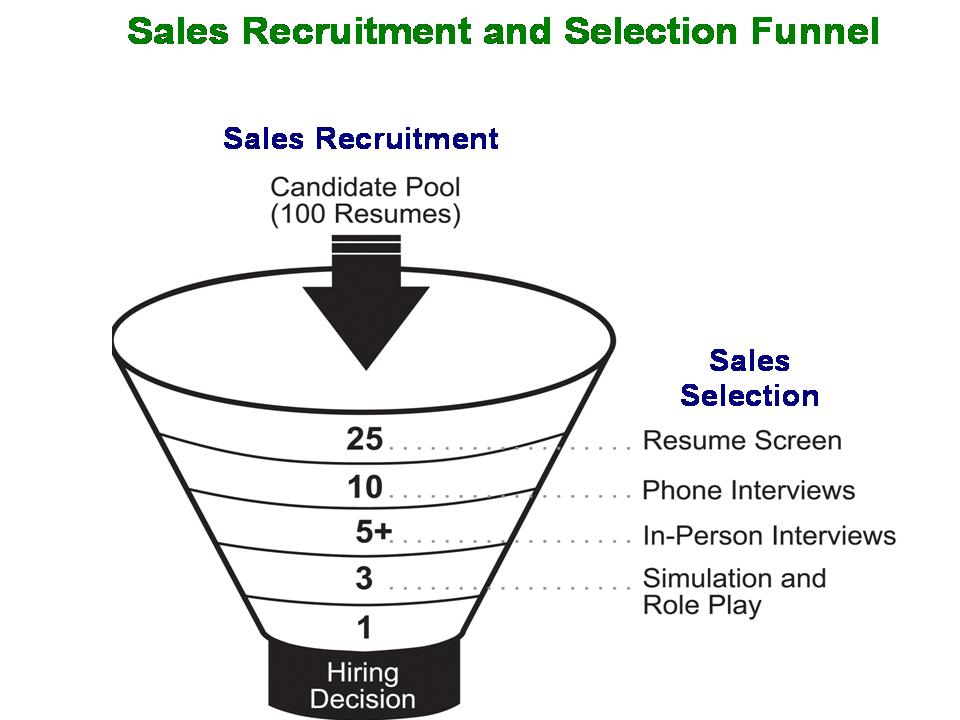
The recruitment and selection funnel works on a “garbage in – garbage out” principle.
If your sales recruitment process (filling the funnel) and your sales selection process (screening and filtering through candidates) aren’t in sync, you’ll be disappointed when it comes time to make the hiring decision. You may be stuck with no good options and have to repost the job...or you may hire a "warm body" out of desperation to fill the position.
Check out Issue 6 of our company's e-newsletter, thinktwice™ Today, for tips and advice on keeping your sales selection funnel full of top quality candidates - and ensuring that you're making the best hiring decisions.
©2006 The Loyalty Group. All Rights Reserved. www.TheLoyaltyGroup.com
Thursday, June 29, 2006
Seven Tips for Effective Sales Performance Management
In many sales organizations, performance management sounds something like this:
"Are you going to make your number?"
"How many did you sell?"
"You need to get in front of five customers a day."
"You did great this year. That's why I know I can count on you for an additional 10% next year."
By nature sales organizations are revenue and numbers focused. Whether or not these organizations achieve their numbers depends, in large part, on how well they manage and leverage their human capital - their sales people.
Performance management, when designed and executed effectively in sales organizations, boosts sales productivity and helps retain sales talent. Below are seven best practices for implementing performance management in sales organizations. How does your organization stack up?
1. Communicate company and sales organization goals, vertically and horizontally. Does every manager, salesperson and support staff member know the sales organization's strategies and goals - and where their department and individual goals fit? Test this by asking various people in your organization to explain the links to you.
2. Focus on manager behavior first. Define manager competencies by doing a validated job analysis. Make sure the competencies stress performance management behaviors, such as setting clear expectations, observing salespeople in the field, coaching, addressing performance problems and developing talent.
3. Make sure all leaders talk about your culture and vision often. Do leaders just talk about numbers and revenue performance...or do they also talk about how to get those results? From the top down, send the message that your company expects people to get the “right results, the right way.”
4. Define and communicate competencies for salespeople. If you already have sales competencies, review them. Do they read like a generic job description (self-starter, aggressive, closer) or are they specific and unique to selling at your company? Think about what distinguishes your best sales performers, in terms of both results and behaviors. Chances are, in addition to being good closers, they show adaptability, they're open to coaching and feedback, they're constantly learning, and they welcome the opportunity to coach others.
5 . Focus your sales efforts, new products and strategic initiatives. Avoid flavor of the month. When changes do happen, communicate them clearly and have an open dialogue with the sales organization. Not everything is equally important. When you introduce a new initiative or product, ask, "What can we take away or stop doing?" Confused salespeople = confused customers. They don’t know what to sell and can’t keep up with the changes.
6. Link sales training, selection, incentive and performance management systems to your business goals and competencies. A rigorous, competency-based selection process will give you a clear profile of each candidate's strengths and development needs. When you do make your hiring decision, use the selection process data to help you create a development plan for the salesperson, starting him or her off on the right foot. Fold this development plan into the performance management process. Coach the new hire to leverage his or her strengths and develop in other areas.
7. Hold managers accountable for coaching and managing performance effectively. Often managers are accountable on paper, but in practice...managers who make their numbers are "forgiven" for poor interpersonal skills, lack of coaching or "not having time" to work with their reps. Decide if this is acceptable in your organization. If managers get their numbers, does it matter how they treat their salespeople, whether they have high turnover or whether they coach and develop their teams? If it does matter, put some teeth into your systems. Reward and recognize managers who develop salespeople and make their numbers. Assign consequences to managers who ignore or consistently mishandle the people-side of management. And don't forget to look at who you're promoting into management positions. Do salespeople get promoted to management as a reward or entitlement for good sales performance...or do they get promoted because they're motivated to lead others and have the skill and patience to coach?
©2006 The Loyalty Group. All Rights Reserved. www.TheLoyaltyGroup.com
"Are you going to make your number?"
"How many did you sell?"
"You need to get in front of five customers a day."
"You did great this year. That's why I know I can count on you for an additional 10% next year."
By nature sales organizations are revenue and numbers focused. Whether or not these organizations achieve their numbers depends, in large part, on how well they manage and leverage their human capital - their sales people.
Performance management, when designed and executed effectively in sales organizations, boosts sales productivity and helps retain sales talent. Below are seven best practices for implementing performance management in sales organizations. How does your organization stack up?
1. Communicate company and sales organization goals, vertically and horizontally. Does every manager, salesperson and support staff member know the sales organization's strategies and goals - and where their department and individual goals fit? Test this by asking various people in your organization to explain the links to you.
2. Focus on manager behavior first. Define manager competencies by doing a validated job analysis. Make sure the competencies stress performance management behaviors, such as setting clear expectations, observing salespeople in the field, coaching, addressing performance problems and developing talent.
3. Make sure all leaders talk about your culture and vision often. Do leaders just talk about numbers and revenue performance...or do they also talk about how to get those results? From the top down, send the message that your company expects people to get the “right results, the right way.”
4. Define and communicate competencies for salespeople. If you already have sales competencies, review them. Do they read like a generic job description (self-starter, aggressive, closer) or are they specific and unique to selling at your company? Think about what distinguishes your best sales performers, in terms of both results and behaviors. Chances are, in addition to being good closers, they show adaptability, they're open to coaching and feedback, they're constantly learning, and they welcome the opportunity to coach others.
5 . Focus your sales efforts, new products and strategic initiatives. Avoid flavor of the month. When changes do happen, communicate them clearly and have an open dialogue with the sales organization. Not everything is equally important. When you introduce a new initiative or product, ask, "What can we take away or stop doing?" Confused salespeople = confused customers. They don’t know what to sell and can’t keep up with the changes.
6. Link sales training, selection, incentive and performance management systems to your business goals and competencies. A rigorous, competency-based selection process will give you a clear profile of each candidate's strengths and development needs. When you do make your hiring decision, use the selection process data to help you create a development plan for the salesperson, starting him or her off on the right foot. Fold this development plan into the performance management process. Coach the new hire to leverage his or her strengths and develop in other areas.
7. Hold managers accountable for coaching and managing performance effectively. Often managers are accountable on paper, but in practice...managers who make their numbers are "forgiven" for poor interpersonal skills, lack of coaching or "not having time" to work with their reps. Decide if this is acceptable in your organization. If managers get their numbers, does it matter how they treat their salespeople, whether they have high turnover or whether they coach and develop their teams? If it does matter, put some teeth into your systems. Reward and recognize managers who develop salespeople and make their numbers. Assign consequences to managers who ignore or consistently mishandle the people-side of management. And don't forget to look at who you're promoting into management positions. Do salespeople get promoted to management as a reward or entitlement for good sales performance...or do they get promoted because they're motivated to lead others and have the skill and patience to coach?
©2006 The Loyalty Group. All Rights Reserved. www.TheLoyaltyGroup.com
Friday, June 09, 2006
Sales Training Best Practices Research
My PR person, Kimberly Hathaway, found this press release link. It's got some useful best practice research on sales training. I've used this site myself for other (non-sales) best practice business research. I recommend it. You have to register but there is some good stuff on it.
Recent benchmarking research completed by Best Practices Research and Consulting shows that the average sales employee receives 41.5 hours of training a year (based on a cross- industry study.) This research on the Design and Administration of Sales Training Programs (a complimentary study excerpt is available at http://www3.best-in-class.com/de215.htm) identifies how much training the average company provides to its sales associates, as well as the skills trained and the most effective medians for conveying information.
I also recommend trying the Best Practices company site for business best practices research on a variety of topics. You have to register but some of the reports are really interesting...great support for making a business case in an organization.
©2006 The Loyalty Group. All Rights Reserved. www.TheLoyaltyGroup.com
Recent benchmarking research completed by Best Practices Research and Consulting shows that the average sales employee receives 41.5 hours of training a year (based on a cross- industry study.) This research on the Design and Administration of Sales Training Programs (a complimentary study excerpt is available at http://www3.best-in-class.com/de215.htm) identifies how much training the average company provides to its sales associates, as well as the skills trained and the most effective medians for conveying information.
I also recommend trying the Best Practices company site for business best practices research on a variety of topics. You have to register but some of the reports are really interesting...great support for making a business case in an organization.
©2006 The Loyalty Group. All Rights Reserved. www.TheLoyaltyGroup.com
Subscribe to:
Posts (Atom)

 Posts
Posts


