Showing posts with label Management. Show all posts

Wednesday, July 08, 2009

Careful What you Measure...You Just Might Get It

Did you read the article in the New York Times about the jailor who made a fortune by letting his prisoners go hungry? Apparently in Alabama, there was a law allowing sheriffs to pocket any money left over after they've paid for prisoners' meals. Over a few years, he'd pocketed almost a quarter million dollars.


Of course he gave them corn dogs, peanut butter and scraps. That's what he was incented to do.


It seems obvious, but there's a good lesson here for business. You get what you reward.


In our performance management practice we often see leaders incenting one desired behavior (like cutting costs or growing revenue), while inadvertantly encouraging a bad behavior at the same time.


Here's an example. A salesperson's performance goals are tied soley to revenue growth. Of course that's the key measure...but be careful what you wish for. Do you just want sales growth -- at any cost? What if the salesperson cuts "bad deals" to make monthly goals?

Lesson Learned:

Metrics and incentives are a form of communication. They tell people in your organization what is valued. You get what you incent, so choose carefully to avoid unintended results.

© 2009. Phyllis Roteman of The Loyalty Group, Inc. Sherman Oaks, CA.

Thursday, May 29, 2008

Riverboarding on the Zambezi River...and Change


I know...white water rafting analogies (like sports analogies) are a bit overused in leadership and teamwork training. But I've got my own new twist and it's a personal example: river-boarding (body surfing) down the Class 2 to 4 rapids of the Zambezi River in Africa.

This is something I did during a pre-midlife crisis in my early 30s. Picture this...ten of us in wetsuits with crash helmets and flippers, on our bellies fighting the rapids on little body boards strapped to our wrists. (I have no idea why I did this.)

At one turn, we were warned about sunbathing crocodiles watching us from the rocks above the water. At another turn, we were warned to "keep to the left" because of dangerous sharp rocks and an undertow to the right. Did I mention that I'm an awful swimmer?

It was a great learning experience. I was attempting something that others had done before (I knew it was humanly possible). Yet I was terrified, lacking the proper skill, and unsure of what was in store. I was with a group of strangers and being led by guides I'd just met...but was trusting with my life.

Sound familiar? Isn't this how many employees and managers feel during times of change?

Here's an example. A client of ours acquired several former competitors in a short period of time. As you can imagine, this was a huge shake-up for the sales organization. Territories were restructured, salesforces were combined and the organization was flattened. Some managers went back into sales - and some managers found themselves leading groups of strangers who used to be their competitors. The acquisitions added product lines, giving the new company a bigger industry footprint and more opportunities. But it significantly changed the sales process, from a simple sale of a few products to a much more strategic, complex sale of integrated solutions.

Suddenly, leaders and salespeople who'd been successful in the "old" environment found themselves on unfamiliar ground. Many skills that were rewarded and made them successful in the past were less relevant. Potential obstacles lurked like crocodiles around each corner as the organization struggled through the transition stage of change. Everyone plowed ahead, as we did on the rapids, while worrying about what might be around the corner or if success would ever come.

My next blog posting will deal with the practical elements of managing change, based on a great
article I just read from Knowledge.Wharton on why business strategies fail. Not surprisingly, the reason is often poor execution. It was this article that got me thinking about my riverboarding trip and the importance of balancing strategy and execution during turbulent times.


Copyright 2008. Phyllis Roteman. The Loyalty Group. Sherman Oaks, CA.

Friday, March 07, 2008

I Don't WANNA Be Coached! (What to do when employees don't want coaching.)

You know who they are. They’re the employees who squirm when you mention having a coaching discussion with them. They’re always “busy” when you want to talk about their development or give them some feedback. And when you do get a coaching meeting scheduled, they placate you by nodding their heads compliantly – or sit silently – anything to get the meeting over with.

They're reluctant coachees.

I asked some of my colleagues who are professional executive coaches what they do with someone who doesn't seem to want coaching. Not surprisingly, they all said that they don't coach unwilling participants. You can't coach someone who doesn't want to be helped.

I agree with that. But if you're a manager or in an internal (corporate) coaching role, it may not be that easy. You can't simply "turn down" coaching gigs when coaching is part of your job. So what do you do, as a manager or internal coach, when faced with people who resist your help?

It's not like you don't have any options. You can always avoid them, focusing your attention on those employees who really want your help. Or you can just fire them.

Before writing these people off as just "difficult", however, try to diagnose why they resist your help. Once you understand what's behind the resistance, you'll be better equipped to address it. If nothing else, you may find that you're just dealing with a difficult, stubborn person who refuses help and needs to seek other employment. At least you'll know.

Here are five common reasons that people resist coaching.

1. The Veteran Aura

This works two ways. Seasoned employees may be afraid to let it be known that they need coaching. After all, they've been around. Other employees probably ask them for advice. They view coaching as something that's for newbies, not them.

Managers often fuel this perception by leaving veterans alone. "They don't need my help," they think. Or they wonder, "What value can I add? The veteran's been here longer than me!"

The downside to this cycle is two-fold. One, veterans without coaching may plateau and never reach their full potential. We all get stale and form bad habits over the years. By leaving veterans alone, you're not doing them a favor. In fact, you're depriving them of the opportunity to learn and be challenged - and holding your company back from reaching its growth potential.

The other downside is that veterans who aren't coached may feel ignored, which can lead to poor morale or even turnover. An ignored employee is ripe pickings for a recruiter working for the competition. Most veterans won't say that they feel ignored or isolated, because they don't want to sound needy. But everyone likes to be recognized. Providing good coaching shows that you care and are interested in what the veteran is doing.

2. Been Burned in the Past

When you hire people or inherit a team, everyone brings their old baggage. If people on your team had poor managers in the past (who led through intimidation or used coaching as an excuse to criticize), don't expect them to welcome your coaching with open arms. They've got trust issues - and being coached requires a lot of trust.

It's a lot like personal relationships. Once bitten, twice shy. If you marry and divorce an overbearing spouse who is a control-freak, you're likely to be turned off by future dating prospects with strong personalities. It's a natural human response to being burned.

You can find out if "been burned in the past" is an issue by simply talking to your team members. Ask, "Tell me a little about how your last manager coached you and gave feedback," "What did or didn't you like about how that coaching relationship went?" Or, "I want this coaching relationship to be effective. How do you like to be coached?" This type of dialogue can clear the air about any bad past experiences with coaching, and give you a fresh start by establishing new expectations for your coaching relationship.

3. They Don't Know How to Participate

It may sound odd, but some people just don't know how to receive coaching. These may be the people that sit silently during coaching discussions, nodding their heads occasionally (like bobbleheads) and contributing little. It may be that they don't know what they're supposed to do in a coaching discussion. Or they may think that coaching means that you tell them what to do.

If you expect your team members to participate in their coaching discussions, you should set that expectation. Don't assume that your "picture" of coaching is the same as the employee's picture. You can set clear expectations by:
Letting them know, before the discussion, why you want to talk and the agenda for the coaching conversation.
  • Explaining clearly what you expect of them during the discussion. ("I expect that this will be a two-way dialogue where we can tackle this problem together.")
  • Being clear about how to prepare for the coaching meeting. ("I'd like to to bring your financial analysis and projections for the next three months, and any supporting data you'd like me to see, so we can go through it together.")
  • Asking them what they'd like to get from the coaching discussion

4. Personal Issues (Out of your control.)

Sometimes, people just don't want to be helped and you can't do anything about it. This should be your last conclusion, after you've explored tested other theories and tried various approaches. And as my executive coaching friends point out, you can't coach someone who just doesn't want it.

5. Look in the Mirror (It may be you!)

It isn't easy to think about, but sometimes the problem is us (I include myself in this, even though I think I'm a pretty good coach). Coaching isn't easy. It takes a consultative mindset, patience, emotional intelligence - and a whole lot of skill and practice. You may need a coaching tune-up or some pointers, like the ones offered in TLG's thinktwice Coaching Cards. Remember, you're a role model for the people you coach. When you start with yourself - and show that you're able to work on your coaching skills - you're sending the message that "everyone needs coaching...even the coach!"

Copyright 2008. Phyllis Roteman. The Loyalty Group. Sherman Oaks, CA.


Thursday, April 26, 2007

Is it OK to Cry at Work?


Early in my career I had a colleague (let's call her Liza) who was a self-professed "crier". She was young, professional and competent. But when she became angry, frustrated or felt backed into a corner, the water-works would start. I remember one day Liza left our boss' office after receiving her performance review. I asked her how it went. She said, "We're just on a break. We stopped because I was crying. I'm humiliated."

No matter how hard Liza tried to choke back the tears, she couldn't. It made her feel weak and stupid - she didn't want to be crying - but she claimed that she just couldn't control it. I felt so bad for her. It was hard enough back then for a young female professional to get respect in the consulting world. Tears just made it near impossible.

I bring this story up because today's Wall Street Journal online edition has an article by Sue Shellenbarger headlined, Crying at Work Gains Acceptance. In it, Shellengbarger makes the case that the proliferation of Gen Y'ers in today's workplace is making it more acceptable to show emotions, including crying. The article says that the younger generation is generally more in touch with feelings than baby boomers - and that clashes between more stoic older bosses and more sensitive younger workers are ensuing in the workplace.

So will crying be "cool" at work? Will managers get promoted for their open sensitivity and ability to openly shed tears? Is crying really gaining acceptance at work?

I think this remains to be seen. A few things I question:

- Even if people (including those interviewed for the WSJ article) claim that they accept crying at work, I wonder what they actually feel about it. I'd like to think that I'm an open, accepting person and wouldn't judge someone who cried at work...but subconsciously, would I feel differently? Would I somehow see the person as weak? (I'm not sure, but I guess it would depend on the circumstances and why the person was crying.)

- I wonder how many of my clients would want their consultant to cry in front of them...or worse yet, in front of a group of their leaders. My bet is that while a client might feel sorry or embarassed for the consultant, they'd be a lot less confident in that individual - and may question their "emotional toughness" or tolerance for stress. Let's face it. There are some situations where crying is just bad for your image and can be damaging.

- When does crying become a real problem? Sure, most of us have felt like crying after we've received bad feedback or had a particularly horrible day. But if an employee cries at seemlingly inappropriate times (for example, he makes a typo or she spills her coffee) and it happens frequently, there might be an underlying issue.

- What can tears tell you? I recently had a client, a sales manager, tell me about a new hire who was a terrific salesperson. She was blowing away her numbers in the first few months on the job. Yet when the manager did her ride-alongs with the rep in the field, she found that the rep would cry before and after every customer call. When the manager asked the rep why she was crying, the rep said, "I'm terrified of making calls. I feel sick to my stomach before I make every call...and then I feel so relieved after the call, I feel sick again!" Needless to say, this rep's crying betrayed an underlying, serious issue - she hated her job even though she was great at it.

Crying at work may be gaining some acceptance...but I wouldn't yet say there's a crying revolution at work. Like any other expression of emotion (yelling, laughing loudly, cursing) - there's a right time and right place. And some very wrong times and places.
© 2006 The Loyalty Group. All Rights Reserved.

Thursday, April 05, 2007

Is "Social Networking" Impacting Performance Management at Your Company? (Maybe It Should Be...)

Social networking (Facebook, MySpace, Twitter) is impacting your workplace, whether you realize it or not.

According to a GenY article in Workforce, Gen Y'rs (born between 1979 and 1994) will number 80 million - versus about 77 million Baby Boomers and 44 million Gen X'rs. In other words, as more Boomers retire, our corporations' cubicles and meeting rooms will be filled with young, tech-savvy workers, many of whom had MP3 players when they were six and had their own websites when they were seven. Social networking sites have become the new roller rinks of today (OK, I'm dating myself...but in my day, we "kids" went to the roller skating rink to meet, hang out and share gossip).

Mike Gotta tackled the issue of social networking's impact on organizations on his Collaborative Thinking blog this Tuesday. It's a well-laid-out discussion of the issues and challenges posed by social networking on organizations.

I agree with Gotta's assertion that "socially oriented systems will significantly reshape organizations over the next several years." And it is already reshaping how people are managed, trained and coached in business, whether we realize it or not.

On the one hand, business is squeezed by growing legal and compliance pressure. For example, in our consulting practice (www.theloyaltygroup.com) we teach performance management and coaching skills, and it's always been a struggle to get managers to record notes on employees' performance. It's harder than ever now, because managers (HR and Legal departments too) often are afraid to put anything in writing...as it may come back to haunt them later in a legal investigation. As a result, important notes from coaching and performance discussions don't get noted, which means the value of feedback to employees is diluted (for lack of written details).

At the same time, the new generation entering our workforce is accustomed to social networking sites and reality TV, where it's completely OK to bare your soul, disclose frank (and sometimes hurtful) opinions, and share intimate thoughts in writing.

Smart companies will need to help employees and managers balance the need for security, professionalism and privacy - with today's technology and social networking culture. To strike the appropriate balance, companies should focus on:

  • Training both employees and their managers on how to talk directly to people (actually hold face to face conversations) rather than put every detail in writing.
  • Creating a strategy for how to incorporate social networking, blogging, instant messaging and other emerging technology into their business practices - from managing human resource issues, to managing projects across departments, to communicating with customers.
  • Communicating clear guidelines about the difference between appropriate "business writing" in the organization and inappropriate "personal writing" that should be kept outside the work environment.
  • Teaching managers and employees how to select the appropriate method (face-to-face, phone, instant message, email, blogging) of communication in day-to-day performance management (coaching, giving feedback, sharing information or conducting reviews).

Companies that don't pay attention to these issues will struggle with miscommunications and unhappy employees that aren't getting the feedback and coaching they need - not to mention legal challenges.

© 2006 The Loyalty Group. All Rights Reserved.

Sunday, March 18, 2007

Performance Reviews: Is Nobody "Average" Anymore?

An article in the Cleveland Plain-Dealer aptly titled, "A's and B's for Everyone", just goes to show how important it is to clearly define performance expectations, measurement methods and rating scales in performance management systems. It also shows what goes awry when you don't get clear.

The article quotes surveys in which Americans rate themselves on a variety of areas. Here's a sampling of results:

- 83% percent of Americans believe they are above-average workers.

- 74% percent of American adults believe they have above-average common sense.

- 58% percent of Americans believe they have above-average IQs.

- 94% percent of university professors say they are better at their job than their average colleague.

- 60% percent of men age 20 to 39 believe they are better than average in bed. (I threw this one in just for fun.)

Either lots of people are fooling themselves, or mostly above-average people respond to these surveys.

This just goes to show you how a simple word like "average" can be perceived differently by so many people. Of course, some things are easy to prove or disprove. For example, it's not hard to find out that an "average" American IQ is between 90 and 110, so you could say you're above average if you're over 110.

What about some of the other "average" measures? In work and life, these are harder to measure objectively. Take the term "above average common sense." What does that look like - and who decides what "average common sense looks like?" Obviously 74% of us can't be above average in common sense, but who among us thinks we're better than we are?

Take this as a lesson, managers and employees. When you're discussing performance expectations at the start of your performance management cycle, remember that:

- Vague words like "average" and "better" need to be defined. How are you going to measure "average"? Better than what? And who decides what "better" looks like?

- People often think they're better than they are. Both managers and employees should be accountable for providing specific data and behavioral examples to support ratings. It's not enough to say, "I think you're below average in X area." Support your rating by saying, "Here are some examples of why I'm rating you below (or above) average."

- Make it OK to be average. Angela Hayes (played by Mena Suvani) in American Beauty, says "I don't think there's anything worse than being ordinary." Unfortunately, lots of people feel this way - and corporate cultures often encourage this thinking. Not everyone can be above average or the best. And certainly not at everything. So make it OK for people to be average in some areas. How can an organization have candid discussions about leveraging strengths and professional development, if individuals feel pressured to inflate assessments of themselves?

TLG's Performance in Action solutions teach managers and employees how to clarify performance expectations and reach a "meeting of the minds" about what success looks like in jobs. Click here for more...


© 2006 The Loyalty Group. All Rights Reserved.

Wednesday, March 07, 2007

Delta's New Customer Service?

It looks like the threat of a hostile bid from US Air has scared some customer service into Delta. Last week I flew Delta from Los Angeles, to Charlotte, to Altanta, then back home. Thursday night, trying to get to Altanta, I got stuck in the Charlotte airport for about eight hours (at least I wasn't sitting on a plane for hours like those poor JetBlue passengers). My first flight at 4:30 was canceled due to mechanical problems, then weather delays in Atlanta kept inching back our takeoff time.

What made the whole thing bearable was the Delta employees customer service.

  • At the gate, agents gave us regular, candid updates on where our inbound plane was and what the expected delay should be. No horsing around, no game playing, and with a sympathetic smile. It's hard to get mad at a gate agent who appears genuinely sympathetic and is patient enough to listen to everyone's complaints.
  • On the plane, the pilot came on the speaker and apologized sincerely for the delays, and acknowledged that we'd all been sitting in the airport for hours.
  • Before we landed, flight attendents walked through the aisles with customer feedback surveys. They actually encouraged us to fill them out. One attendant said, "I know you've been delayed and that you've had a rough night. We want to know how we handled it. Please give us some feedback."

I hope that this type of customer service commitment doesn't wear off after the sting of an acquisition threat fades!

Wednesday, October 04, 2006

Cost of a Bad Sales Hire in Your Organization

What’s the impact of making a hasty hiring decision? Think about the cost of a bad sales hire in your organization by completing the table below. You will need to calculate costs using your best estimate. Consult with others in your organization for help as needed. For example, human resources may have numbers on costs for recruiting, hiring and training a new salesperson.

Assume that the ineffective salesperson remains in the territory for three months.

While the poor sales performer is in the job for three months:


1. Lost sales revenue in territory (Calculate what the territory should be producing versus what a poor performer actually produces.)

$

2. Value of manager time, dealing with poor performer’s issues.

$

3. Cost of recruiting and hiring the poor performer.

$

4. Cost of training and coaching the poor salesperson.

$

5. Cost of low morale on team, caused by poor hire (think about burnout, turnover, and negative attitudes).

$

6. Value of human resource’s time facilitating the termination.

$

7. Other

$


When the poor performer leaves the organization:


8. Revenue drops in other territories while salespeople are covering the open territory.

$

9. Time and dollars spent repairing damaged customer relationships or making good on promises made by the poor salesperson.

$

10. Dissatisfied customers who left for a competitor (lost accounts).

$

11. Other

$


Total estimated cost of a bad sales hire:
©2006 The Loyalty Group. All Rights Reserved. www.TheLoyaltyGroup.com

$

Friday, September 29, 2006

Fill Your Funnel with Stronger Sales Candidates

Sales managers often ask salespeople what they have in the “sales prospecting funnel”. The funnel is a prospecting tool used to predict how much new business a salesperson will bring in over the next few months. The idea is that salespeople who “fill their funnels” with a high volume of quality sales leads typically end up with a high volume of viable prospects…which if pursued, turn into a high volume of new business.

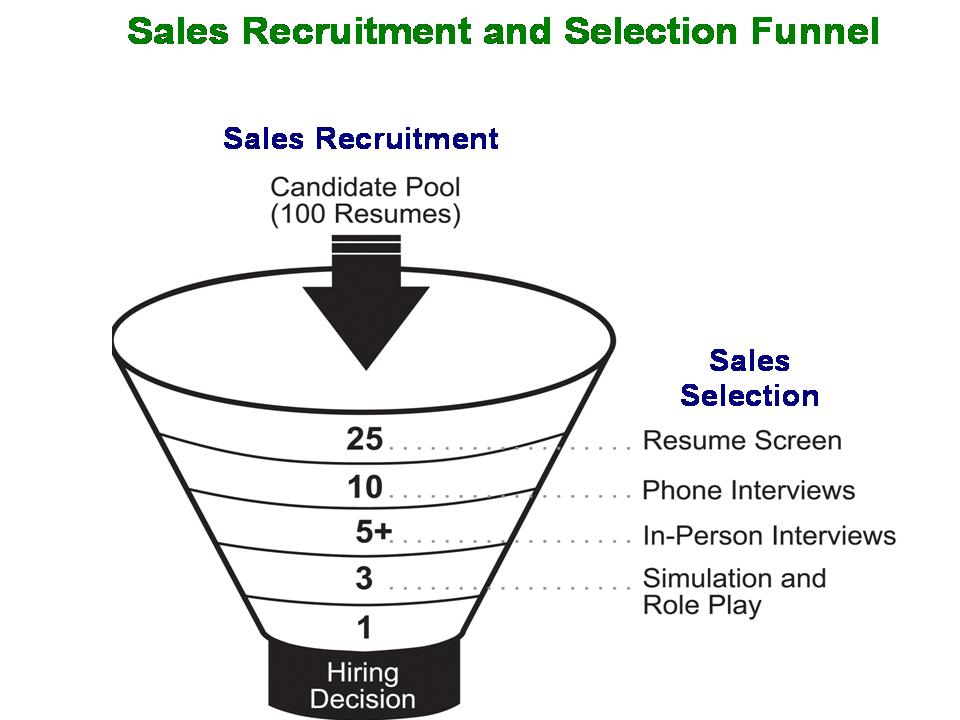
The funnel concept also applies to recruiting and selecting sales candidates for open positions:
  • The more sales talent your company consistently attracts;
  • The bigger the pool of qualified applicants for each open sales position;
  • The more strong candidates make it through the selection process;
  • Yielding a better quality sales hire.


The recruitment and selection funnel works on a “garbage in – garbage out” principle.

If your sales recruitment process (filling the funnel) and your sales selection process (screening and filtering through candidates) aren’t in sync, you’ll be disappointed when it comes time to make the hiring decision. You may be stuck with no good options and have to repost the job...or you may hire a "warm body" out of desperation to fill the position.

Check out Issue 6 of our company's e-newsletter, thinktwice™ Today, for tips and advice on keeping your sales selection funnel full of top quality candidates - and ensuring that you're making the best hiring decisions.

©2006 The Loyalty Group. All Rights Reserved. www.TheLoyaltyGroup.com