Showing posts with label Training. Show all posts

Thursday, January 08, 2009

Stupid Sales Blunders

Note to self: Don't do that again.

Falling on your face is a great educator.

In that vein, I'm going to confess two of the most embarrassing things I've said and done in my 20+ year sales career. Funny how they're little things -- that make a big impact.

Want to Chat?
The first year I started my business, I did a lot of "warm calling". I'd research companies I wanted to target, then make the call. I'd get up and start calling at 7 am, hoping to catch decision makers at their desks.

One woman I'd been trying to reach for months was the Director of Training for a major auto dealership on the east coast. One early morning, to my surprise, she answered her own phone. Caught off guard, I introduced myself and said, "I was hoping we could chat about your business and see if there might be a fit with what we offer." Flatly, the woman replied, "I don't have time to chat."

Note to self:
Most of the time, you only get one shot at an opportunity. Don't blow it by winging it. Always be ready and focused, even at 7 am.


Relaying Two Much on Spill Check
You know where this is going, right?
Big proposal. Fortune 100 prospect. Big typo.

Yes, we misspelled the client company's name throughout the proposal.

I don't want to give the company name, but let's say that it includes a word that's commonly misspelled -- like principal and principle. Alas, the client wasn't very forgiving and (surprise!) we didn't get the business.

Note to self:
Details can win or lose business. We put a lot of work into that proposal - and it was good. Don't ever let something like a (big) spelling error kill you.

If you think you've got me beat with a really silly sales blunder, please share!


Copyright 2008. Phyllis Roteman. The Loyalty Group. Sherman Oaks, CA.

Thursday, December 18, 2008

TRUST Me...Not


As soon as someone says "trust me", I don't.


Maybe I'm cynical. But isn't the Bernard Madoff case just one more example of how a "guru" or expert pulls the wool over intelligent, well educated people's eyes with little more than a promise of guaranteed results and entry into an exclusive club of people who "get it"?


Have you, like I, seen this in business? Someone with a thick PowerPoint deck, mounds of data and models that no one understands, complex explanations of simple things or a beefy resume casts a spell on those around him or her. Those who challenge the experts' promises and think they sound fishy are either denied access to the club - or accused of not understanding. I read that some Madoff supporters, when challenged about his too-good-to-be-true returns, said about Madoff, "he's just smarter than you and me" (or something to that effect).


This is a good cautionary reminder to all of us in business - and particularly those who hire experts or buy training solutions. When an "expert" offers you a training program that promises "500% returns", a quick fix to your team's motivational problems, or a performance management software solution that will fix your workforce issues - run away. If it sounds too good to be true, it probably is. Trust but verify...


Anyone willing to admit being swept off of their feet by a guru or expert who promised results, but couldn't deliver? Please share. It's happened to the best of us.
Copyright 2008. Phyllis Roteman. The Loyalty Group. Sherman Oaks, CA.

Tuesday, February 13, 2007

Soft Skills Training in MBA Programs

Yesterday's WSJ Online had an article describing how top tier business schools like Dartmouth and MIT are now focusing on the soft skills of managing, by "...copying and adapting popular corporate techniques such as coaching, personality assessments and peer feedback. The article says the schools are responding to increasing interest from employers who are looking for better inpersonal skills in freshly minted MBAs.

I remember when I was pursuing my Executive MBA at the University of Miami's business school several years ago, I had a few academically-obsessed professors who frequently "poo pooed" the work of consultants. (Overall I HIGHLY recommend UM's Executive MBA program and most of the professors were amazing.) One Leadership professor in particular grudgingly shared some of Ken Blanchard's work, to "just let us know what's out there," because we'd probably be exposed to it when we got into the corporate world. She clung to her heavily-research based theory and leadership models, which in her opinion (and which she was not shy about sharing) was much more ligitimate than the practical but "light" stuff that corporate consultants taught.

It's about time that business schools started recognizing the need for balance between teaching strategy, finance and analysis (the "hard" stuff), and the interpersonal skills and emotional intelligence (the "soft" stuff) required to lead effectively in today's business environment.

What's the implication for business? You can capitalize on this trend by doing the following:

  • When hiring new business school graduates, ask them what they learned about the "interpersonal-side" of managing in their MBA program. The WSJ article says that many programs now require students to take leadership assessments and create development plans for themselves. Find out what insight graduates gleaned from their assessments and development plans, and what actions they have been taking to hone their skills.

  • Don't assume that even with soft-skills built into the curriculum, new MBAs are ready-made for leadership responsibility...particularly the challenge of managing people of diverse backgrounds and styles. Nothing is a substitute for the first-hand experience of leading people in a corporate setting. Give them support, such as mentoring, continuous leadership development training and coaching, to help them deal with the day-to-day challenges of applying soft-skills theory to the real world.

  • Talk to your local college about incorporating practical, soft-skills training into their MBA and undergraduate business programs. By doing this, you're helping to create your own pool of better-prepared, new leaders in your own back yard.

  • Keep your seasoned managers' soft-skills sharp with ongoing development. New business school graduates with stronger interpersonal skills raises the bar on all leaders in the organization. Make sure your vets are getting the same tools and resources your new managers are getting. It's easy to assume that veteran managers have "been there, done that" when it comes to training in topics like Coaching, Performance Management and Giving Feedback. But seasoned vets get sloppy on the soft-skills without continuous development, feedback and refreshers (I include myself in that category...even I can get sloppy and I teach this stuff!).

For more information about succession management and the importance of soft skills for future leaders, see the following link to our e-newsletter:

http://www.theloyaltygroup.com/tt.Vol1.issue7.pdf


Tuesday, February 06, 2007

Don't be Sorry. Be Accountable Before You Act.

Accountability is a hot topic today. When we deliver performance management and coaching workshops, the discussion always gravitates to the topic of accountability. In an era of Enron, Anderson and Sarbane-Oxley, clients are looking for ways to make people more accountable for their words and actions.

We often think that accountability means "owning up to your mistakes" and saying you're sorry. But that definition is back-ended. It implies that you've done something wrong and that, on the back end, you make amends.

Think Gavin Newsom (San Fran Mayor).
Think Mel Gibson and Michael Richards.
Think Mark Foley.
Think Patrick Kennedy.
I could go on.

All messed up, then apologized and entered rehab or therapy. I know it takes courage to apologize and admit mistakes. And it truly takes courage to seek help for a real problem. This is an important part of accountability.

The most important part of accountability, however, is the front-end. What about being accountable before the fact? How about thinking about consequences before acting? I'm afraid that part of the accountability message is being lost.

What does this have to do with corporate learning or training? Think about how difficult it is to get people in organizations to be accountable. And when we do talk about being accountable, we tend to talk about the back-end, taking responsiblity for outcomes and admitting mistakes. That's important. But let's not forget to make the front-end just as important. Be accountable for your actions before committing them. Think a little before doing.

As leaders and facilitators, we should broaden the discussion of accountablity and remember than an apology on the back end doesn't always erase past behaviors.

Monday, January 22, 2007

Managers as "Coaches and Conductors"

Today's Wall Street Journal Boss Talk article interviews Ken Favaro, co-chairman of Marakon Associates. He discusses the challenge, or "tension", leaders face in balancing conflicting business goals. One set of conflicting goals is the need to build individual business unit autonomy versus the need to strengthen the company as a whole. Too much focus on individual autonomy, Favaro says, creates silos. Too much centralization can inhibit innovation and specialization.

To achive the right balance, Favaro says that CEOs must be both "coaches and conductors." Good coaches know the strengths and development needs of individuals, and capitalize on them. Good conductors know how to bring a team together, to work as a whole. In other words, strong leaders must be able to focus on the big picture (the entire business enterprise) as well as tap into individual needs.

I agree with Favaro and even go a step further. I believe that in today's flat, technology-driven organizations, managers at all levels (not just the C-level), must be coaches and conductors. Imagine an operations manager who can only focus as a coach, at the individual level. She may get the best out of her own team, but she's unlikely to build strong cross-functional partnerships. She may make decisions that help her team, but conflict with the greater organizational goals.

On the flip side, think of a sales manager who is a strong conductor, but is weak as a coach. He may be good at influencing up and make strategic decisions that are in the company's long-term interest. Yet he may be out of touch with the individuals on his team and their needs. He may avoid performance problems and stay in the office attending meetings, rather than be in the field with his reps.

Being a manager at any level is always a balancing act. The right amount of coaching and conducting helps ensure that individuals feel empowered and automous - while the good of the whole is being served.

Friday, January 19, 2007

Majority of Employees Don't Seek Boss' Advice. Why Worry?

A recent article in Chief Learning Officer's online magazine has the headline, "Majority of Employees Don't Seek Advice from Boss." Is this news?

The article cites research from CO2 Partners, whose President, Gary Cohen, states that “someone’s immediate report would be the logical starting place for advice..."

Really? I'm not at all surprised that only about 10% of survey respondents ask their supervisors for advice on workplace issues. Even when employee-manager relationships are at their best, it is still a direct-reporting relationship. There are some issues that are best discussed with a peer or mentor, particularly if the issue is one involving the supervisor. Peer-coaching makes an organization strong and encourages networking. It discourages employees from becoming too dependent on their supervisors for advice and answers.

Employees seeking advice from others (rather than their supervisors) only becomes a problem when issues are being side-stepped and conversations with the boss are being avoided. Asking peers or mentors for advice should never replace candid, regular performance discussions with supervisors.

What do you think?

Thursday, December 28, 2006

How to Survive Long Sales Cycles (The Four "Ps")

Like investing, selling is not a profession for the faint of heart. Both professions require a strong stomach and the ability to endure the ups and downs of long business cycles.

If you're an organization that deals with long selling cycles (typically selling big-ticket items or working with “major accounts”), you need a plan to thrive in both good times and bad.

I tell clients that there are four “Ps” for surviving long sales cycles and business fluctuations. They are: Planning, Pacing and Patience and Protection.

Planning
Many sales managers and sales people think short term. “What is coming in this week?” “What can I do to close this deal now?” However, the sales cycle for a large-ticket sale or corporate account can take months. In fact, I’ve worked on prospects that have taken years to develop. (I recall that it took me three years to get in the door of a major cruise line. They later turned out to be our biggest client.) To deal with a long sales or prospecting cycle, salespeople must take a longer-term view and anticipate the steps required to close a big sale. Ask customers planning questions directly, such as “Tell me about your decision-making process.” “What steps are involved in this decision?” “How urgent is this?” and “What are your timeframes?” Customers appreciate your asking (they don’t want you hounding them every other day if their sales cycle is long), and it helps you plan and schedule your follow-up.

Pacing
Working a long-term sale is like dancing with a partner. You and your partner (customer) must be in step at all times. It can be really tempting, when a salesperson has a number to achieve or when a sales division isn't making budget, to move faster than your customer. Out of desperation, you push your customer faster than they’re ready to move. The result is that you look desperate and pushy – and you likely lose the sale. I suggest living by your Outlook calendar. I schedule every customer contact during a sales process, months in advance. If a prospective customer says, “We’ll be ready to talk on August 15th” and it’s only March, I’ll put a reminder on my calendar for August 15th. On that day, I call back the prospect and remind them that they asked me to call that day…and even recap our previous call. I’ve found that customers are very impressed – they feel confident that if they give you their business, you’ll be diligent in your follow-up and deliver as promised. (You’d be surprised how many salespeople don’t follow-up during a long sales cycle. If you’re the person who doesn’t give up and is reliable, you’ll stand out.)

Patience
This goes hand-in-hand with Pacing. I’ve found that the best salespeople have immense patience. This is a personal trait that really can’t be taught. If you’re an impatient person, you shouldn’t be selling to customers with long sales cycles. You’re probably better suited for quick, short-term sales (such as selling stereo systems to consumers or selling office supplies) which give you immediate gratification.

Protection
Salespeople by nature are optimists. They don’t like to think about the possibility that a sale won’t close right away. So often they put all of their eggs into one basket – that “big sale” that’s going to make the year a success. This “waiting game” can wreak havoc on a salesperson's paycheck. And if enough salespeople are overly optimistic in their projections, the entire sales organization's budget projections are thrown off.

Often, salespeople are derailed when sales don't close as quickly as anticipated. In our consulting business, we call this the “hurry up and wait” syndrome. Customers initially want your proposal “yesterday” – they can’t wait to get started on a project. The need is “urgent.” Yet once the proposal is submitted to the customer, it loses priority or gets stuck in their internal decision-making process. The “urgent” need suddenly loses urgency. If you’re a salesperson and were banking on getting those dollars in the next month or two, you’d better be prepared. As a salesperson, always ask yourself, “What if this sale doesn’t close in the expected time frames?” “What if this big sale falls apart?” Make sure that you always have other sales activity happening as you’re following up on the big potential sale. This is your insurance policy for your business. If the long-term sale doesn’t pan out, or takes longer than expected, will you be able to survive?

©2006 The Loyalty Group. All Rights Reserved. www.TheLoyaltyGroup.com

Thursday, October 26, 2006

Find the Fear (If You Want to Sell Your Idea or Gain Support)

I thought of this Blog topic after reading an article in last Wednesday's Wall Street Journal (Why Your Lizard Brain Makes You a Bad Investor - and How to Battle Back), in which writer Jonathan Clements discusses the psychology of financial investing. His article makes the point that humans instinctively (dating back to caveman days) have a strong aversion to loss. And this fear of loss tends to be much more powerful than the desire to gain.

He quotes economics Professor Robert Frank of Cornell University, who notes that "animals will fight viciously to protect territory that they hold, but they won't fight nearly as hard to extend their territory." Most humans have this same protective instinct, which is why we tend to be more motivated by fear than desire.

Why should business people care? Think about those times you tried to sell an idea, make a proposal or get someone's help and you got a "no." Chances are there is some fear behind the response. Think about the following examples:

- Your boss dumped a bucket of cold water on your last budget request. (He was worried that if his boss called him on the expenditure, he wouldn't be able to defend it, making him look bad.)

- Your process improvement idea was rejected by other departments, despite the fact that it would save the company thousands of dollars. (They like their current processes, they created them, and only they understand them. Now you want to take that all away.)

- You hit a brick wall when you asked someone from your IT Department to show you how to fix your own computer problem. (They felt threatened. If they show you how to fix your own problems, you won't need them.)

Granted, not every decision is fear-based. But you can have greater influence over others if you tune into their worries and fears.

Below are some pointers for getting more "yes" responses to your ideas and proposals by finding people's hidden fears - and alleviating them...

Before presenting your idea or proposal:

  • Stay objective - No matter how good your idea is or how much time and money it will save, don't assume that just because you're excited about your idea, others will be.

  • Play devil's advocate with yourself and someone else - Before presenting your idea, test it. List all of the possible arguments against it...and go beyond the obvious. For example, if you're asking for a raise, think beyond the actual dollars. Even if there is budget for your salary increase, your boss may be afraid that if he gives you the raise and word gets out, others will ask for more money as well. Check yourself by asking an objective third party - preferably someone who knows the person to whom you're presenting the idea - to play devil's advocate with you. That person will likely think of arguments against your idea that you've missed.

  • Figure out how to "Tip the Value Scale" - Imagine that inside everyone's head is a little scale - the "Value Scale." Humans use this value scale to make decisions. The scale helps the brain weigh the benefits (gains) they'll receive from saying "yes" to a decision, versus the losses (fears) they'll face if they say "yes". Since the loss/fear side of the Value Scale can be a more powerful motivator than the benefit/gain side, your job as the proposal-presenter is to get inside the other person's head and tip that scale, so that the gain outweighs the fear. You've got to figure out, "What is it going to take to alleviate that person's fear of my proposal?" and "How do I tip the 'value scale', so that in the other person's head, the gains from my proposal outweigh the fears about it?"

  • Think about other influencers or decision-makers - A note of caution. Make sure that you're presenting your proposal or idea to the right person. Ask yourself, "Is this person truly the decision maker, or will he/she have to check with others for approval?" If others are likely to influence or be involved with the decision, you must assess each person individually. Everyone has different concerns and fears. Make sure that you've thought through each person's value scale and prepare to address potential fears. For example, when you're asking the person in your IT Department to help you, think about who else might be impacted if he says "yes". Not only may the IT person be threatened by your desire to learn how to fix your own computer problem - but he may also need to ask his manager for an extension on a project deadline because he'll be spending more time with you (it would be quicker for him if he just fixed your problem and went back to his project). In other words, his manager's fear may be that the project work won't get done because the IT person is wasting time teaching you how to fix a problem. To get the IT person to help you, you may need to help him think about how to ask his boss for the project deadline extension.

When presenting your idea or proposal:

  • Ask first - Don't start the conversation by launching into an explanation of your idea, or trying to sell the benefits. It's important to get the individual talking, so you can confirm whether your assessment of the person's fears and desires was accurate. For example, if you've anticipated that the IT person may resist your request to teach your team how to do basic troubleshooting, you might ask questions such as: "How much time have you spent fixing this problem over and over again for our department?" "What other projects are you working on, when you're not trouble-shooting for us?" "If you didn't have to fix these recurring problems, what could you be doing with your time?" "If our team were willing to invest the time on our end...how would you feel about teaching us some of the trouble-shooting basics - so you could focus on the more complex, business-critical work?" What's good about these questions is that they're addressing the person's potential underlying worry, that he won't be valued, in a non-threatening way. You're helping him see that by teaching your team some basic trouble-shooting, he'll actually increase his value to the organization by focusing on more complex, business-critical work.

  • Don't be cagey - Most people can smell a manipulation job a mile away. It's ok to acknowledge the fact that you have an idea or proposal right up front. You might say, "I've been toying with an idea, but first I'd like to ask you a few questions to see if it's even viable." Then start asking your questions. If the person says, "Can't you just tell me your idea and I'll tell you if I like it or not?" it's all right to say, "I could, but I don't want to waste your time trying to sell you on an idea that won't work. If you give me a minute to ask a few questions, I can probably save both of us some time." Very few people will resist that approach, because most people fear having their time wasted, or having a bad idea pushed on them. In most people (because we're such a busy society), these fears will outweigh their desire to hear your idea quickly or skip the questions.

  • Acknowledge and encourage challenges - No matter how much analysis you did in advance, you'll occasionally be caught off guard by a challenge you weren't prepared for as you present your idea. Welcome these challenges! In fact, thank the person for bringing up these issues. Once their concerns are on the table, you have the chance to address them. As long as concerns are unspoken, you'll be in the dark about why your ideas are being rejected.

  • Tell a story with your proposal - One of the biggest mistakes people make when presenting ideas or proposals is forgetting to put them in context. In other words, forgetting to tell the story of why your idea's benefit (value) outweighs the cost (fear). If you've done your work in advance by assessing the other person's fears and desires, and asked questions to get the person talking about costs and benefits, you have what you need to tell a strong story. A story sounds something like this, when presenting your idea:
    • "Here's the idea..."
    • "Here's how it's going to address your needs and here's the assessment I've done."
    • "I recognize that there are some issues, such as X and Y. Here's how we can address those issues."
    • "What additional questions do you have - or what other information do you need?"
If there are no other questions, just ask for the approval to proceed. For example, ask
    • "How should we move forward on this?" or just recommend a next step.

Keep in mind, it's not about using fear to manipulate others. Rather, it's about working to understand what people worry about (what keeps them up at night)...and figuring out ways to alleviate those worries with your ideas. In other words, you get what you want when you're a problem-solver (aka: fear-remover). The best part is, you're giving the other person what they want - making the problem/fear go away.

Are you a salesperson who wants to learn how to be a problem-solver by uncovering customers' concerns and needs? Click here for more information on TLG's Sales in Action programs.

©2006 The Loyalty Group. All Rights Reserved. www.TheLoyaltyGroup.com


Wednesday, October 04, 2006

Cost of a Bad Sales Hire in Your Organization

What’s the impact of making a hasty hiring decision? Think about the cost of a bad sales hire in your organization by completing the table below. You will need to calculate costs using your best estimate. Consult with others in your organization for help as needed. For example, human resources may have numbers on costs for recruiting, hiring and training a new salesperson.

Assume that the ineffective salesperson remains in the territory for three months.

While the poor sales performer is in the job for three months:


1. Lost sales revenue in territory (Calculate what the territory should be producing versus what a poor performer actually produces.)

$

2. Value of manager time, dealing with poor performer’s issues.

$

3. Cost of recruiting and hiring the poor performer.

$

4. Cost of training and coaching the poor salesperson.

$

5. Cost of low morale on team, caused by poor hire (think about burnout, turnover, and negative attitudes).

$

6. Value of human resource’s time facilitating the termination.

$

7. Other

$


When the poor performer leaves the organization:


8. Revenue drops in other territories while salespeople are covering the open territory.

$

9. Time and dollars spent repairing damaged customer relationships or making good on promises made by the poor salesperson.

$

10. Dissatisfied customers who left for a competitor (lost accounts).

$

11. Other

$


Total estimated cost of a bad sales hire:
©2006 The Loyalty Group. All Rights Reserved. www.TheLoyaltyGroup.com

$

Friday, September 29, 2006

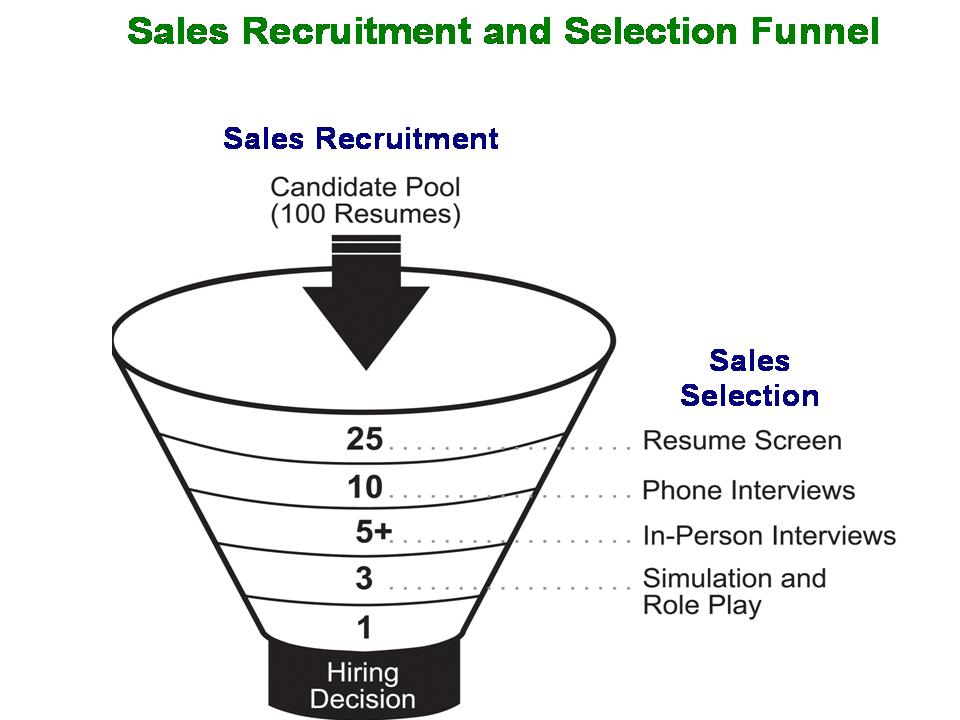
Fill Your Funnel with Stronger Sales Candidates

Sales managers often ask salespeople what they have in the “sales prospecting funnel”. The funnel is a prospecting tool used to predict how much new business a salesperson will bring in over the next few months. The idea is that salespeople who “fill their funnels” with a high volume of quality sales leads typically end up with a high volume of viable prospects…which if pursued, turn into a high volume of new business.

The funnel concept also applies to recruiting and selecting sales candidates for open positions:
  • The more sales talent your company consistently attracts;
  • The bigger the pool of qualified applicants for each open sales position;
  • The more strong candidates make it through the selection process;
  • Yielding a better quality sales hire.


The recruitment and selection funnel works on a “garbage in – garbage out” principle.

If your sales recruitment process (filling the funnel) and your sales selection process (screening and filtering through candidates) aren’t in sync, you’ll be disappointed when it comes time to make the hiring decision. You may be stuck with no good options and have to repost the job...or you may hire a "warm body" out of desperation to fill the position.

Check out Issue 6 of our company's e-newsletter, thinktwice™ Today, for tips and advice on keeping your sales selection funnel full of top quality candidates - and ensuring that you're making the best hiring decisions.

©2006 The Loyalty Group. All Rights Reserved. www.TheLoyaltyGroup.com

Wednesday, August 30, 2006

Marketing to Your Internal Customers

Marketing to Your Internal Customers for Effective Organizational Communication
Each year, companies spend millions of dollars on communicating the benefits of their products to an end user…but what about when they communicate to their internal customers—their employees? It is crucial to communicate effectively internally as well as externally. If you get the message across well to your employees, in turn, it sets the standard of how they communicate with consumers. Here are some tips on how you can use your company’s marketing and branding skills to achieve effective communication within your organization:
  • Use simple messages: “Taste Great, Less Filling”, “We Try Harder.” According to a 2005 survey of the Most Influential Taglines, these are among the top 10. Having a short, succinct message helps employees remember the message. If you are communicating a culture change for example, try coming up with a short title or tagline about it so that it becomes easy to understand. Longer messages tend to get lost in the crowd.
  • Repeat those messages: By repeating the message over and over in different circumstances, you reassure the audience that this is not just a fleeting “Flavor of the Month” change. Talk about the message consistently after the usual Annual Company Town Hall Meeting to help your employees live the message on a daily basis.
  • Use consistent language: Give credibility to your message by defining and using consistent vocabulary. Starbucks, for example, uses the term “tall” to mean the smallest serving available—and even though it’s counterintuitive, it’s caught on everywhere because they are persistent about their vocabulary. Using consistent language helps eliminate confusion as more and more people repeat the message throughout the organization.
  • Build champions: Who doesn’t want to “Be Like Mike?” To give credibility to a company-wide change or announcement, find people who are respected and well liked to champion your idea. Even though major communication begins at the top level, it helps to have “local leaders” also pitching the message.
  • Use visuals: Remember that different people communicate differently. Some understand better visually and some need to hear messages. Companies like BMV and Atari talk advantage of this and have created widely recognizable logos to represent their communication. While you don’t have to come up with a logo for every announcement you make, remember that visually showing how everything fits together or depicting a timeline is usually more effective then a wordy description.

If you ask five people on the street about Nike’s latest marketing, most likely you’ll hear “Just Do It” from everyone. What will you hear if you asked five of your employees about your latest organizational message?

©2006 The Loyalty Group. All Rights Reserved. www.TheLoyaltyGroup.com

Wednesday, August 02, 2006

Explaining Competencies in Simple Language

Some people "get" competencies and behaviors right away and love them. If you're charged with implementing competencies in an organization full of these people, lucky you. Your job is easy. In most organizations, however, there's a contingent of people who don't "get" - or don't want to get - the whole idea of using competencies. They may see them as too soft or subjective, they may be too numbers-driven to focus on people, or they may just not be accustomed to thinking about behavior, motivations and feelings.

This blog entry is dedicated to keeping your explanation of competencies and behaviors as simple as possible. It's easy to over-explain, use consultant/HR jargon or just overcomplicate the whole idea of competencies and behaviors. That's when you start to see people checking their watches and cell phones.

I thought it would be helpful to share some of the visuals, analogies and tips we use for explaining the whole concept of competencies and behaviors. We find it helps to start by analyzing your audience - who they are, what they care about and what they relate to. Then put competencies and behaviors into their language, using analogies and examples that they can get their arms around. This makes competencies simpler, more practical and easier for them to implement.

The Competency Yardstick

We use the "yardstick" or "ruler" analogy to show managers and employees that competencies are merely units of measure. A competency profile is a yardstick that sets a standard for what "ideal behavior" looks like. In other words, the competency yardstick shows what the "ideal performer" would look like in terms of how they behave.

It can be used to:

  • Take an individual measurement ("What are my current strengths and development needs?"),
  • Compare different measurements ("How do I stack up against my peers, using the competency profile as a guide?"),
  • Measure growth ("How do I compare to my past measurements? Where have I grown?")

No one is expected to be perfect. The competency yardstick is a model, against which people can assess themselves and others...the goal being to get as close to perfect as possible, and keep getting better over time.

The slide below shows how the competency yardstick can be used in a number of business applications, such as selecting the right people, career planning and development, and managing performance. It's a good discussion starter. I use this slide in all types of meetings and trainings, to reinforce the importance of competencies.


What are Competencies?

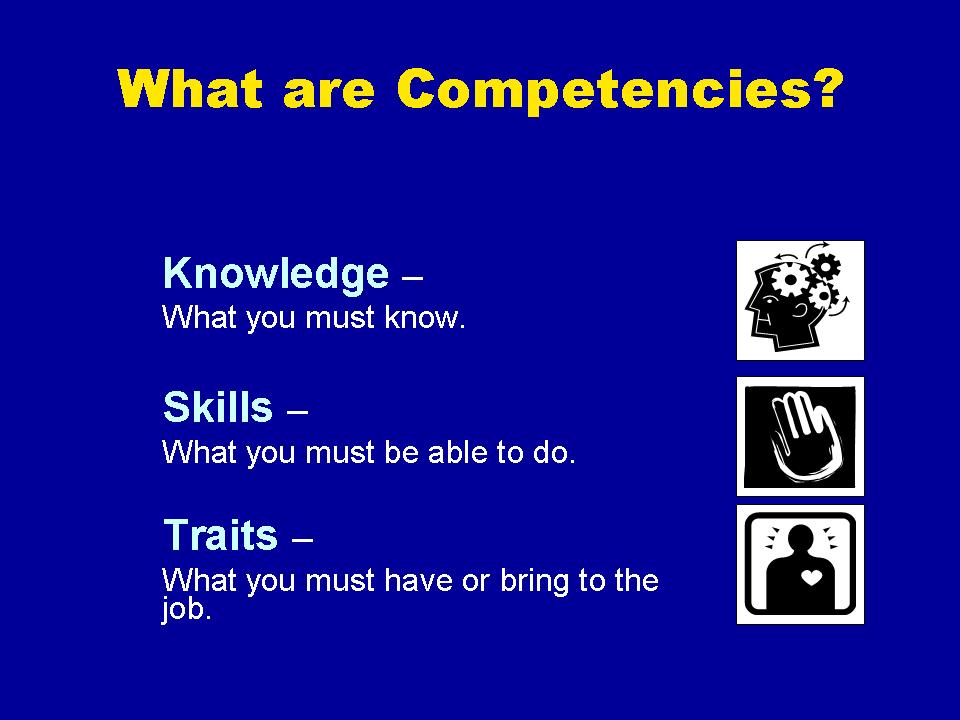
"Competency" is a tough word to define, particularly because experts and academics disagree on definitions. Ask 100 consultants what competencies are, and you'll likely get 100 different definitions. Ours is below. We like it because it's simple and most people can relate to it.

Competencies are the things people need to know (knowledge), to do (skills) and have (traits), to be successful in a role. They are defined by behaviors that describe what that competency would look like if someone were using it effectively.

Here's a frequently asked question. "Why do we have to be so specific about putting behaviors and actions into the right competency category, and why be so specific in defining behaviors? Aren't we splitting hairs?" Valid question. It may seem like wordsmithing and being nit-picky. Here's the explanation I give. Labeling the "soft stuff" - behaviors that we observe - and defining them clearly allows us to talk about them. It gives us a common language, so that when we say that we want to improve our Coaching skill (for example)...we all know that we're talking about the same thing. If our competencies, definitions and behaviors are fuzzy or open to interpretation, we'll have misunderstandings and disagreements down the road when we talk about strengths, development needs, performance reviews and who we should hire.

Another frequently asked question:
"Why group competencies into knowledge, skills and traits/motivations?"

We break them down into knowledge, skills and traits/motivations because the first two - knowledge and skills - are trainable. Personal traits and motivations are deeply engrained in people. In business, sending people to a training class to improve their personality rarely works. Grouping competencies helps us, as managers, understand what's within our control to change and what isn't.


How Companies Use Competencies

We use this visual with all audiences. It's helpful to show over and over again in meetings and training, to remind people of how all "people-systems" are linked in best-practice companies. It can be used as a very simple diagnostic tool, by asking the group: "Where are our systems aligned and where are there gaps?" Or, "Do we hire for the right competencies, then train people to those competencies?" This is also a good visual to use when making the business case to senior leadership for integrated "people-systems". When all of these systems are aligned, and based on competencies that are critical to future business success, the company works efficiently. There is less wasted effort, hiring is more on-target and everyone is working toward common goals.
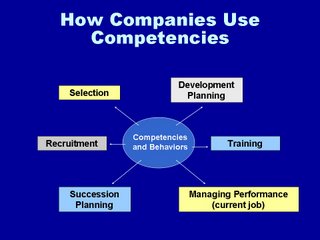


Analogies
For some people, often those who are numbers or technically oriented, competencies and behaviors are too "squishy". They may have trouble relating to them, or see more value in focusing on numbers and hard data (more tangible ideas). That's where analogies help. Below are some analogies I've used with different audiences to help them understand how to use competencies and behaviors - and see their value.

Just a note...my intent here isn't to stereotype anyone. I acknowledge that every individual is different and unique.

Taking with Engineers or Scientists

Engineers and scientists are trained to look for precise measurements. They like to analyze. Scientists and engineers learn by observing patterns and trends. So they should enjoy working with competencies and behaviors when presented this way. Competencies and behaviors are units of measure that help us take something very intangible - how people behave - and make it more tangible and measurable.

Talking with IT/Systems Groups

A key function of IT or Systems staff is to problem solve and diagnose. They're driven to figure out what's going on and make systems run better.

That's why competencies and behaviors should appeal to IT-types. People are like systems...we're all programmed differently. Competencies and behaviors give us a common language and "platform" from which to assess our behavior, just like programmers, IT analysts, and others need a common language and tools to assess why information systems work and why they don't work.

Talking with Sales Groups

Numbers rule in sales. Salespeople make their money, get recognition and are judged by the numbers they produce. Why care about competencies and behaviors? We like to give examples to show why competencies and behaviors very directly impact sales numbers. "What if you're not making your numbers?" Typical sales manager will say "go sell more" or "make more calls" or "be more aggressive". But how? What does that mean? It's not actionable...doesn't tell the salesperson what they should be doing differently tomorrow when they get in their car. And it doesn't really diagnose what the root problem is. What if the salesperson isn't asking enough questions? What if the salesperson isn't listening to customers? "Go sell more" or "make more calls" won't help. Competencies and behaviors give sales managers and reps tools to diagnose what is working...and what isn't. They help improve the numbers.

Tell me your tips for simplifying competencies and behaviors for people in your organization!

©2006 The Loyalty Group. All Rights Reserved. www.TheLoyaltyGroup.com

Saturday, July 15, 2006

Bosses From Hell: What's Trainable and What's Not

Maybe you've worked for this boss. Maybe you are this boss (and don't realize it). Or maybe you've quietly simmered as you've watched this boss get promoted, rewarded or just forgiven for his or her steamroller management approach or piercing comments to subordinates.

If you're in the training or HR profession, you've probably been asked at some point to rehabilitate this manager by sending him or her to a magical training session (aka: charm school for interpersonally-challenged leaders) that will teach them how to play nicely with others. This is usually a reaction to employee complaints, a negative 360 feedback survey, or extremely high turnover in the department or division.

My point is that we've all seen managers from hell...the "Teflon leaders" who, despite their lack of interpersonal skills or empathy for others, still seem to climb the corporate ladder and receive positive recognition.

In severe cases, managers like these need years of therapy, not a training session or executive coach. Training or coaching only helps when the leader:

- Has the ability (Emotional Intelligence) to change and empathize with others.
- Wants to change and sees a painful consequence for not changing.

When these two conditions don't exist, no amount of training, coaching or executive development will help. Therapy probably won't help either, but it's a start.

For fun, below are a few links to movies about bosses from hell. They're extreme, but really illustrate in a funny, dark way how abusive leaders can rise to the top - and make life painful for the people who report to them. They also show how these leaders' dysfunctional styles have domino effects through their organizations...creating extremely dysfunctional behavior among their staffs who desperately try to survive and guess their bosses' next moves.

Devil Wears Prada

Swimming with Sharks

Glenngarry Glen Ross

©2006 The Loyalty Group. All Rights Reserved. www.TheLoyaltyGroup.com

Thursday, June 29, 2006

Seven Tips for Effective Sales Performance Management

In many sales organizations, performance management sounds something like this:

"Are you going to make your number?"
"How many did you sell?"
"You need to get in front of five customers a day."
"You did great this year. That's why I know I can count on you for an additional 10% next year."

By nature sales organizations are revenue and numbers focused. Whether or not these organizations achieve their numbers depends, in large part, on how well they manage and leverage their human capital - their sales people.

Performance management, when designed and executed effectively in sales organizations, boosts sales productivity and helps retain sales talent. Below are seven best practices for implementing performance management in sales organizations. How does your organization stack up?

1. Communicate company and sales organization goals, vertically and horizontally. Does every manager, salesperson and support staff member know the sales organization's strategies and goals - and where their department and individual goals fit? Test this by asking various people in your organization to explain the links to you.

2. Focus on manager behavior first. Define manager competencies by doing a validated job analysis. Make sure the competencies stress performance management behaviors, such as setting clear expectations, observing salespeople in the field, coaching, addressing performance problems and developing talent.

3. Make sure all leaders talk about your culture and vision often. Do leaders just talk about numbers and revenue performance...or do they also talk about how to get those results? From the top down, send the message that your company expects people to get the “right results, the right way.”

4. Define and communicate competencies for salespeople. If you already have sales competencies, review them. Do they read like a generic job description (self-starter, aggressive, closer) or are they specific and unique to selling at your company? Think about what distinguishes your best sales performers, in terms of both results and behaviors. Chances are, in addition to being good closers, they show adaptability, they're open to coaching and feedback, they're constantly learning, and they welcome the opportunity to coach others.

5 . Focus your sales efforts, new products and strategic initiatives. Avoid flavor of the month. When changes do happen, communicate them clearly and have an open dialogue with the sales organization. Not everything is equally important. When you introduce a new initiative or product, ask, "What can we take away or stop doing?" Confused salespeople = confused customers. They don’t know what to sell and can’t keep up with the changes.

6. Link sales training, selection, incentive and performance management systems to your business goals and competencies. A rigorous, competency-based selection process will give you a clear profile of each candidate's strengths and development needs. When you do make your hiring decision, use the selection process data to help you create a development plan for the salesperson, starting him or her off on the right foot. Fold this development plan into the performance management process. Coach the new hire to leverage his or her strengths and develop in other areas.

7. Hold managers accountable for coaching and managing performance effectively. Often managers are accountable on paper, but in practice...managers who make their numbers are "forgiven" for poor interpersonal skills, lack of coaching or "not having time" to work with their reps. Decide if this is acceptable in your organization. If managers get their numbers, does it matter how they treat their salespeople, whether they have high turnover or whether they coach and develop their teams? If it does matter, put some teeth into your systems. Reward and recognize managers who develop salespeople and make their numbers. Assign consequences to managers who ignore or consistently mishandle the people-side of management. And don't forget to look at who you're promoting into management positions. Do salespeople get promoted to management as a reward or entitlement for good sales performance...or do they get promoted because they're motivated to lead others and have the skill and patience to coach?

©2006 The Loyalty Group. All Rights Reserved. www.TheLoyaltyGroup.com

Tuesday, June 20, 2006

What Makes a Successful Project Team?

It seems that these days, everyone's on a project team. There are new product development teams, process mapping teams, customer service teams, sales teams, special project teams, strategic planning teams...teams to discuss teamwork, teams to oversee other teams, etc.

This means lots of time spent in meetings, much of which is spent spinning wheels. During these meetings, people often bring other work, check their Blackberries, or think about what else they could be doing if they weren't in this meeting.

My experience is that most project teams, departmental or cross-functional, aren't very efficient or effective. So what makes a project team successful?

Last week I was at Harvard, delivering a half-day session for the Maynard Institute's Media Academy, a leadership development program for high-potential managers from diverse backgrounds. The group of 20 managers was divided into project teams at the beginning of the week-long program and given a business case study. The week ended with project team presentations, with each team giving their analysis and recommendations. My session was early in the week; the topic was team dynamics and process. The point was to help these project teams recognize what makes teams successful and what derails them, to set them up for success.

Below are some of the key points from the session I delivered.

- Research from Eckes and Associates shows that the root cause of most project team failures is poor team dynamics.

- The Loyalty Group's experience shows that the following are success factors for project teams:
  • Common, clearly-defined goals.
  • Trust and a “safe” environment.
  • Everyone participates.
  • Perceived importance of the project or goals.
  • Team agreements/ground rules.
  • All team roles are fulfilled (diverse styles, approaches, ways of thinking, etc.)
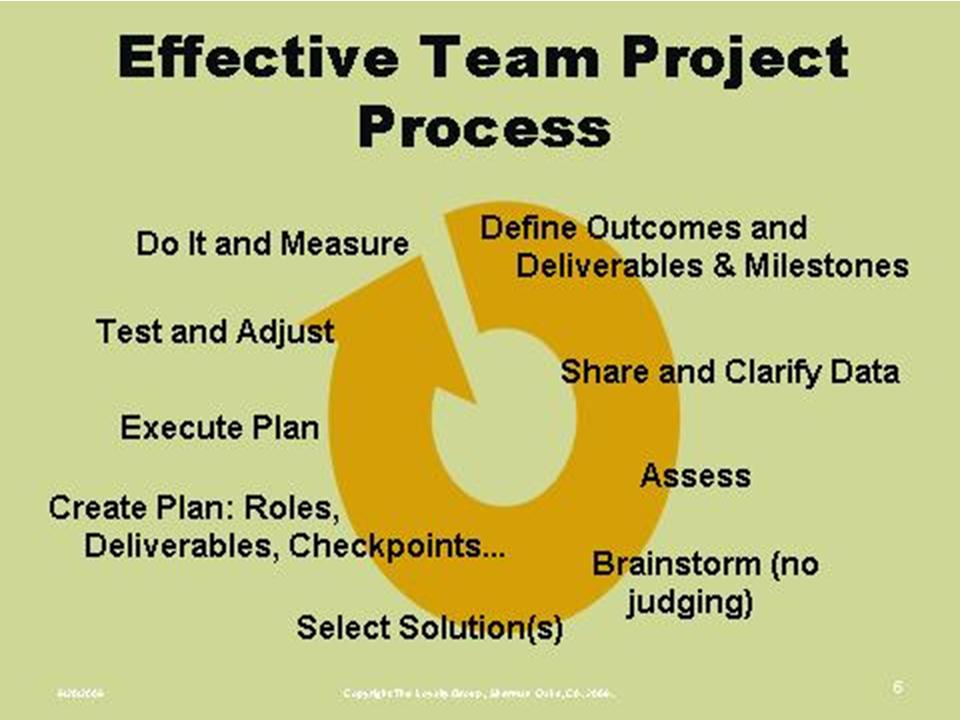
  • An effective Team Process (see graphic below, copyright The Loyalty Group, Inc.).

- Most project teams move too quickly through the first step, defining outcomes, deliverables and milestones. They don't clearly define the end. As I told my Mayard group, one of my mantras is "Start with the End." If you're not clear on where you're going, why, and what success will look like...you're throwing darts at a moving target while blindfolded. It's inefficient and unproductive.

- Depending on the team dynamics and styles of team members, teams may get stuck in the assessment phase (over-analyzing) or jump to selecting solutions too quickly (driving to get the project done).

In our session, we used a Team Dimensions Profile, developed by Inscape Publishing. It worked really well and gave us a framework for talking about people's roles in teams. The Harvard session participants had very rich discussions after seeing their personal profiles and gained insights into why their project teams were working or stuck in storming (wheel spinning). My only advice if you're going to use this instrument is that you do it yourself first, then walk your participants through it step by step. The instructions are a bit confusing in the participant assessment booklet.

There is so much more out there on team dynamics and what makes project teams work. It's a very complex topic (read Animal Farm or Lord of the Flies). What can you do? The next time you're assigned to a project team, step up by: insisting on a clear process that "starts with the end", defining roles and ensuring diversity on the team, and facilitating healthy discussions about team dynamics along the way. Your time is too valuable to waste.

©2006 The Loyalty Group. All Rights Reserved. www.TheLoyaltyGroup.com

Friday, June 09, 2006

Sales Training Best Practices Research

My PR person, Kimberly Hathaway, found this press release link. It's got some useful best practice research on sales training. I've used this site myself for other (non-sales) best practice business research. I recommend it. You have to register but there is some good stuff on it.


Recent benchmarking research completed by Best Practices Research and Consulting shows that the average sales employee receives 41.5 hours of training a year (based on a cross- industry study.) This research on the Design and Administration of Sales Training Programs (a complimentary study excerpt is available at http://www3.best-in-class.com/de215.htm) identifies how much training the average company provides to its sales associates, as well as the skills trained and the most effective medians for conveying information.

I also recommend trying the Best Practices company site for business best practices research on a variety of topics. You have to register but some of the reports are really interesting...great support for making a business case in an organization.

©2006 The Loyalty Group. All Rights Reserved. www.TheLoyaltyGroup.com

Monday, June 05, 2006

Toughen Up with Hard to Hear Feedback

In The Loyalty Group's June e-newsletter on Coaching, I promised my own personal story about how a coach impacted me. Here goes...

Several years ago my company was at a turning point and I had some tough decisions to make about our direction, and the role I would play as our company's leader. It was the perfect time to work with a coach.

We started with the usual stuff - goal setting, crafting my personal mission, my company's business plan, etc. We reviewed The Loyalty Group's values, which included Integrity. I stressed to my coach that this value was very personal to me - as well as critical to our business philosophy. I talked at length about what integrity looked like, why I valued it - and how I'd always prided myself on it.

In a later meeting, I shared with my coach a problem I was having with a long-term business associate. We were struggling to come to terms on a contract, and I thought that my associate was being petty. I was resentful that he was asking for what I perceived as unfair terms. I was considering pulling out of the relationship all together. I remember telling my coach, "This is causing me more time and stress than it's worth. It's easier to just walk away."

My coach asked if I'd shared my feelings with the associate.

"Not really," I said. "We've had lots of discussions about the business terms, but I haven't actually said how I feel, or that I'm ready to walk away. I don't think it'll do any good."

My coach called me out. He said, "So you don't truly value Integrity?"

I was taken aback. I asked what he meant.

He explained, "You say that you pride yourself on your high Integrity. Yet you're not being honest with your associate. You're stewing, stressing, complaining behind his back, talking to me about the problem, thinking that he's being petty...yet you haven't told him how you feel. Now you're thinking of ending this long-term relationship without giving him the benefit of knowing what's going on. How is that acting with Integrity?"

Now I don't recommend this type of tough-love coaching approach for everyone. My coach knew that, given my strong personality, it was what I needed. And he was right. His words were like icewater being thrown in my face. I had to rethink everything. Was it possible that I saw myself as someone who was candid and possessed high integrity - but was actually something different in practice?

This was an especially appalling thought for me, being a consultant. How many clients and organizations had I coached about "Walking the Talk?" But here I was, being called on the very same issue. I felt like a hypocrite.

Why am I sharing this story? Take what you want from it, but there are a few key lessons I learned:

- Great coaches are like great parents, in that they don't have to be your friends. If you want someone to always make you feel good, support you even when you're wrong and have laughs with...call a friend. If you want to hear the truth and be asked the tough questions that your friends won't ask...go get a good coach.

- When someone gives you feedback that hurts, there's probably some truth to it...even if the words themselves are harsh. My husband is an actor so I read some of the acting trade magazines. The world's most accomplished actors consistently say, "When I read a script and I'm afraid of taking the part, I know I have to do it. If it's going to be a tough role for me, it's probably the right one." Remember, from discomfort comes growth. When you get tough coaching feedback, take a deep breath, count to 10, resist the urge to defend yourself, and ask yourself, "What's behind this feedback?" Assume there is at least some grain of truth to it. Work with your coach to find it and do something about it.

In case you're wondering, I do believe that I've changed from the experience. After this coaching discussion, I had a very direct conversation with my associate. I won't lie. It was painful. But when it was done, we came out the other side in a very good place. We're closer than ever and have a new level of candor in our relationship. I always remember this when I'm confronted with a difficult interpersonal situation and I'm tempted to walk away. Face it. It'll be painful in the short-term, but easier in the long-term.

I'd like to hear your personal story about a tough coaching discussion. What's the most difficult feedback or coaching you've received - and how did it change you for the better?

©2006 The Loyalty Group. All Rights Reserved. www.TheLoyaltyGroup.com

Tuesday, May 30, 2006

Charisma...Are We Influenced?

When I saw that my Monday morning LA Times included a feature article on charisma called The "It" Factor, I braced myself for a fluffy story about skinny Hollywood "it girls" or Brad and Angelina's new baby. Refreshingly, it wasn't. In fact, it was a well-researched, substantial article in the Times Health section that has a lot of relevance to being a manager in the corporate world (or "non-entertainment world" as we call it in Los Angeles).

Not surprisingly, the experts say that charisma is an inherent trait, like creativity. Some of us are born with more of it than others. Yet the article by Janet Cromley also makes the case that people can learn to be more charismatic. Imagine the potential impact on the training profession. Some consulting company is going to make a bundle marketing a training course that teaches managers, salespeople and executives to be more charismatic. "Charisma 101." A kind of charm school for Jack Welch, Arnold Schwarzenegger or Tom Cruise wanna-be's.

I joke, but in fact it makes sense. To some extent, charisma can be taught. Break "charisma" down into its components and what do you see? Good listening. Passion. Eye contact. Enthusiasm. Mirroring the person with whom you're speaking. Confidence. Some of these are behaviors that can be learned with practice (for example, making strong eye contact or modeling confident body language). And a good therapist (or coach) can help improve self-esteem, boost confidence and develop a more positive attitude.

Still, I believe that it's like any other trait. Don't count on any charisma-boot camp working miracles on someone who's lacking impact. If you hire an uptight, type-A manager...all of the training and coaching in the world is unlikely to change her disposition. If you choose to marry a slob hoping to change them into a neatnick, you'll likely end up divorcing a slob someday.

Work your talents. If you've got charisma, go for it and use it for good. If you don't have it, find other ways to compensate. Capitalize on your smarts, your analytical ability, your tell-it-like-it-is communication style or your ablity to nurture and develop talent. And if a good charisma course comes your way, give it a shot. You probably won't emerge a Ronald Reagan or a Martin Luther King, but you can pick up a few tips to improve your impact.

What do you think? Who's the most charismatic person you've ever met...and what made them that way?

©2006 The Loyalty Group. All Rights Reserved. www.TheLoyaltyGroup.com