Showing posts with label Managers. Show all posts

Monday, May 17, 2010

Is Your Strength Also Your Weakness?


Karate masters teach students to use their opponents’ strength against them in combat. They know that often, a strength can also be a weakness.

Think about yourself.


What is your greatest strength? Then consider the following two questions:

How has your strength helped you achieve success?

Examples:

  • Jane Manager climbed the corporate ladder because of her in-depth industry and company knowledge. Over time, she became an irreplacable company resource and to retain her, she was promoted.

  • Ted Manager achieved high levels of success through strong relationship building and interpersonal skills. He's a great listener, networker and question-asker. He also loves helping others and cares about people.

How has your strength hurt you or held you back?

Examples:

  • Jane Manager's strength becomes a problem when she assumes she knows all of the answers and has the best ideas. No one can teach her anything, she thinks (been there, done that). She preaches and gives everyone advice, but rarely asks questions or engages people in dialogue. As a result, people avoid her and only use her knowledge when absolutely necessary. Her employees respect her expertise, but aren't motivated because they're lacking leadership.

  • Ted Manager's strength becomes an obstacle when, because he's so nice and empathetic, he has difficulty having tough conversations with employees. Employees like Ted personally, but they don't respect him as a manager. Bad behavior and mediocre performance goes unchecked in the department. As a result, morale suffers and performance lags.

Today's tip: Be aware of your greatest strength and how it may be holding you back in a current situation. Ease up a bit on using your strength in this situation -- and try using a more productive behavior that you're less comfortable with.

Thursday, September 03, 2009

Managers Must Remember Feelings

"Man bites off fingertip of other man at Healthcare rally!"

"Man slaps stranger's crying toddler in WalMart!"

These are just two of today's news headlines. Is it me, or are there a lot of angry people out there these days? It's not surprising, given the economy, reality TV and lack of trust in corporate America (among other things).

However -- it did make me think that it's a good time to remind anyone who's a manager to remember that people have feelings. Emotions are running high these days. We're all busy, so it's easy to forget to be "nice", say thank you or just sit and listen to employees.

But it's more important than ever to make extra time.

The majority of employees aren't dangerous or violent. What managers should worry about is the impact of angry employees who suffer quietly and unproductively, who badmouth your company or who subtly sabotage your efforts. That's the biggest threat you face when you ignore feelings at work.

Now get out there and be nice. Or else! Grrrr..!

Friday, January 02, 2009

Avoid "Flavor of the Month" Change


  • Do employees sigh and roll their eyes when they hear about a new change happening at your company?

  • Do veterans wait out or resist change because they know it'll fade away - like a hundred other programs they've seen come and go?

  • Are you facing the rollout of a major change, but afraid that it'll be perceived as another "flavor of the month" company initiative?

If your organization has a legacy of shifting from one major change to the next, without much to show for it, expect resistance to anything touted as "new" by senior leadership.

There's a limit to how many times an employee can rally 'round a new initiative, shift gears, serve on change committees, get excited and raise their hopes...only to see the "important initiative" fizzle and disappear without much explanation. After a while, it's understandable why people become cynical.

So what's a leader to do? If you've inherited a "flavor of the month" culture where cynicism for anything new abounds, what do you do? How do you implement change when a large part of your organization is just waiting for it to fail and go away?

While there is no magic formula for implementing change successfully, there are some basics that almost every successful change initiative covers. The challenge is just doing them. I have found that most organizations fail in executing these basics of change management.

Below is a checklist of basic elements that make change stick. It's not comprehensive, so feel free to post your own change tips. If you do these things consistently - before, during and after change - you can earn organizational trust and turn even the most cynical employees into committed supporters of change.

Over-communicate

There's a saying: Tell them what you're going to say. Say it. Then tell them what you just said.

Don't be afraid to over-communicate in times of change. Ask questions, talk, exchange ideas, give updates, share success stories and seek feedback. You may feel like you're repeating yourself, but repetition is how people learn, remember and believe. Think about religious services. People go week after week repeating the same prayers, but they're still comforting. Repetition breeds familiarity and trust. Familiarity and trust is just what most people need to stay focused and motivated during the uncertainty and chaos that accompanies change.

Prepare the "story" and paint the picture

It's human nature to want to feel involved. Employees want to know the big picture - the rationale behind the change, the vision and specifically where they fit in. Ask yourself: Can all leaders in our organization - in a consistent way - tell their employees the "story" behind the change, the rationale, and how they'll be affected? Remember that employees talk. If leaders tell different stories about the change initiative, employees will lose trust - and the rumor mill will take over.

Ask open-ended questions and listen

Most leaders tend to ask closed-ended questions. Closed-ended questions ask people to answer with a yes or no response - or make a choice between options you present. Why? They're easy to ask, quick and safer than asking open-ended questions. (If I ask an open-ended question, what if I hear things I don't want to hear?!!) In a follow-up blog, I'll provide a "cheat sheet" of powerful open-ended questions leaders can ask during times of change.

Set clear expectations
Make sure your "story" includes your best, realistic estimate of how long the change initiative will take (most major change takes years). Obama did a good job of conveying this through his campaign. He tempered his uplifting vision of hope with a dose of realism. It's not going to be easy. It may feel worse before it gets better. We're going to require you to get involved.

Celebrate successes and milestones

This is easy to forget. In the chaos of change, leaders often lose site of the big picture and how far they've come. For morale, it's critical to pause and celebrate even the smallest successes on the way to change. This celebration reminds people that progress is being made. Remember, change happens slowly (three steps forward, two steps back). It's important to celebrate the three forward steps.


Copyright 2008. Phyllis Roteman. The Loyalty Group. Sherman Oaks, CA.

Friday, March 28, 2008

How to Be Recession Resistant: Five Strategies

Earlier I posted on the idea that nothing is "recession proof", as much as popular media and many "experts" want to peddle their recession-proofing wares to us.

Reality check....the best we can do is build up our resistance to recession and the other ups and downs of business. This blog is the first in a series of articles with pointers on how to be recession resistant, as an employee, manager, salesperson or business.

Below are five strategies for surviving during tough times and always landing on your feet. I'll cover each in more detail in follow-up posts.

1. Pull Your Head out of the Sand

Stay alert for predictable surprises. Harvard Professor Max Bazerman says that "Predictable surprises happen when leaders had all the data and insight they needed to recognize the potential, even the inevitability, of major problems, but failed to respond with effective preventative action."

2. Live with Healthy Fear

Paralyzing fear is bad. Fear that propels you to take action is healthy!


3. Don't Assume You're Still Valuable

What made you successful in good times may not be what matters in bad times. Question what is really important to your business and your bosses when recession looms...and find ways to fill that need.

4. Keep Your Pipeline Full

If you only network and ask for referrals when times are bad (and you're looking for opportunities)...it's probably too late.

5. Become Your Own PR Person

Whether you know it or not, we're all in the public relations business. Be your own advocate and build your brand year-round.

Tune in for more postings describing how to execute each of these survival strategies.

Copyright 2008. Phyllis Roteman. The Loyalty Group. Sherman Oaks, CA.

Tuesday, June 12, 2007

Praise to the "Me" Generation


"I can't deny the fact that you like me...you like me!"

These words, delivered with elation by Sally Field when she won a Best Actress Oscar for Places in the Heart, reveal the depth of a performer's need for recognition.

In the work world, it seems we have our own brand of love-starved performers: the "me" generation.

A podcast last week on NPR discussed how the 20-somethings now flooding our workplaces are fueled by constant praise. Experts cited in the story theorize that this trait was instilled by this generation's parents - whose parenting style was more focused on building self-esteem than on objective self-appraisal. Kids that grew up in the late 80s and 90s often played in sports leagues where there were no losers (everyone got trophies), strong discipline was frowned upon, and kids got praise for everything including getting up for school or getting dressed (things they're supposed to do anyway).

We All Like Praise, But How Much?

When these praise-hungry kids grew up and entered the workforce, their expectations of authority figures were high. As a result, managers have had to look for reasons to lavish recognition on younger employees who need regular pats on the back to stay engaged. ("Congrats on meeting that deadline." "Thank you for showing up for work on time." "You're really smart.")

Some may argue that every worker likes positive feedback. True. The questions are: "How much?" "How often?" and "For what?"

Research into "Generation Me" shows that overall, this younger group of workers typically needs more positive stroking, more often, for more types of behaviors to stay motivated.

The Implication for Managers

The impact on managers' jobs can be significant. If you manage people today, you've got to go out of your way to look for positives to praise, even if you're busy or under pressure.

Managers: challenge your own principles. Below are attitudes that won't work anymore for managers who lead younger workers:

  • "I had to work hard without much praise. Younger employees need to suck it up and work hard too, like I did."

  • "I don't have time to babysit and pat people on the back for every little thing they do. I'm too busy for that."
  • "I feel phoney giving out praise for little things. I don't give a lot of thanks, but when I do, I mean it."

  • "They should feel lucky that they have a good job, benefits and decent pay! That should be enough to keep them motivated!"
While there's validity to all of these beliefs, they just may not work today. Managers who cling to these principles may quickly find themselves losing young employees to managers who dole out a daily dose of praise.


© 2007. Phyllis Roteman, The Loyalty Group. All Rights Reserved.

Sunday, May 13, 2007

Toxic People


Have you ever worked with a toxic person?

These are people who spread negativity. And when you let them into your workplace or your life, they are like mold. They're unpleasant, they spread their nastiness everywhere...and they're often hard to get rid of. I have one of these in my life now. Every time I think I've removed this toxic person from my life, she keeps coming back.

There's a great book by Keith Harrell called
"Attitude is Everything", in which he warns about "toxic negativity" and the damage these people cause to the poor souls who encounter them. According to Harrell, these poisonous people fall into different categories:

Judges and Critics: They invest most of their time and effort criticizing and judging others (deflecting attention away from their own short-comings and unhappiness). They can be direct and outright demeaning, or they can be subtle (but no less critical).

"I wouldn't have done it that way."
"Do you really want to wear that?"
"Let me tell you what's wrong with your idea."


Professional Victims: Things always happen to them. Nothing is ever their fault.

"It's not my fault that the customer changed his mind."
"If my manager were better, I could do my job better."
"Nobody told me I was supposed to do that."
"I couldn't make any sales because you gave me bad leads."

Soap Opera Stars: These people are drama kings and queens. They thrive on turmoil, chaos and conflict. When there isn't any drama, they stir the pot to create it.

"Did you hear what Donna said about Albert?"
"I heard a rumor that there are going to be some big changes in the department!"
"I can't believe I was so wronged! How could they do this to me?!"
"I wouldn't take that. You should give her a piece of your mind!"


Bitter to the Core: According to Harrell, these people have a motto: "There's nothing worse than seeing your friends succeed." These are miserable people who are so unhappy with themselves and their lives that they want to spread their misery. They may smile and put up a friendly facade, but they'll stab you in the back and bring you down every chance they get (smiling the whole time).

"I wouldn't get too excited. It probably won't last."
"If it weren't for me, you'd never make it!"
"You got a promotion? Great! I heard you got the job because no one else wanted it."

"You're pregnant? Congratulations. My sister's pregnancy was hell. I hope yours isn't as miserable."

So what do you do when you encounter toxic people? Here are some tips, many of which I've learned the hard way, through experience.
  • Don't let them in. Have you ever seen a vampire movie? If so, you'll know that one of the "rules" of vampires is that they can't enter your house unless you invite them in. (In the movies, the unwitting victims ALWAYS let them in for some reason!) Toxic people are like vampires. They'll suck the life out of you. If you see them, don't even let them in...because once they're in, they'll do damage.

  • Contain them. These people need to be reigned in, or their toxicity will spread rapidly, partciularly if they're on your work team. Let them know the rules early on. When you hear an example of negative talk, criticism or rumor-mongering, address it immediately. Let them know that the behavior is not acceptable. If it's in the workplace, give them examples of how their negative behavior is impacting work performance and the morale of others. If the behavior continues, let them go.

  • Create a "buffer zone". If you're forced to live with a toxic person (for example, your father-in-law) or work with one (for example, your peer in another department), you've got to deal with it. Protect yourself by creating a buffer zone. You can do this by limiting your interaction with this person as much as possible. And when you must interact with them, prepare yourself emotionally in advance. Build up your strength by doing something that makes you feel good first, like going for a long walk. Talk to someone positive beforehand, so you feel upbeat and good about yourself. Mentally prepare by saying to yourself: "I'm happy. I won't let this person get to me."

Positive attitude is a choice you can make. You can either allow yourself to get dragged down by toxic people, or you can leave them to roll around in their own mud. You choose.


© 2007. Phyllis Roteman, The Loyalty Group. All Rights Reserved.

Thursday, May 03, 2007

Beware Workplace Bobble-heads (Part 1)

We've all seen them.

They stare at you in meetings as you discuss ideas. They appear to be listening as you give them feedback. They say little. They nod their heads. (That's why I like to call them "workplace bobble-heads.")

Rarely will they disagree openly or challenge ideas. In fact, to the untrained human eye, they might even seem agreeable and pleasant. But beware. Behind that agreeable facade may lurk a hidden cynic, doubter, nay-sayer, or behind-the-scenes griper who would rather smile and nod than express him or herself to your face. Who are these bobble-heads...and what causes them to nod silently as if in agreement, even when they're not?

Customer Bobble-heads

If you're a salesperson, you've most likely met customer head bobbers. Here's the scenario. The salesperson is making an engaging presentation, with all the bells and whistles, saying all of the "right things"...and there's the customer, not saying a word but nodding (seemingly in agreement). But when the salesperson asks for the order, the customer (to the salesperson's surprise) says something like "I need to think about it" or "Thanks, can you leave me some information?"

What happened? The salesperson, who was falsely encouraged by the customer's quiet head-bobbing, assumed that the customer's silence meant the customer was ready to buy. She wasn't.

Employee Bobble-heads

This can frustrate the heck out of managers. Here's the scenario. A manager and employee are meeting to discuss a new project the employee is going to take on. The manager tells the employee all about the project in great detail (while the employee looks on and - you guessed it - nods his head as if he's listening). The manager then asks something like, "Do you have any questions for me?" And the employee shrugs and says, "I guess not."

Fast forward...it's three weeks later. The manager and employee meet for a project update. To the manager's surprise, the employee is floundering. The manager wonders why the head-bobber didn't speak up and ask questions in their initial meeting.

What happened? The manager assumed that the employee was bought into the assignment and understood it. (Fooled again by the head bob).

Manager Bobble-heads

Imagine a meeting with a group of managers. A senior executive (or someone in power) is talking. She's droning on and on - plugging through endless PowerPoint slides - and no one really knows what she's trying to say. Instead of speaking up to get clarification, the group just sits there and nods, as if in agreement...as if what they're hearing makes perfect sense. The meeting adjourns. In the hallway (after the exec leaves), the managers whisper to each other, "What do you think she meant?" and "I'm more confused than before the meeting!"

What happened? Because of fear of speaking up or looking dumb, the managers just kept their mouths shut and nodded. And no doubt, this body language from the manager group assured the senior exec that she was communicating loudly and clearly. She likely left the meeting thinking it was a success.

In my next blog (Part 2 of Beware Workplace Bobble-heads), I'll provide tips for how to communicate more effectively with head bobbers - and engage them in dialogue.

© 2007. Phyllis Roteman, The Loyalty Group. All Rights Reserved.

Thursday, March 01, 2007

Accountability Run Amuck

Can an organization be too focused on accountability? Too much of a good thing is always bad. Below are some examples of accountability run amuck and its unintended negative consequences. See if your organization suffers any of these symptoms.

The “Ask for Forgiveness Later Syndrome”

Are there people in your organization who seem to think that saying “I’m sorry” or “I’m responsible” on the back end makes everything better?

When talking about accountability in your culture, make it clear that saying “I’m sorry” doesn’t give you carte blanche to behave however you want. Let everyone know that accountability starts on the front end, before you act. Accountability means taking responsibility for your words and actions, not just owning up to them after the fact.

The “I Gotcha” Syndrome

When things go wrong, do people blame and finger-point? Do managers try to catch employees doing things wrong, instead of doing things right?


While it is important for individuals to own their mistakes, too much focus on placing blame can create a “police state”. This is a distrusting, punitive environment in which more time is spent asking “Who did it?” versus actually fixing the problem. Remember, don’t let accountability interfere with getting good work done.

The “Track Everything” Syndrome

Has your organization gone “metrics happy”? Do people spend so much time tracking and measuring that they can’t get their work done?

These organizations are so concerned with being accountable and measuring everything that they lose focus. People in the organization forget to ask “Why are we tracking this?” As a result, everything gets tracked, even things that just aren’t that important.

Figure out what is most important to track and measure, and focus on those. Eliminate reports, tracking systems and accountabilities that aren’t critical to business success, like Home Depot's new CEO, Frank Blake, is trying to do. Who knows…when your employees start spending less time tracking and more time thinking, you might discover a whole new level of innovation in your business!

© 2006 The Loyalty Group. All Rights Reserved.

Monday, January 22, 2007

Managers as "Coaches and Conductors"

Today's Wall Street Journal Boss Talk article interviews Ken Favaro, co-chairman of Marakon Associates. He discusses the challenge, or "tension", leaders face in balancing conflicting business goals. One set of conflicting goals is the need to build individual business unit autonomy versus the need to strengthen the company as a whole. Too much focus on individual autonomy, Favaro says, creates silos. Too much centralization can inhibit innovation and specialization.

To achive the right balance, Favaro says that CEOs must be both "coaches and conductors." Good coaches know the strengths and development needs of individuals, and capitalize on them. Good conductors know how to bring a team together, to work as a whole. In other words, strong leaders must be able to focus on the big picture (the entire business enterprise) as well as tap into individual needs.

I agree with Favaro and even go a step further. I believe that in today's flat, technology-driven organizations, managers at all levels (not just the C-level), must be coaches and conductors. Imagine an operations manager who can only focus as a coach, at the individual level. She may get the best out of her own team, but she's unlikely to build strong cross-functional partnerships. She may make decisions that help her team, but conflict with the greater organizational goals.

On the flip side, think of a sales manager who is a strong conductor, but is weak as a coach. He may be good at influencing up and make strategic decisions that are in the company's long-term interest. Yet he may be out of touch with the individuals on his team and their needs. He may avoid performance problems and stay in the office attending meetings, rather than be in the field with his reps.

Being a manager at any level is always a balancing act. The right amount of coaching and conducting helps ensure that individuals feel empowered and automous - while the good of the whole is being served.

Tuesday, June 20, 2006

What Makes a Successful Project Team?

It seems that these days, everyone's on a project team. There are new product development teams, process mapping teams, customer service teams, sales teams, special project teams, strategic planning teams...teams to discuss teamwork, teams to oversee other teams, etc.

This means lots of time spent in meetings, much of which is spent spinning wheels. During these meetings, people often bring other work, check their Blackberries, or think about what else they could be doing if they weren't in this meeting.

My experience is that most project teams, departmental or cross-functional, aren't very efficient or effective. So what makes a project team successful?

Last week I was at Harvard, delivering a half-day session for the Maynard Institute's Media Academy, a leadership development program for high-potential managers from diverse backgrounds. The group of 20 managers was divided into project teams at the beginning of the week-long program and given a business case study. The week ended with project team presentations, with each team giving their analysis and recommendations. My session was early in the week; the topic was team dynamics and process. The point was to help these project teams recognize what makes teams successful and what derails them, to set them up for success.

Below are some of the key points from the session I delivered.

- Research from Eckes and Associates shows that the root cause of most project team failures is poor team dynamics.

- The Loyalty Group's experience shows that the following are success factors for project teams:
  • Common, clearly-defined goals.
  • Trust and a “safe” environment.
  • Everyone participates.
  • Perceived importance of the project or goals.
  • Team agreements/ground rules.
  • All team roles are fulfilled (diverse styles, approaches, ways of thinking, etc.)
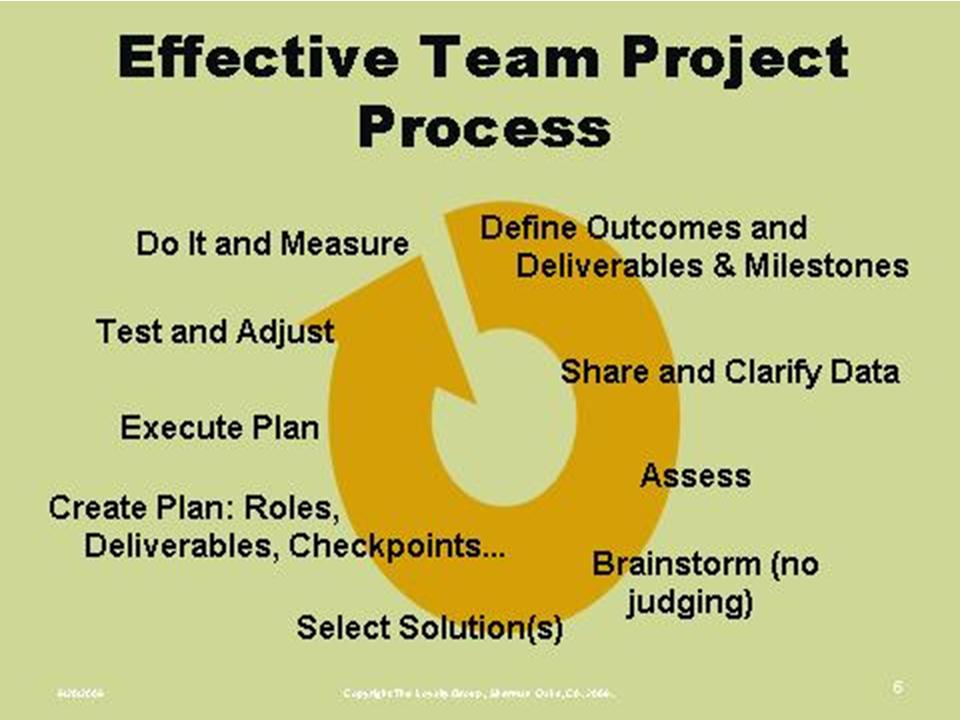
  • An effective Team Process (see graphic below, copyright The Loyalty Group, Inc.).

- Most project teams move too quickly through the first step, defining outcomes, deliverables and milestones. They don't clearly define the end. As I told my Mayard group, one of my mantras is "Start with the End." If you're not clear on where you're going, why, and what success will look like...you're throwing darts at a moving target while blindfolded. It's inefficient and unproductive.

- Depending on the team dynamics and styles of team members, teams may get stuck in the assessment phase (over-analyzing) or jump to selecting solutions too quickly (driving to get the project done).

In our session, we used a Team Dimensions Profile, developed by Inscape Publishing. It worked really well and gave us a framework for talking about people's roles in teams. The Harvard session participants had very rich discussions after seeing their personal profiles and gained insights into why their project teams were working or stuck in storming (wheel spinning). My only advice if you're going to use this instrument is that you do it yourself first, then walk your participants through it step by step. The instructions are a bit confusing in the participant assessment booklet.

There is so much more out there on team dynamics and what makes project teams work. It's a very complex topic (read Animal Farm or Lord of the Flies). What can you do? The next time you're assigned to a project team, step up by: insisting on a clear process that "starts with the end", defining roles and ensuring diversity on the team, and facilitating healthy discussions about team dynamics along the way. Your time is too valuable to waste.

©2006 The Loyalty Group. All Rights Reserved. www.TheLoyaltyGroup.com